AI Agents for Healthcare Operations: 7 Workflows You Can Automate

Summary:
Healthcare organizations are increasingly using AI agents to automate administrative workflows that slow down operations and increase staff workload. From appointment scheduling and insurance verification to claims processing, patient communication, and care coordination, AI agents help streamline healthcare operations, improve efficiency, reduce costs, and support better patient experiences. This guide explores seven key workflows healthcare providers can automate, along with ROI considerations and implementation best practices.

Healthcare organizations are dealing with more operational pressure than ever before. Administrative workloads keep growing. Staffing shortages remain a challenge. Patients expect faster service, better communication, and seamless care experiences.
Behind every patient interaction is a long list of operational tasks. Scheduling appointments, verifying insurance, processing claims, coordinating care, and managing follow-ups all require time and resources.
Many healthcare providers have already adopted automation tools, but traditional systems often struggle with complex workflows that require decision-making and adaptability.
This is where AI agents are making a difference. Unlike basic automation, AI agents can understand requests, manage workflows, communicate with patients and staff, and take action across multiple systems. They help healthcare organizations reduce repetitive work while improving efficiency and patient satisfaction.


What Are AI Agents in Healthcare Operations?

AI agents are intelligent software systems designed to complete tasks, make workflow decisions, and coordinate actions with minimal human involvement. AI in healthcare operations acts like digital team members that help manage administrative and operational processes.
Many people assume AI agents are simply chatbots. They are not. A chatbot typically answers questions based on predefined rules. Traditional automation follows fixed workflows and performs actions only when specific conditions are met.
AI agents go beyond that. They can understand context, gather information, trigger actions, communicate with multiple parties, and adapt when situations change.
For example, an AI agent can:

  • Schedule a patient appointment
  • Verify insurance eligibility
  • Send reminders
  • Route requests to the correct department
  • Follow up automatically
  • Update operational systems

All within a single workflow. As AI in healthcare operations continues to evolve, more hospitals, clinics, and healthcare enterprises are using AI agents to streamline day-to-day operations and reduce administrative burden.


The Busywork Behind Healthcare Operations

Healthcare teams spend a significant portion of their day on administrative work. While these tasks are essential, they often slow down operations and take time away from patient-focused activities.
Common operational challenges include:

  • Appointment scheduling delays
  • Insurance verification bottlenecks
  • Claims processing errors
  • Patient communication gaps
  • Documentation backlogs
  • Workforce coordination issues
  • Internal workflow inefficiencies

Many healthcare workflows still rely heavily on manual processes. Staff frequently switch between systems, make phone calls, send emails, and update records by hand. This creates delays, increases the risk of errors, and contributes to employee burnout.
Traditional automation tools help with simple repetitive tasks, but healthcare workflows rarely follow a predictable path.
Patients reschedule appointments. Insurance information changes. Prior authorizations require additional documentation. These real-world situations often require more flexibility than rule-based automation can provide. AI automation in healthcare helps solve this problem by reducing repetitive work while supporting more complex workflows.


Why AI Agents Work Better Than Traditional Healthcare Automation

Traditional automation follows a fixed set of rules. If a specific condition occurs, a specific action follows. While useful, these systems often struggle when workflows become more dynamic. Healthcare operations involve constant changes, exceptions, and human interactions. AI agents are designed to adapt. Instead of following rigid workflows, they analyze information, understand context, and determine the next best action.
Key advantages include:

Workflow Flexibility

AI agents can handle changing inputs and unexpected scenarios without extensive reconfiguration.

Conversational Intelligence

Patients and staff can communicate naturally instead of navigating rigid workflows.

Real-Time Decision Support

AI agents can analyze information instantly and trigger appropriate actions.

End-to-End Workflow Management

Rather than automating individual tasks, AI agents can coordinate entire workflows across multiple departments.

This adaptability is one reason healthcare organizations are investing more heavily in healthcare operations automation powered by AI.


7 Healthcare Operations Workflows AI Agents Can Automate
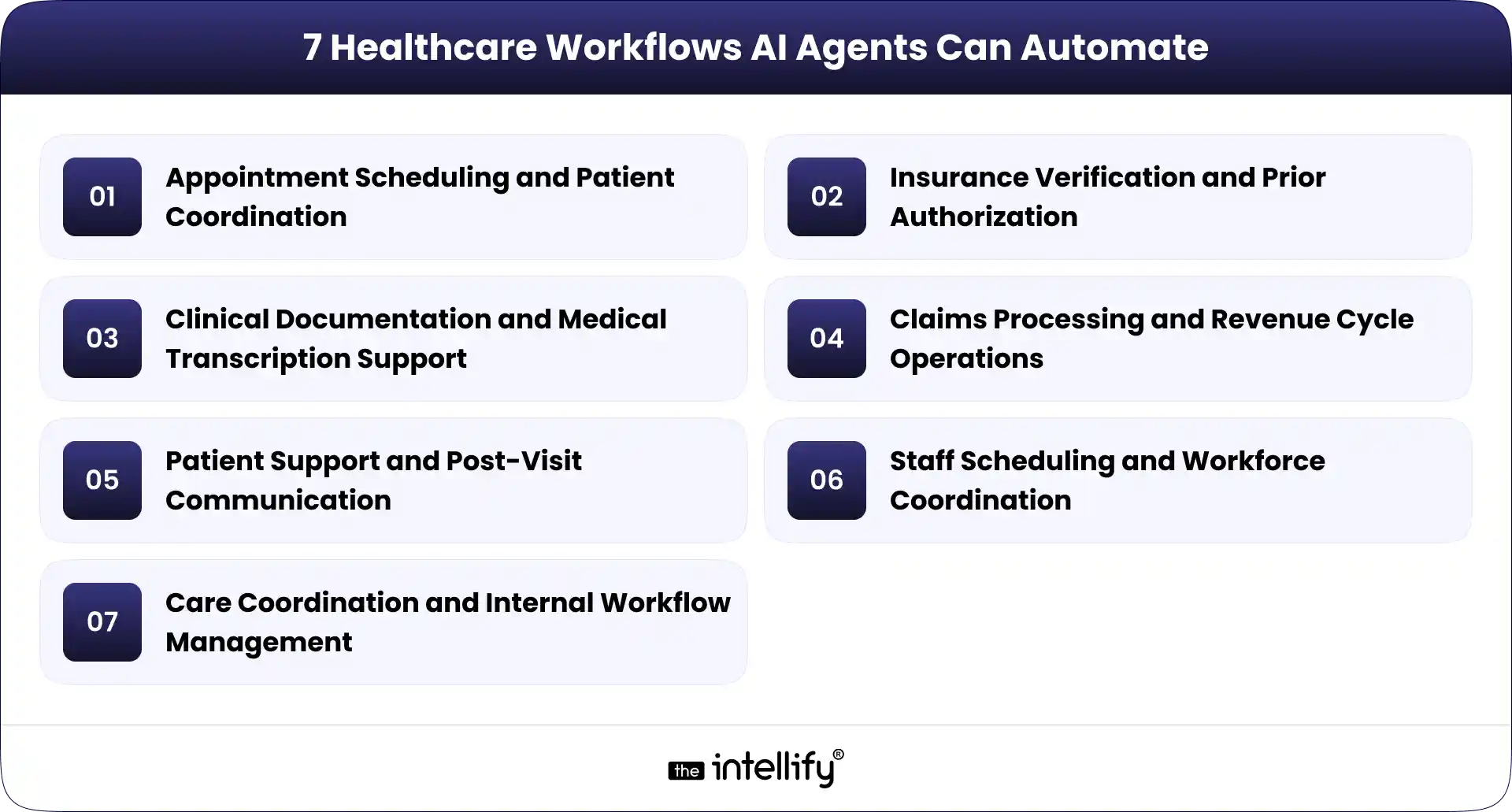
7 Healthcare Workflows AI Agents Can Automate

1. Appointment Scheduling and Patient Coordination

Appointment management remains one of the most resource-intensive administrative functions in healthcare.
AI agents can automate booking, rescheduling, cancellations, reminders, and follow-ups. Patients can interact through phone, SMS, email, or chat while AI agents update schedules in real time. These systems can also manage waitlists by automatically filling open appointment slots when cancellations occur.
Benefits include:

  • Reduced no-shows
  • Faster scheduling
  • Improved patient communication
  • Increased front-desk efficiency
  • Better patient experiences

This is one of the most common use cases for AI agents for healthcare workflow automation.

2. Insurance Verification and Prior Authorization

Insurance verification is often a major source of delays. Staff members spend hours collecting insurance details, checking eligibility, and managing prior authorization requirements. AI agents can automate much of this work. They can gather patient information, verify coverage, identify missing details, and track authorization status. This helps reduce delays while improving operational efficiency.
Benefits include:

  • Faster eligibility verification
  • Reduced administrative workload
  • Improved approval turnaround times
  • Fewer manual errors
  • Better patient access to care

3. Clinical Documentation and Medical Transcription Support

Documentation requirements continue to increase across healthcare organizations. Physicians and clinical staff often spend hours creating patient notes and updating records.
AI agents can assist with:

  • Voice-to-text transcription
  • Visit note generation
  • Clinical summaries
  • Documentation review
  • Record organization

These tools help reduce administrative burden while improving documentation speed and consistency. The goal isn’t replacing clinicians. It’s helping them spend less time typing and more time caring for patients.

4. Claims Processing and Revenue Cycle Operations

Revenue cycle management depends on accurate and timely claims processing. Even small errors can result in delays, denials, and lost revenue. AI agents can automate several claims-related workflows. They can review submissions, identify missing information, validate records, and flag potential issues before claims are submitted.
Benefits include:

  • Reduced claim denials
  • Faster reimbursements
  • Improved billing accuracy
  • Lower rework costs
  • Stronger revenue cycle performance

This is one of the most impactful examples of AI in healthcare operations.

5. Patient Support and Post-Visit Communication

Patient engagement doesn’t end after an appointment. Healthcare organizations must manage reminders, follow-ups, discharge instructions, and ongoing communication. AI agents can automate these interactions at scale.
They can:

  • Send medication reminders
  • Share care instructions
  • Answer common questions
  • Schedule follow-up visits
  • Provide 24/7 assistance

Patients receive timely information while healthcare teams reduce call volumes and manual outreach efforts. The result is better engagement and stronger continuity of care.

6. Staff Scheduling and Workforce Coordination

Managing healthcare staffing is a constant challenge. Scheduling conflicts, shift changes, and fluctuating patient volumes can create operational headaches.
AI agents help by:

  • Coordinating schedules
  • Predicting staffing requirements
  • Managing shift adjustments
  • Reducing scheduling conflicts
  • Supporting workforce planning

This improves workforce allocation while reducing the administrative burden on managers. Better scheduling often leads to improved staff satisfaction and operational efficiency.

7. Care Coordination and Internal Workflow Management

Healthcare delivery depends on smooth coordination between departments. When communication breaks down, delays follow. AI agents can automatically route information, assign tasks, escalate issues, and track workflow progress. This helps ensure the right information reaches the right people at the right time.
Benefits include:

  • Faster handoffs
  • Better departmental communication
  • Reduced delays
  • Improved workflow visibility
  • More efficient operations

Organizations using AI agents in healthcare workflows often see significant improvements in care coordination.
 

Healthcare Operations Automation Solutions


How to Identify the Right Healthcare Workflow for AI Automation

Not every workflow should be automated immediately. The best approach is to start with processes that are repetitive, time-consuming, and easy to measure.
Look for workflows that:

  • Require significant administrative effort
  • Create operational bottlenecks
  • Affect patient experiences
  • Generate frequent errors
  • Deliver measurable outcomes

Appointment scheduling, claims processing, insurance verification, and patient communication are often excellent starting points.
Starting small allows organizations to validate results before expanding automation initiatives across larger operational areas. Workflow readiness and integration requirements should also be evaluated early in the planning process.


What Healthcare Teams Gain From AI-Driven Workflows

Healthcare organizations implementing AI-driven workflows often experience benefits across multiple areas. These include:

  • Faster workflow execution
  • Reduced manual work
  • Improved patient communication
  • Lower operational costs
  • Increased staff productivity
  • Fewer administrative errors
  • Better scalability
  • More time for patient care

Perhaps the biggest advantage is allowing healthcare professionals to focus on work that truly requires human expertise.


Building an ROI Framework for AI in Healthcare Operations

Before implementing AI agents, organizations should establish clear success metrics. Measuring ROI helps healthcare leaders understand operational impact and justify future investments.
Common metrics include:

  • Administrative hours saved
  • Reduced appointment no-shows
  • Faster claims processing
  • Improved reimbursement rates
  • Lower operational expenses
  • Increased employee productivity
  • Higher patient satisfaction

Simple ROI Example

A healthcare clinic spends 300 hours each month managing appointment scheduling. If AI agents reduce that workload by 40%, the clinic saves 120 staff hours monthly. Those hours can then be redirected toward patient support and other high-value activities.
Short-term ROI often comes from efficiency gains. Long-term ROI typically includes improved patient experiences, reduced burnout, and greater operational scalability.
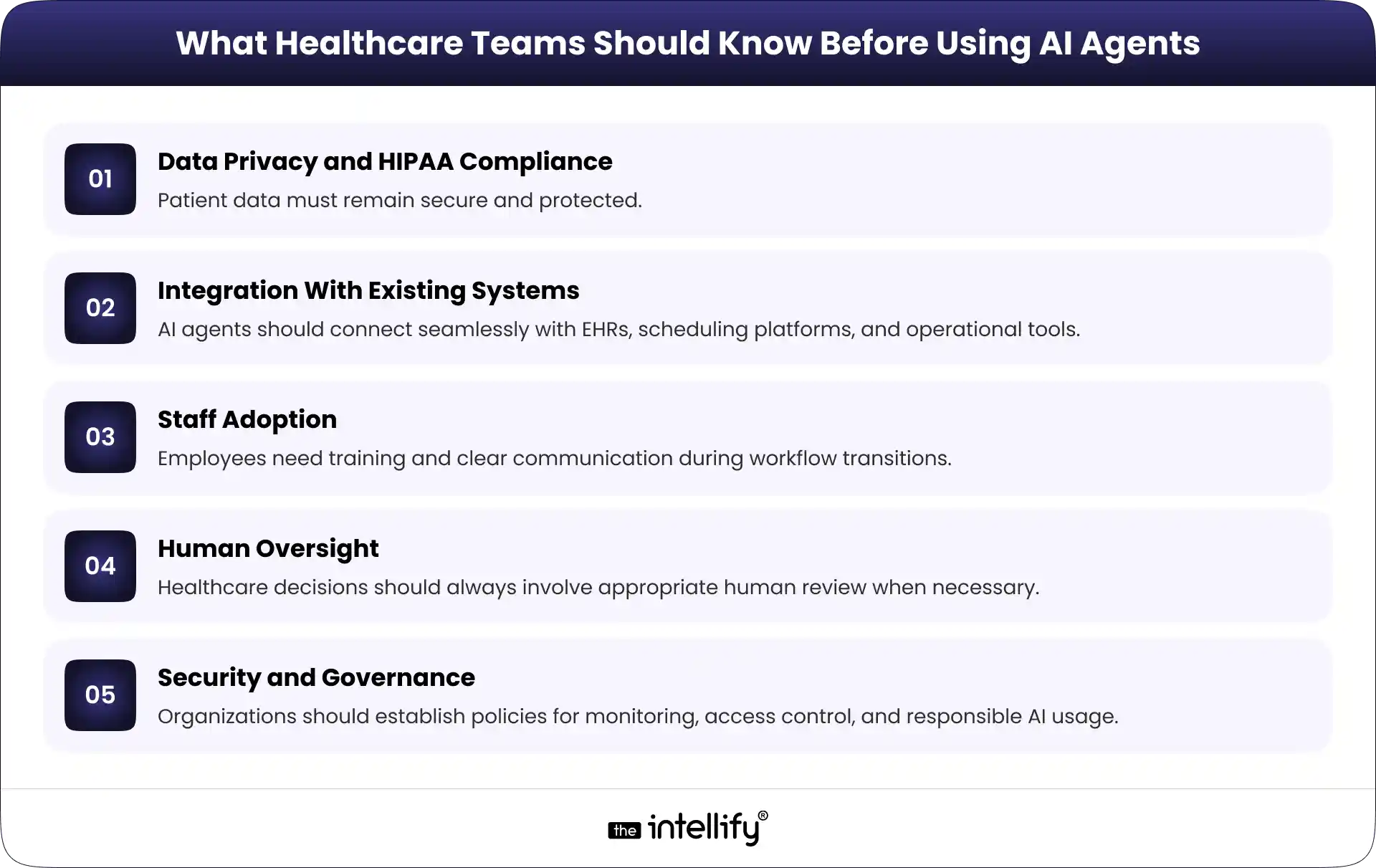
 

Key considerations before implementing AI Agents


Best Practices for Implementing AI Agents in Healthcare

Healthcare organizations can improve success rates by following a structured implementation strategy.

  • Start With One High-Impact Workflow: Focus on a process that delivers measurable value quickly.
  • Define Clear Success Metrics: Set goals before deployment begins.
  • Involve Teams Early: Operational and clinical stakeholders should participate throughout the implementation process.
  • Train Employees: Help staff understand how AI supports their daily work.
  • Monitor Performance Continuously: Track outcomes and refine workflows over time.
  • Choose Scalable Solutions: Invest in platforms that can support future growth.
  • Think Long-Term: The goal isn’t simply automation. The goal is continuous improvement across healthcare workflow operations.


Where AI Agents Could Take Healthcare Workflows Next

Healthcare automation is moving beyond individual tasks. The future lies in connected workflow orchestration. AI agents will increasingly help organizations:

  • Predict operational needs
  • Coordinate resources automatically
  • Personalize patient communication
  • Improve workforce planning
  • Connect workflows across departments
  • Support enterprise-wide operations

Rather than acting as standalone tools, AI agents will become intelligent operational support systems that work alongside healthcare teams every day.


Conclusion

AI agents are rapidly becoming a valuable part of healthcare operations. From appointment scheduling and insurance verification to claims management and care coordination, they help healthcare organizations reduce repetitive administrative work while improving efficiency.
The greatest value comes from automating the right workflows, not every workflow. Organizations that take a strategic approach, measure outcomes, and maintain human oversight will be better positioned to improve operations and patient experiences.
As healthcare continues to evolve, AI agents for healthcare operations will play an increasingly important role in building more scalable, efficient, and patient-focused healthcare systems.
 

Healthcare Automation Solutions


Frequently Asked Questions (FAQs)

1. How are AI agents different from regular healthcare automation tools?

Traditional automation follows fixed rules, while AI agents can understand context, manage workflows, and handle more dynamic healthcare tasks.

2. Which healthcare workflows are easiest to automate with AI agents?

Scheduling, insurance verification, patient follow-ups, claims processing, and documentation are some of the easiest and most common starting points.

3. Can AI agents help reduce workload for healthcare staff?

Yes, AI agents reduce repetitive administrative work so healthcare teams can spend more time on patient care and daily operations.

4. Can AI agents work with existing healthcare systems?

Yes, many AI agents can integrate with EHRs, scheduling platforms, and healthcare management systems.

5. How is ROI measured for AI agents in healthcare?

Healthcare organizations usually track time saved, reduced operational costs, fewer errors, and improved workflow efficiency.
Digital Transformation in Healthcare: Strategy for Membership Platforms

Summary:
Digital transformation is helping healthcare organizations build modern membership platforms that improve patient experience and operational efficiency. This blog explains how technologies like telehealth, AI, secure patient portals, and subscription billing systems support the growth of membership-based healthcare models. It also explores key platform components, implementation strategies, industry challenges, and future trends. With the right digital approach, healthcare providers can create scalable platforms that deliver continuous care and strengthen long-term patient relationships.

Why Membership-Based Healthcare Is Rapidly Evolving

The healthcare landscape is experiencing significant changes. We’re seeing a leap from traditional care models to subscription and membership platforms, fundamentally reshaping how services are delivered and consumed. With patients increasingly demanding convenience, transparency, and digital access, healthcare providers are under pressure to boost operational efficiency and retain their clientele. As we gear up for 2026, this year stands as a pivotal moment for modernizing healthcare platforms, making it essential for decision-makers to craft effective strategies.

In this guide, we’ll delve into what digital transformation means for healthcare membership platforms and how you can navigate this shifting landscape to enhance patient outcomes and drive business performance.


What Digital Transformation in Healthcare Means for Membership Platforms

Digital transformation in healthcare goes beyond simple digitization; it’s about creating connected experiences that weave together clinical, administrative, and customer functions. This integration paves the way for smoother patient journeys, allowing for preventive, continuous, and personalized care models.

Aligning technology with your business goals and focusing on member value is crucial. When organizations do this, they’re better equipped to meet the needs of their subscribers and foster a more engaged and loyal patient base.


Key Drivers Accelerating Digital Transformation in Healthcare

Several key factors are pushing this transformation in healthcare:

  •  Demand for Virtual Care: More patients prefer remote access to healthcare services, prompting platforms to expand their telehealth options.
  • Value-Based Care models: As these models gain popularity, healthcare organizations must adopt data-driven approaches to improve care quality and patient outcomes.
  • Competitive pressure: Providers face growing competition from digital first health solutions that cater to modern patient needs more effectively.
  • Regulatory Requirements: Compliance mandates are driving the need for robust systems focusing on data management and security.
  • Workforce Shortages: The rising demand for healthcare services often surpasses available resources, making automation critical.


Core Components of a Modern Healthcare Membership Platform

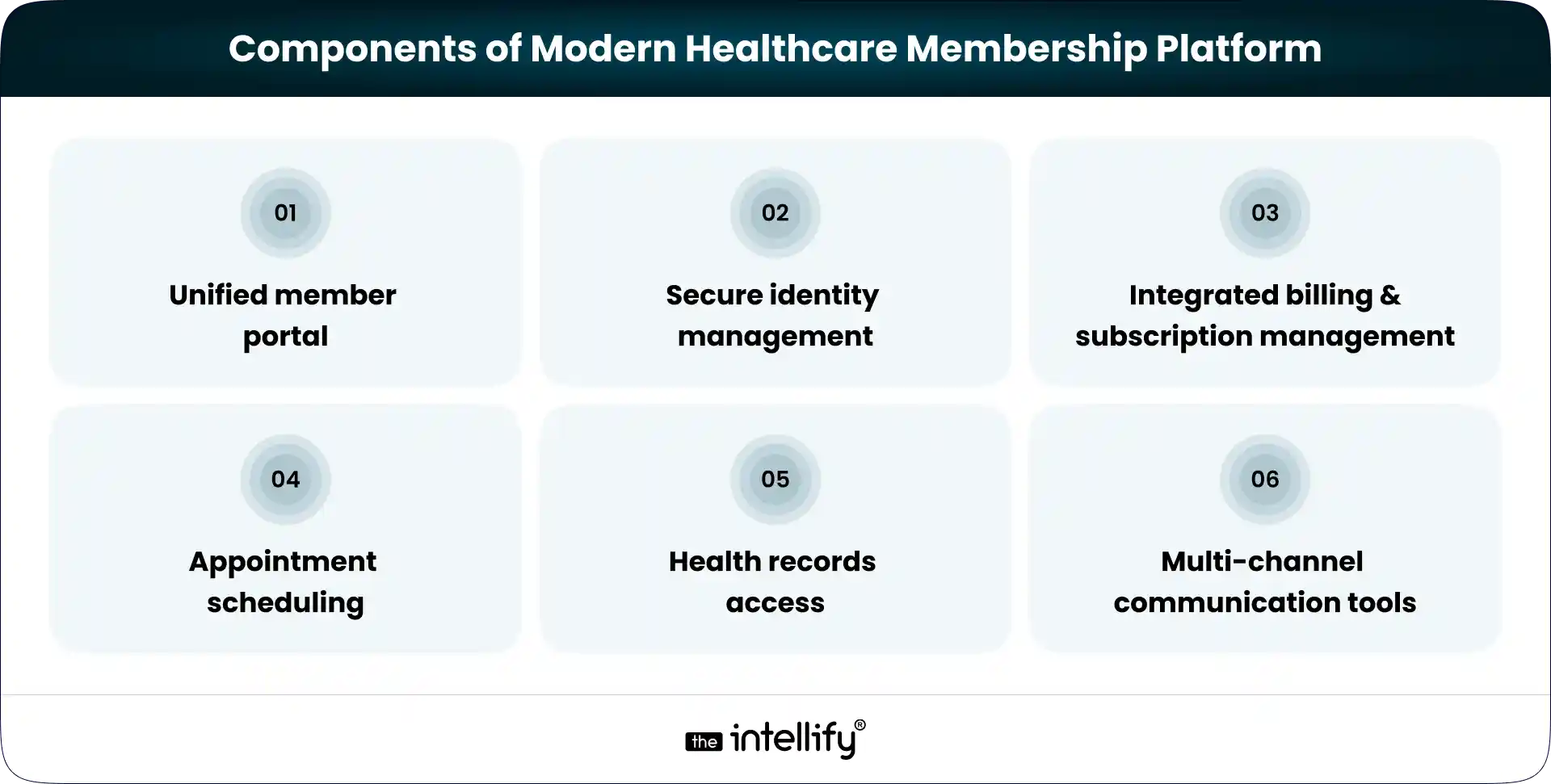
A contemporary healthcare membership platform should feature several essential components:

1. Unified member portal:- A central hub for services, plans, and communication can significantly enhance the user experience.

2. Secure identity management:- Safeguarding member information through secure access protocols is absolutely essential.

3. Integrated billing and subscription management:- Streamlined payment processes boost operational efficiency.

4. Appointment scheduling:- It should be easy for users to select telehealth services or in-person visits.

5. Health records access:- Allowing members to view and manage their health records fosters a sense of ownership.

6. Multi-channel communication tools:- Incorporating chat, messaging, and notifications keeps members engaged and informed.


Build Healthcare Membership Platform


Building a Practical Digital Transformation Strategy for Healthcare Organizations

To thrive in this transition, organizations should follow these key steps:

  • Assess current platform maturity: Identify any technology or workflow gaps that might be holding the organization back.
  • Define clear objectives: Understand what success looks like for you, improved patient satisfaction, or heightened engagement levels.
  • Prioritize improvements: Focus on high-impact changes that can deliver quick wins.
  • Secure leadership buy-in: Getting alignment across departments promotes unified efforts during this transition.
  • Plan budget and timelines: Having realistic financial and operational plans helps pave the way for smoother implementation.


Digital Healthcare Solutions That Deliver Real Member Value

The best digital healthcare solutions genuinely add value for members, including:

  • Mobile-first access: Make sure services are available on mobile devices, allowing patients to engage with healthcare wherever they are.
  • AI-supported tools: Such tools can assist in triaging symptoms and streamlining care.
  • Wellness tracking integration: Real-time health monitoring empowers patients to take charge of their wellness.
  • Simplified payment processes: Minimize the friction often encountered during claims processes.


Step-by-Step Implementation Plan

To implement a digital transformation strategy effectively, consider these phases:

Phase 1: Discovery: Engage stakeholders to gather requirements and align on clear objectives.

Phase 2: Technology selection: Select technologies that will work in harmony to support your goals.

Phase 3: Pilot programs: Begin with controlled rollouts to test systems and processes.

Phase 4: Staff training: Equip your team with the skills they’ll need for a successful transition.

Phase 5: Full deployment: Launch the platform in full and concentrate on ongoing optimization.

Navigating change management throughout this journey is vital.


Use Cases of Digital Transformation for Healthcare Membership Models

1. Concierge care:- Subscription based models that provide comprehensive care.

2. Corporate wellness programs:- Employee health initiatives that offer preventive care while lowering healthcare costs.

3. Chronic disease management:-  Memberships dedicated to managing long-term health conditions.

4. Integrated care networks:- Bundled services that enhance complementary care options.

5. Community based initiatives:- Programs focusing on public health and wellness.


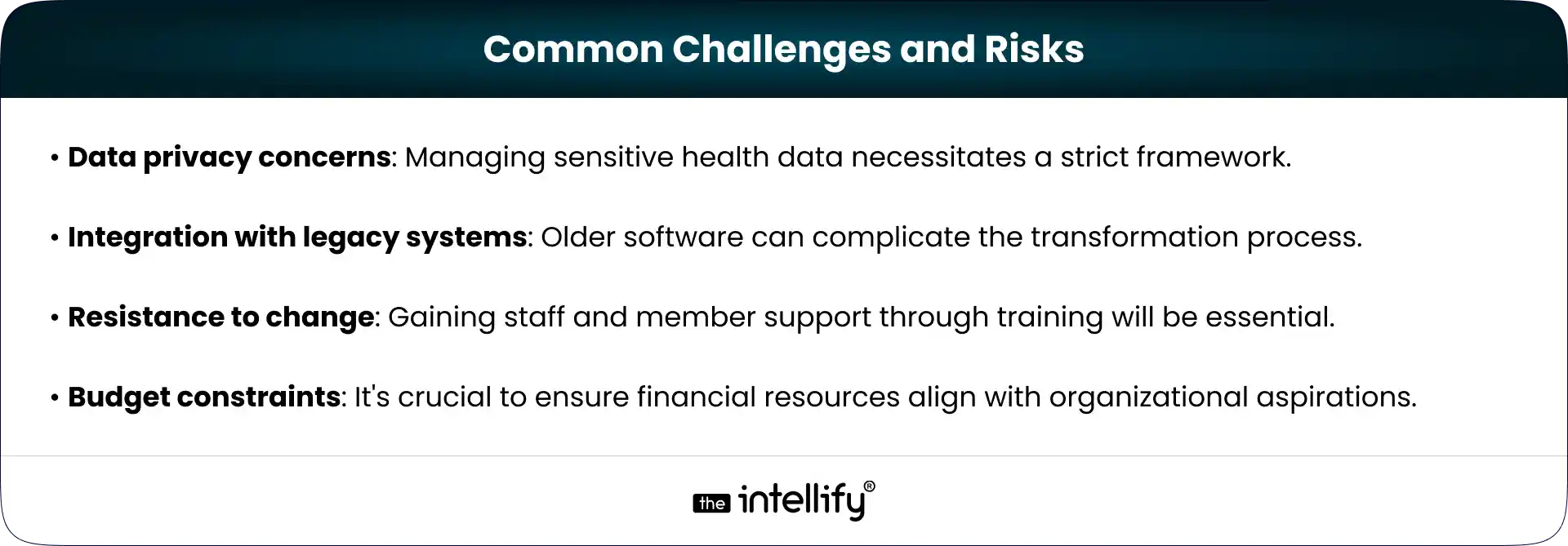
Common Challenges and Risks


Measuring Success: KPIs That Actually Matter

To understand whether digital transformation is truly working, healthcare organizations need to track a few meaningful performance indicators rather than just surface level metrics. Some of the most useful KPIs include:

Member acquisition and retention: how effectively the platform attracts new members and keeps existing ones engaged over time.

Engagement and platform usage: how frequently members use features like appointments, messaging, or health records.

Operational efficiency: improvements in workflows, response times, and overall service delivery.

Reduction in administrative workload: the extent to which automation reduces manual tasks for staff.

Patient satisfaction and experience: feedback, ratings, and overall member experience with the platform.

Subscription revenue growth: whether membership programs are generating stable and increasing recurring revenue.


Future Trends Shaping Healthcare Membership Platforms in 2026 & Beyond

Healthcare membership platforms will keep evolving as patient expectations, technology, and care delivery models change. A few trends are already shaping what the next phase may look like.

Expansion of hybrid care models

Many providers are blending virtual consultations with in person visits. This hybrid approach gives patients flexibility while still allowing clinics to handle physical care when it’s needed.

Greater use of predictive analytics and AI

Healthcare platforms are starting to rely more on AI and predictive analytics to identify potential health risks early and support better clinical decisions.

Interoperability across healthcare ecosystems

Platforms will increasingly need to connect with labs, pharmacies, insurers, and other systems so patient information can move smoothly across the care journey.

Personalized preventive care programs

Membership models are gradually shifting toward prevention. Using patient data, providers can design wellness programs tailored to individual health needs.

Integration with wearables and home devices

Wearables and remote monitoring tools are becoming part of everyday healthcare. These devices help providers track health signals continuously and respond earlier.

Shift toward outcome-focused services

Rather than focusing only on the number of visits, healthcare organizations are paying more attention to long-term health outcomes and patient experience.


Healthcare digital transformation Solutions


Conclusion:

Digital transformation in healthcare is essential for organizations aiming to stand out in a competitive landscape. By implementing effective membership platforms, healthcare providers can enhance patient care and improve operational efficiency. As expectations continue to evolve, many organizations are also working with experienced digital teams like The Intellify to modernize systems in a way that supports both clinical and operational needs without disrupting existing services.

The strategic steps you take now will build a robust foundation for a patient centered future in healthcare. Over time, this approach helps build trust, improve outcomes, and ensure healthcare delivery remains sustainable in an increasingly digital world.


Frequently Asked Questions (FAQs)

1) Why are subscription and membership models becoming popular in healthcare?

Many patients want predictable costs, faster access to care, and ongoing support instead of one-time visits. Membership models offer scheduled checkups, preventive care, virtual consultations, and wellness services under a single plan, which feels more convenient and reassuring.

2) What are the first steps to start digital transformation for a healthcare membership platform?

Most organizations begin by evaluating their current systems, identifying gaps in patient experience, and defining clear goals. Instead of replacing everything at once, successful teams prioritize high-impact improvements like online scheduling, secure communication, and digital payments.

3) How can digital tools improve member retention in healthcare programs?

Digital tools make services easier to use and more responsive. Features like reminders, personalized health tips, quick support chat, and smooth renewals help members stay engaged. When people feel supported between visits, they are far more likely to continue their subscription.

4) Is digital transformation necessary for existing healthcare membership programs, or only for new ones?

Digital transformation benefits both. Established programs can modernize outdated systems, improve member experience, and reduce operational costs, while new programs can launch with scalable digital foundations from the start.

5) How can providers ensure patient data stays secure during transformation?

Security must be built into every stage, from system design to daily operations. This includes encryption, strict access controls, compliance with regulations, regular audits, and staff training. Trust is critical in healthcare, so privacy protection cannot be an afterthought.

6) What common mistakes should organizations avoid when modernizing their platforms?

A frequent mistake is focusing only on technology while ignoring user experience. Another is trying to implement too many changes at once. Successful transformations balance innovation with simplicity and involve both staff and patients in the process.

How to Choose the Right Digital Transformation Partner for Healthcare Platforms

Summary:
Healthcare platforms can no longer rely on outdated systems. This blog explains why digital transformation in healthcare industry has become essential and how the right digital transformation partner can shape long-term success. It covers modernization challenges, AI automation in healthcare, operational improvements, and key factors to consider before choosing a partner. The goal is simple: help healthcare organizations make a strategic, informed decision that strengthens patient care and operational stability.


Why Healthcare Platforms Can No Longer Ignore Digital Change

Healthcare doesn’t work the way it used to. And honestly, it can’t. Patient expectations have changed. People now expect healthcare platforms to feel as smooth as booking a cab or ordering groceries. They want:

  • Online appointment booking
  • Easy access to digital medical records
  • Quick responses and reminders
  • Clear billing transparency

The shift toward online consultations and digital records has accelerated. Telehealth calls from living rooms. Reports shared through secure portals. Prescriptions delivered digitally. This isn’t futuristic anymore it’s normal.

At the same time, hospitals, clinics, and health startups are under operational pressure. Staff shortages. Rising compliance requirements. Increasing patient volumes. Limited budgets. This is why digital transformation in healthcare industry is no longer optional. It’s becoming a survival need.

Platforms that stay dependent on outdated systems face real risks:

  • Slow reporting cycles
  • Data stuck in disconnected tools
  • Higher chances of billing and documentation errors
  • Poor patient experience

In healthcare, delays and mistakes aren’t minor inconveniences. They affect real lives. That’s the reality.


What Digital Transformation Really Means for Healthcare Platforms

Many leaders think digital transformation solutions mean upgrading software. That’s only a small part of it.

True transformation connects systems instead of running isolated tools. Your scheduling system should sync with billing. Billing should integrate with patient records. Labs, pharmacies, and admin teams should work on shared data not separate spreadsheets.

It also means bringing AI and automation into daily workflows in practical ways. For example:

  • Automated appointment reminders
  • Real-time claim verification
  • Intelligent flagging of abnormal test results
  • Smart patient communication system

Another key element is data accessibility. Doctors shouldn’t waste time searching through multiple dashboards. Administrators shouldn’t manually compile reports just to understand performance.

Digital transformation is about smoother internal operations. Less confusion. Less duplication. More clarity. It’s not about flashy technology. It’s about systems working together quietly in the background.


How Healthcare Platforms Operated Before Modernization

Before modernization, most healthcare platforms relied heavily on manual processes. Paper files, Duplicate data entry, Sticky notes on desks, and Long Excel sheets emailed back and forth.

Common challenges included:

  • Manual patient registration
  • Scheduling conflicts and double bookings
  • Billing handled across disconnected systems
  • Delayed insurance claim processing
  • No real-time visibility into operations

Patient wait times often increased due to inefficient scheduling. Billing teams struggled with reconciliation because systems didn’t talk to each other. Leaders had to make decisions based on outdated monthly reports.

Care delivery was reactive. Issues were addressed after they surfaced. Predictive planning was rare. For many organizations, this still feels familiar. And exhausting.


Where Healthcare Platforms Are Adopting Digital Transformation Today

Healthcare platforms are now modernizing in focused areas.

Online appointment systems and patient portals allow patients to book visits, access reports, and manage records without calling reception desks.

Telehealth and remote consultations reduce travel time and improve accessibility. This is especially useful for follow-ups and chronic condition monitoring.

Automated billing and revenue cycle management tools reduce manual errors and accelerate payments. Claim validation becomes faster and more accurate.

AI-supported diagnostics and reporting are helping identify patterns in patient data. AI and digital transformation in healthcare are now working together to support clinicians, not replace them.

Operational dashboards provide real-time visibility into bed occupancy, patient flow, and staffing levels. This strengthens digital transformation in healthcare operations by enabling proactive planning.

The goal isn’t complexity. It’s clarity.


Digital transformation solution for healthcare


Why Choosing the Right Digital Transformation Partner Is a Strategic Decision

Technology alone cannot solve operational gaps.

A healthcare platform might invest in advanced systems, but without proper alignment and execution, results fall short. A wrong digital transformation partner can delay growth and introduce new inefficiencies.

Healthcare requires industry-specific understanding. Patient data is sensitive. Regulations are strict. Workflows are layered and interconnected.

Key considerations include:

  • Compliance with healthcare regulations
  • Secure data management practices
  • Deep understanding of healthcare workflows
  • Long-term scalability

Some vendors prioritize fast implementation. Quick launches sound attractive. But healthcare systems need stability and thoughtful integration. Selecting a digital transformation partner is not just an IT choice. It’s a strategic business decision.


What to Look for in a Healthcare Digital Transformation Partner

When evaluating a digital transformation partner, focus on practical factors.

1. Proven healthcare experience

Have they worked with hospitals, clinics, or health platforms before? Real industry exposure matters.

2. Integration capabilities

Healthcare systems rarely start from scratch. The partner must integrate with existing infrastructure rather than forcing complete replacement.

3. Regulatory understanding

Compliance standards cannot be an afterthought. The partner should demonstrate clear knowledge of healthcare data regulations.

4. Clear roadmap and milestones

A structured plan with measurable phases ensures transparency and accountability.

5. Post-launch support

Implementation is only the beginning. Continuous monitoring, updates, and optimization are necessary.

6. AI-powered expertise

Experience with AI automation in healthcare enables smarter scheduling, billing, and reporting systems.

A strong digital transformation partner combines healthcare knowledge with technical execution and long-term commitment.


The Role of AI in Modern Healthcare Operations

AI automation in healthcare is becoming increasingly practical.

Administrative tasks such as:

  • Appointment confirmations
  • Data validation
  • Claims pre-checks
  • Basic patient queries

can be handled through AI-powered solutions.

In clinical settings, AI supports diagnosis by analyzing large datasets and identifying unusual patterns. It assists doctors in making informed decisions. AI also helps predict patient demand by analyzing historical data.

This allows better staffing and resource allocation. Billing accuracy improves when AI systems flag inconsistencies before submission. Revenue leakage decreases. When AI and digital transformation strategies work together, healthcare platforms become more proactive instead of reactive.


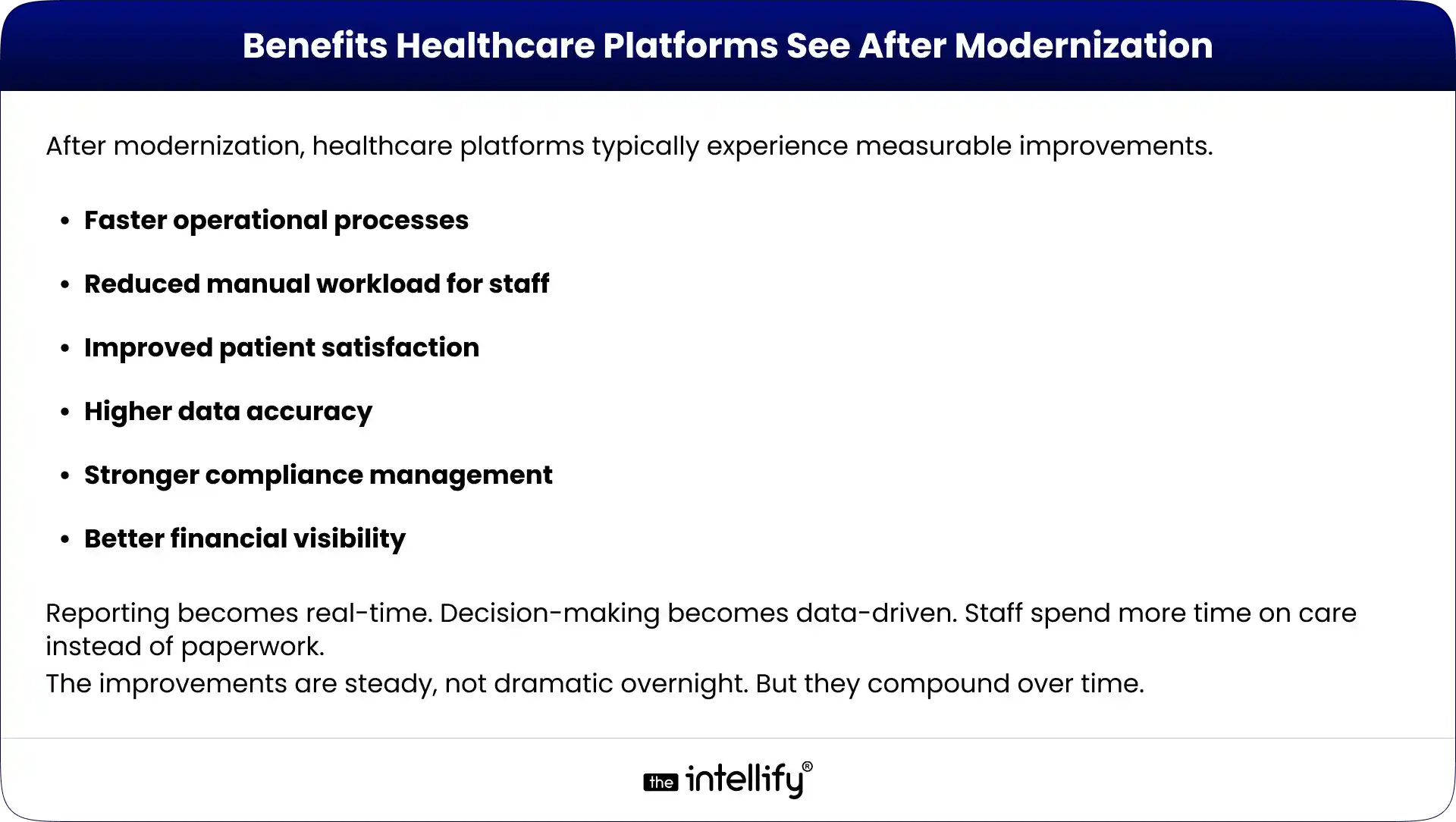
Benefits Healthcare Platforms See After Modernization


Common Mistakes While Choosing a Healthcare Partner

Some common errors include:

  • Choosing solely based on cost
  • Ignoring long-term scalability
  • Underestimating integration complexity
  • Overlooking post-launch support
  • Selecting general IT providers without healthcare expertise

Low-cost solutions often lead to expensive corrections later. Systems that don’t scale create bottlenecks. Lack of support leaves teams struggling after deployment.

Healthcare platforms require specialized understanding. Generalized solutions rarely work smoothly.


Working With a Partner That Understands Healthcare Complexity

Healthcare operations are layered and interconnected. Clinical workflows, administrative processes, billing cycles, and compliance frameworks must function together.

A reliable digital transformation service partner understands this complexity. They assess existing workflows before recommending changes. They focus on measurable results rather than generic implementations.

Organizations like The Intellify combine healthcare domain knowledge with AI and digital transformation expertise to design customized digital transformation solutions. The focus remains on operational clarity, compliance, and long-term scalability.

A long-term partnership approach ensures that modernization evolves with the organization’s growth.


Healthcare Digital Transformation Solutions


Final Thoughts

Digital transformation in healthcare industry affects patient care, operational efficiency, and financial sustainability. Choosing the right digital transformation partner influences how smoothly this transition happens.

When AI-powered systems and structured digital transformation strategies align, healthcare platforms become more resilient and intelligent.
This decision should be strategic, carefully evaluated, and future-focused. In healthcare, every operational improvement eventually impacts patient outcomes, and that makes the choice significant.


Frequently Asked Questions (FAQ)

1. What does a digital transformation partner do for healthcare platforms?

A digital transformation partner reviews your current systems, identifies gaps, and implements connected digital transformation solutions. In healthcare, this includes integrating patient records, automating workflows, improving billing systems, and strengthening data security. The goal is smoother operations and better patient experience.

2. Why is choosing the right partner important for digital transformation in healthcare?

Healthcare platforms handle sensitive patient data and strict compliance requirements. The wrong partner can create delays, integration issues, or security risks. The right digital transformation partner like The Intellify understands healthcare workflows and builds scalable, secure systems that support long-term growth.

3. How do I start evaluating a potential digital transformation partner?

Begin by checking their healthcare experience, integration capability, and regulatory knowledge. Ask for a clear roadmap, measurable milestones, and post-launch support plans. A structured evaluation helps avoid costly mistakes later.

4. Can digital transformation work with existing hospital systems?

Yes. Digital transformation in healthcare industry usually focuses on integrating existing systems rather than replacing everything. Proper integration improves data flow, reduces manual work, and enhances overall efficiency without major operational disruption.

5. How long does digital transformation take in healthcare?

The timeline depends on the scope of modernization. Smaller improvements may take a few months, while full-scale transformation can take longer. A phased approach with defined milestones allows healthcare platforms to improve steadily without overwhelming staff.

6. What role does AI play in digital transformation for healthcare?

AI automation in healthcare helps reduce manual tasks, improve data analysis, flag billing errors, and support clinical decisions. When combined with connected systems, AI makes healthcare operations faster, more accurate, and more proactive.

7. How do I measure success after adopting digital transformation solutions?

Success can be measured through reduced patient wait times, fewer claim denials, improved operational efficiency, stronger compliance tracking, and better financial visibility. Clear KPIs should be defined before implementation to track real progress.

View
Case Study