AI in Healthcare Administration: Streamlining Hospital Operations

Summary
The growing complexity of healthcare administration is driving the need for smarter, more efficient solutions. Automation technologies are helping streamline key processes such as scheduling, billing, and data management, reducing manual workload and improving accuracy. This enables faster operations, better coordination, and enhanced patient experiences. As adoption increases, healthcare organizations are moving toward more efficient, scalable, and patient-focused administrative systems.

In today’s fast-paced healthcare landscape, administrative tasks often take priority over direct patient care. With more patients seeking services and regulations tightening, tasks like scheduling, billing, and record management have become increasingly complex and time-consuming. That’s where AI in healthcare administration steps in. This blog will explore how AI is reshaping hospital operations, giving staff and patients a much-needed breather.


The Growing Administrative Burden in Healthcare

It’s striking how much time healthcare staff spend buried under paperwork instead of attending to patients. From registering patients to managing billing and navigating compliance requirements, these tasks are essential but can feel overwhelming.

  • Patient registration often means gathering and verifying a mountain of information.
  • Insurance processing can get tricky, frequently leading to frustrating delays.
  • Communication between departments is vital but can feel Herculean, especially as patient numbers swell.

As regulations tighten and patient volumes rise, hospitals find themselves grappling with an expanding list of administrative responsibilities. Manual processes can lead to delays, costly errors, and increased workloads for staff. This impacts both productivity and the bottom line.

To tackle these challenges, more healthcare organizations are embracing AI in healthcare administration to streamline operations and ease the burden on their teams.


Why Traditional Administrative Processes Are No Longer Sustainable

The issues facing healthcare administration often come from sticking to outdated models that can’t keep up with modern demands. Some notable challenges include:

  • Mounting patient demand combined with a shortage of administrative staff.
  • Frequent errors that crop up from repetitive manual tasks.
  • Delays in approvals and documentation that frustrate both staff and patients.
  • Staff burnout stemming from an unsustainable workload filled with non-clinical tasks.

In this context, it’s pretty clear that old-school administrative methods just aren’t cutting it anymore. A smarter, more efficient approach is essential.


What AI in Healthcare Administration Means Today

AI is emerging as a game-changer for healthcare administration. It’s not about replacing staff but enhancing their skills. Key features of AI in this area include:

  • Rapid processing of large volumes of data while minimizing errors.
  • Learning from patterns to help inform decision-making.
  • Seamless integration with the existing hospital system to improve workflow.
  • Enhancing efficiency, accuracy, and speed at every turn.

Thanks to these capabilities, AI can significantly declutter administrative tasks, letting healthcare professionals shift their focus back to what matters most: patient care.


How Hospitals Are Using AI to Streamline Daily Operations
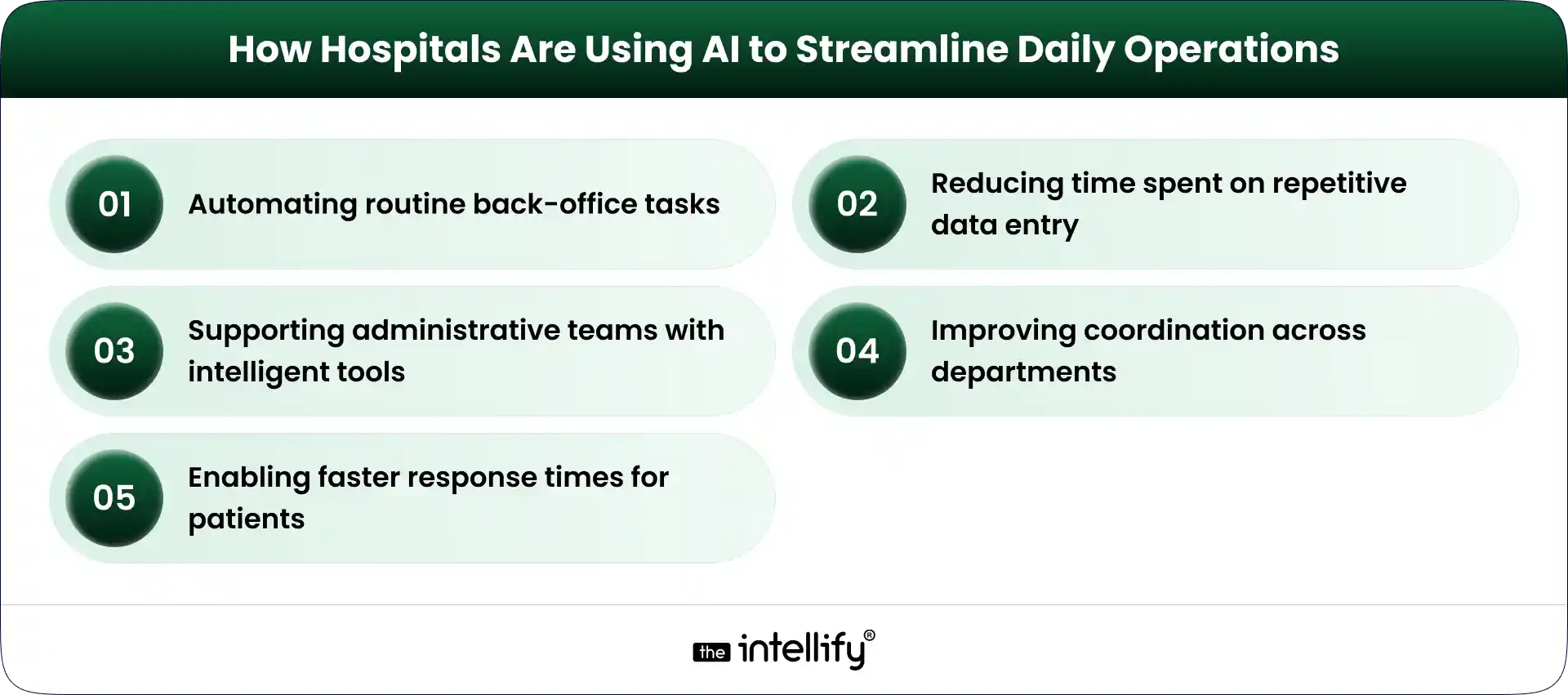
AI for Hospitals Daily Operations

  • Automating routine back-office tasks to reduce manual workload and free up staff time for higher-value activities
  • Reducing time spent on repetitive data entry by minimizing paperwork and improving data accuracy across systems
  • Supporting administrative teams with intelligent tools that simplify workflow management, task prioritization, and decision-making
  • Improving coordination across departments by enabling seamless communication and better alignment between teams

Enabling faster response times for patients and staff, from appointment scheduling to handling queries and internal processes
These improvements help hospitals operate more efficiently while creating a smoother, faster, and more patient-focused administrative experience.


Key Use Cases of AI in Healthcare Administration

Several specific applications demonstrate how AI in healthcare can be effectively deployed in healthcare administration:

Patient Scheduling and Appointment Management

  • Automated booking and rescheduling:- minimize missed appointments and optimize staff availability.
  • AI quickly allocates time slots based on various factors, leading to happier patients.

Billing, Claims, and Insurance Processing

  • Faster verification and claims handling speed up the revenue cycle.
  • Reduced paperwork errors contribute to better financial performance.

Medical Records Management

  •  AI assists in organizing and retrieving patient information swiftly.
  •  It cuts down on duplicate or incomplete records while ensuring secure data handling.

Communication and Support Services

  • Chatbots and virtual assistants offer quick answers to common patient inquiries.
  • Timely reminders for appointments and follow-ups enhance patient care.

Compliance and Reporting

  • AI supports monitoring documentation needs and auditing tasks.
  • It helps reduce the risk of non-compliance, ensuring adherence to regulations.
 

Automation in healthcare operations


Benefits for Hospitals, Staff, and Patients

Embracing AI in healthcare administration yields a slew of benefits:

  • Reduced administrative workload: for healthcare professionals, allowing them to focus less on paperwork and more on meaningful tasks
  • Faster processes and shorter waiting times,: leading to quicker service delivery and improved patient satisfaction
  • Improved operational efficiency: through streamlined workflows and fewer manual errors across administrative functions
  • More time for staff to focus on patient care: especially in areas that require human judgment, empathy, and attention
  • Better overall experience for patients: with smoother interactions, timely updates, and more responsive healthcare services.

These benefits collectively help create a more efficient, patient-centric healthcare system while easing the burden on medical and administrative staff.


Challenges and Considerations When Implementing AI
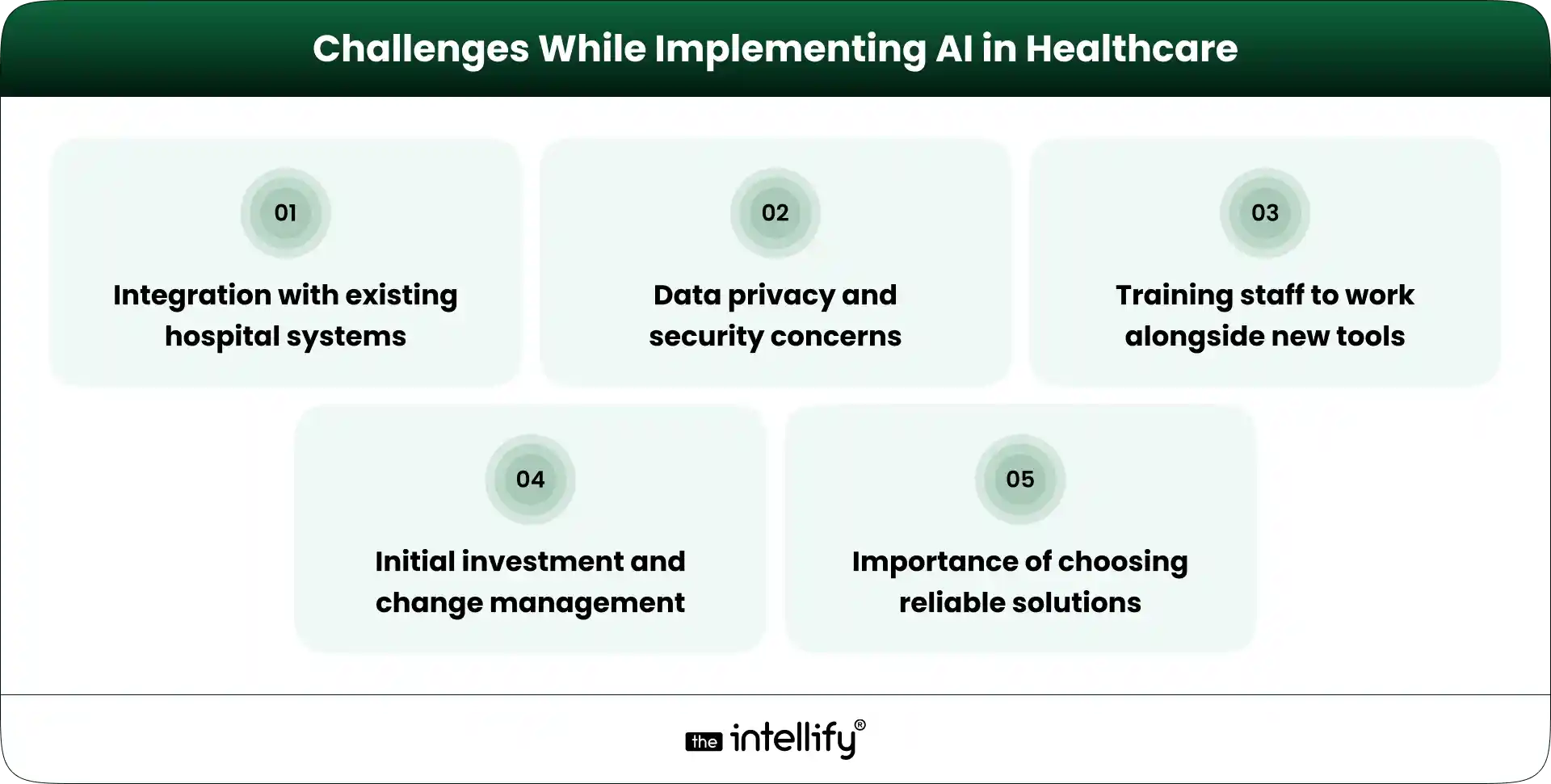
Challenges While Implementing AI in Healthcare

While the perks of AI are numerous, deploying it isn’t without its hurdles:

  • Integration with existing hospital systems can be complex, especially when dealing with legacy infrastructure and multiple data sources
  • Data privacy and security concerns must be addressed carefully to ensure compliance with healthcare regulations and protect sensitive patient information
  • Training staff to work alongside new tools is essential to ensure smooth adoption and maximize the value of AI solutions
  • Initial investment and change management require thoughtful planning to minimize disruption and ensure a seamless transition
  • Importance of choosing practical, reliable solutions that align with real operational needs rather than overly complex or unnecessary implementations

Addressing these challenges early helps healthcare organizations adopt AI more effectively and achieve long-term success.


How AI Helps Healthcare Staff, Not Replaces Them

The role of AI is to enhance, not replace healthcare staff. Here’s how:

  • Administrative work still requires judgment and empathy, which only healthcare professionals can provide
  • AI handles routine tasks, while humans manage complex situations, ensuring better decision-making and patient care
  • Collaboration between technology and staff enables more efficient workflows and improved outcomes
  • Building trust in automated systems is essential for smooth adoption and long-term success
  • Importance of oversight and accountability to ensure AI systems are used responsibly and accurately

AI works best as a support system empowering healthcare staff rather than replacing the human touch that patient care depends on.


What the Future of Healthcare Administration Looks Like

As we look ahead, it’s clear that AI will only become more entrenched in healthcare administration. We can expect to see:

  • Increasing adoption of intelligent automation to handle repetitive tasks and streamline administrative workflows at scale
  • More connected hospital systems enabling seamless data flow, better coordination, and improved operational efficiency
  • Predictive insights for planning and resource management, helping hospitals make smarter, data-driven decisions
  • Shift toward proactive rather than reactive administration, allowing issues to be identified and addressed before they escalate
  • Continued focus on efficiency and patient-centered operations, ensuring smoother experiences for both staff and patients.

The future of healthcare administration will be driven by smarter systems that enhance efficiency while keeping patient care at the center of every decision.


How Organizations Can Start Adopting AI in Administration

For organizations keen to integrate AI, consider these steps:

  • Identifying high-impact areas for automation where AI can quickly reduce manual workload, eliminate bottlenecks, and deliver measurable efficiency gains
  • Starting with small, practical use cases to test effectiveness, minimize risk, and demonstrate early success before scaling further
  • Evaluating technology partners carefully by considering their healthcare expertise, integration capabilities, and long-term scalability
  • Ensuring staff involvement and training to encourage adoption, improve usability, and help teams confidently work alongside new tools
  • Measuring outcomes and scaling gradually by tracking performance metrics, refining processes, and expanding AI implementation based on real results.

A phased, well-planned approach makes it easier for organizations to adopt AI successfully while ensuring long-term operational and clinical value.

 

Hospital operations with AI


Conclusion:

AI is clearly transforming the realm of healthcare administration. By boosting operational efficiency and enriching the patient experience, we can make significant strides toward sustainable healthcare systems. Thoughtful adoption of AI is crucial; rushing the implementation could stymie progress.

As we move forward, the importance of human oversight in managing AI systems can’t be overstated. Striking the right balance will enable healthcare organizations to flourish in the face of modern challenges. If you’re ready to unlock the potential of AI in healthcare administration, let us at The Intellify show you how to implement effective solutions for your organization.


Frequently Asked Questions (FAQs)

1. How is AI actually used in healthcare administration today?

AI is mainly used to handle routine tasks like appointment scheduling, billing checks, document processing, and patient communication. It helps staff complete work faster and reduces manual effort without changing clinical care.

2. Can AI reduce the paperwork burden in hospitals?

Yes. AI tools can automatically organize records, fill forms, and process documents, which significantly cuts down time spent on paperwork and reduces errors caused by manual entry.

3. Does AI in administration improve patient experience too?

Indirectly, yes. Faster scheduling, shorter waiting times, accurate billing, and quicker responses to queries all make the patient journey smoother, even though AI works behind the scenes.

4. Is AI replacing administrative staff in hospitals?

No. In most cases, AI supports staff by handling repetitive tasks, allowing them to focus on coordination, problem-solving, and patient interaction that require human judgment.

5. What administrative tasks benefit the most from AI automation?

Tasks that follow clear patterns benefit the most, such as appointment management, insurance verification, claims processing, reminders, reporting, and data entry.

6. Is AI in healthcare administration only for large hospitals?

Not anymore. Many modern solutions are scalable, meaning clinics and mid-sized hospitals can also adopt AI tools without major infrastructure changes.

7. How does AI help reduce operational costs in hospitals?

By automating routine work, hospitals need fewer manual hours for repetitive tasks, reduce errors that lead to financial losses, and improve overall efficiency, all of which lower operational expenses over time.
AI Workflow Automation in Hospitals: Smarter Systems for Better Care

Summary:
AI workflow automation is transforming hospital operations by streamlining both administrative and clinical tasks. This blog covers how AI for workflow automation connects systems like EHR, billing, lab, and scheduling platforms to reduce manual coordination, improve accuracy, and accelerate patient flow. It also highlights practical use cases, key benefits, implementation challenges, and best practices for adopting AI in hospital environments to build more efficient and responsive healthcare systems.


Why Hospital Workflows Need Smarter Systems

Walk into any hospital at 9:15 a.m. on a Monday, and you’ll see it. Phones ringing. Nurses juggling files. Someone chasing a signature. Someone else is waiting for a lab update that should’ve arrived 20 minutes ago.

Hospitals handle thousands of daily tasks, both clinical and administrative. Admissions, billing, discharge summaries, lab coordination, referrals, approvals… the list doesn’t end. And when these tasks depend on manual coordination, care slows down.

Staff spend hours on repetitive processes. Copying data from one system to another. Sending reminder emails. Following up on missing documents. It’s not exactly why they chose healthcare. This is where AI workflow automation steps in. It connects systems, moves tasks automatically, and reduces the need for constant follow-ups. In short, it helps hospitals breathe a little.

In this blog, we’ll break down what AI workflow automation means in hospitals, where it fits, how it works step-by-step, real use cases, benefits, challenges, and what the future looks like.


What AI Workflow Automation Means for Hospitals

At its core, AI workflow automation means using intelligent systems to move tasks, data, and decisions across hospital operations without manual intervention.

Traditional automation follows fixed rules. “If X happens, do Y.”

But hospitals are messy. Priorities change. Emergencies happen. Data isn’t always clean. That’s where intelligent automation differs. AI in hospital workflows can:

  • Recognize patterns in patient flow
  • Prioritize urgent cases automatically
  • Flag missing information before it causes delays
  • Suggest actions based on historical data

Instead of just executing rules, AI supports decision-making and coordination. It doesn’t just automate tasks. It understands context. Inside hospital operations, this fits across:

  • Admissions and registration
  • Clinical documentation
  • Lab coordination
  • Scheduling
  • Billing and claims
  • Internal communication

Basically, anywhere there’s repetitive movement of information, AI for workflow automation can step in.


Core Areas of Hospital Workflow Automation

Now let’s talk about how this actually works on the ground.

Automating Administrative Processes

Administrative work is where time quietly disappears.

  • Registration and admissions: AI systems can auto-fill patient data, verify insurance, and route admission requests instantly.
  • Form processing: Instead of staff manually reviewing every form, AI can validate entries, flag missing fields, and push them to the next department.
  • Internal approvals: Whether it’s bed allocation or procedure approval, intelligent routing ensures requests reach the right authority without delay.
  • Automated document routing: Discharge summaries, reports, and billing documents, all can move automatically based on predefined workflows.

No more “Did you send that file?” emails.

Automating Clinical Support Tasks

Clinical teams deal with pressure. Removing small friction points matters.

  • Updating patient records:- AI syncs updates across systems in real time, reducing duplicate data entry.
  • Lab report coordination:- Results can be automatically shared with the concerned physician and flagged if critical.
  • Discharge summaries:- Drafts can be generated using structured data, reducing typing time.
  • Referral management:- Referrals can be routed, tracked, and scheduled automatically.

It’s not flashy. But it saves hours each week.

Automating Communication and Alerts

Communication gaps cause delays. And sometimes worse.

  • Appointment reminders:- Automated SMS or email reminders reduce no-shows.
  • Staff notifications:- When a lab result is ready or a patient is admitted, relevant staff get notified instantly.
  • Emergency alerts:- Critical cases can trigger priority routing.
  • Task assignments:- Tasks can be assigned based on availability and workload.

This is where AI in healthcare settings quietly improves coordination.


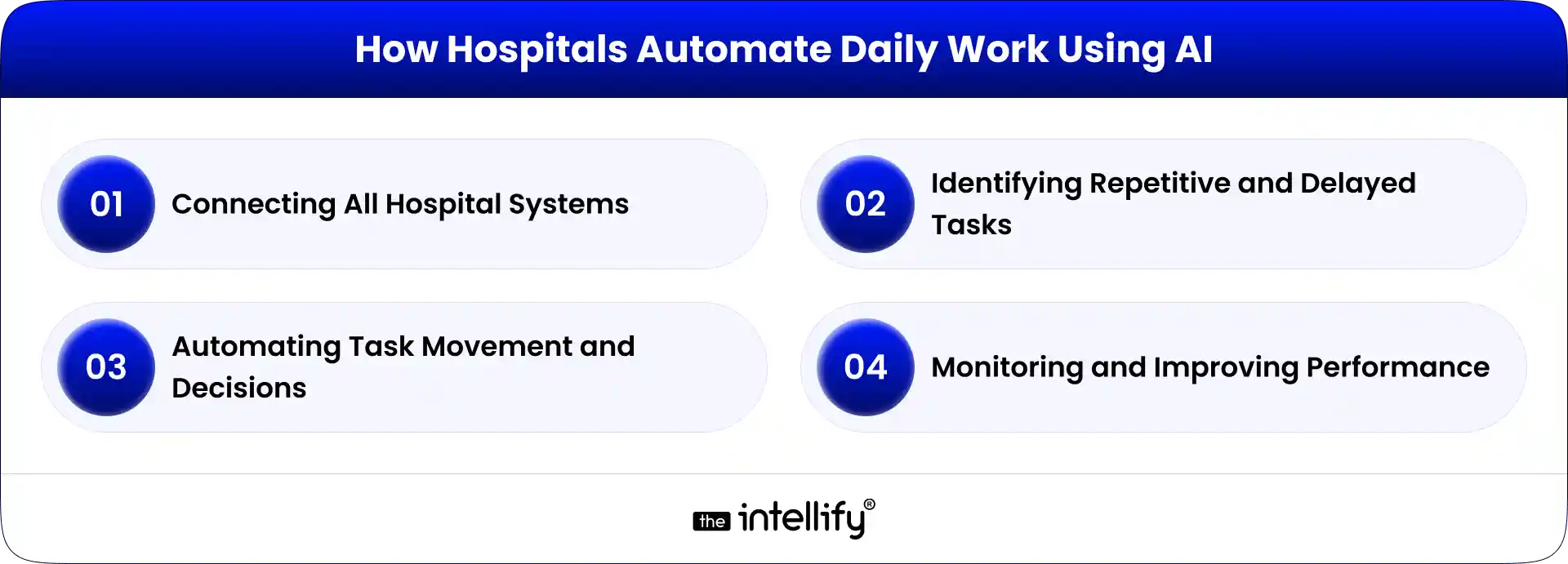
How Hospitals Automate Daily Work Using AI

AI automation for Daily Hospital Work

Let’s break this down into simple, practical steps.

Step 1: Connecting All Hospital Systems

Most hospitals use multiple platforms:

  • EHR
  • Billing software
  • Lab systems
  • Pharmacy systems
  • Scheduling tools

When these systems don’t talk to each other, staff switch screens constantly. It’s exhausting. AI workflow automation begins by integrating these systems. Data flows into one connected environment. No more scattered silos.

The goal? A unified operational view. This is the foundation. Without it, automation won’t work smoothly.

Step 2: Identifying Repetitive and Delayed Tasks

You can’t automate what you don’t understand. Hospitals analyze:

  • Manual data entry points
  • Approval bottlenecks
  • Delays in admissions or discharge
  • Patterns in daily workflow

For example, if discharge approvals are consistently delayed by two hours, that’s a signal.

AI systems help detect these patterns using real data. This step often reveals surprising inefficiencies.

Step 3: Automating Task Movement and Decisions

Now the real shift begins.

  • Patient files are routed automatically
  • Appointments are scheduled based on availability
  • Alerts and reminders are sent without manual input
  • Records update in real time
  • Billing triggers after treatment completion

Instead of someone manually coordinating every step, the system moves tasks forward. Manual follow-ups drop. Turnaround time improves. Staff feel it almost immediately.

Step 4: Monitoring and Improving Performance

Automation isn’t a one-time setup. Hospitals track:

  • Turnaround time
  • Workflow efficiency
  • Admission-to-discharge duration
  • Error rates

AI systems learn from historical data. Over time, they refine processes. If something slows down, the system highlights it. Continuous improvement becomes part of daily operations.


AI for Workflow Automation Services


AI Workflow Automation Use Cases in Hospitals

Let’s look at practical examples.

1. Patient Admission and Discharge Management

AI reduces paperwork. It verifies details instantly and speeds up bed allocation. Discharge summaries move faster. Billing starts automatically. Patients leave without waiting in corridors for hours.

2. Intelligent Scheduling Systems

Balancing doctor availability and patient demand is tricky. AI-driven scheduling considers:

  • Doctor availability
  • Appointment urgency
  • Past no-show patterns

It adjusts schedules dynamically. Fewer gaps. Fewer conflicts.

3. Billing and Claims Coordination

Billing errors are common in manual systems. AI verifies insurance details, checks documentation completeness, and routes claims correctly. This reduces rejections and speeds up reimbursements.

4. Clinical Documentation Assistance

Doctors often spend late evenings finishing documentation. (You’ve probably seen it.) AI can auto-populate structured fields and assist in drafting reports. Manual typing decreases.

5. Emergency Workflow Optimization

In emergency departments, seconds matter. AI prioritizes urgent cases based on symptoms and historical data. It routes them accordingly. Smarter triage with faster action.


Benefits of AI Automation in Hospitals

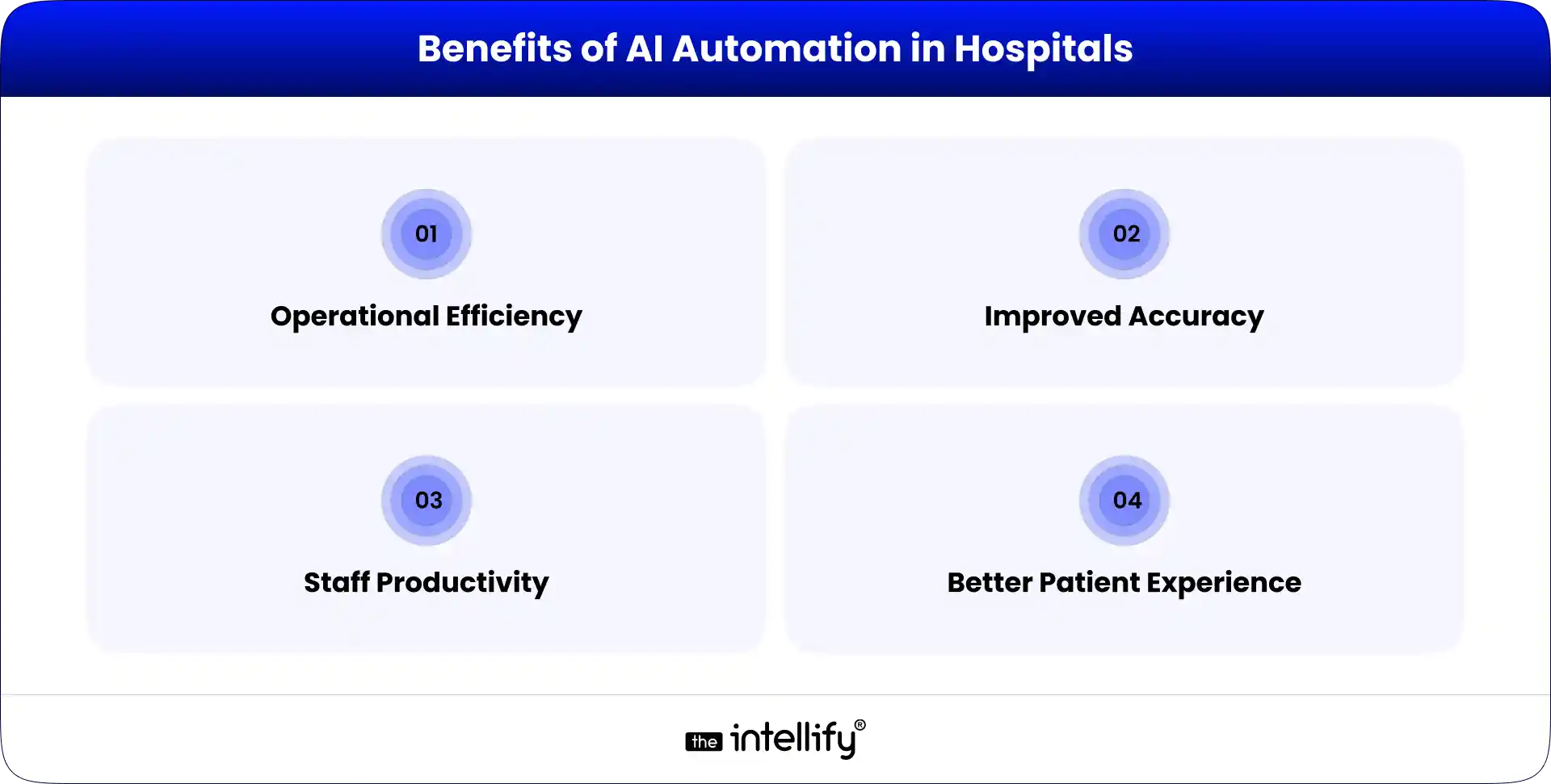
Benefits of AI Automation in Hospitals

AI workflow automation brings practical improvements to daily hospital operations. The impact is visible not in theory, but in how smoothly work moves from one department to another.

Operational Efficiency

Processes move faster because tasks no longer wait for manual follow-ups. Admissions, documentation, lab coordination, and billing flow automatically. Bottlenecks are reduced, and departments stay aligned. This creates a more stable and predictable operational rhythm.

Improved Accuracy

Manual data entry often leads to small but costly errors. AI in hospital workflows helps validate information, flag inconsistencies, and reduce documentation mistakes. Fewer errors mean fewer claim rejections and fewer compliance risks.

Staff Productivity

When repetitive coordination is automated, staff spend less time switching systems and more time focusing on patients. Even saving a few minutes per task makes a difference across an entire shift.

Better Patient Experience

Faster admissions, timely updates, smoother discharge processes, and fewer billing issues improve the overall care journey. Patients may not see the automation, but they feel the efficiency.


Challenges to Consider Before Implementation

While AI for workflow automation offers clear advantages, hospitals must plan carefully before implementation.

  • System Integration Complexity:-Many hospitals operate on multiple legacy platforms. Connecting EHR, billing, lab, and pharmacy systems can require technical effort. Without proper integration, automation cannot function smoothly.
  • Data Privacy Compliance:-Healthcare data is sensitive. AI systems must comply with strict privacy regulations. Security and compliance should be built into the system from the beginning.
  • Staff Adaptation:- New workflows can create hesitation among staff. Clear communication and proper training are essential to ensure teams feel supported rather than disrupted.
  • Cost Considerations:- Initial setup costs can be significant. However, long-term efficiency gains often balance the investment when planned correctly.


Best Practice for Implementing AI Automation in Healthcare

A structured approach increases the success rate of AI workflow automation in hospitals.

1. Start with High-Impact Workflows

Focus on repetitive tasks that slow down patient flow. Automating admissions, discharge coordination, or billing verification often delivers quick results. Avoid automating everything at once.

2. Involve Both IT and Healthcare Teams

Doctors, nurses, administrative staff, and IT teams should collaborate early. Their combined insight ensures automation aligns with real hospital needs.

3. Monitor Workflow Performance

Track time savings, error reduction, and improvements in patient wait times. Measuring performance ensures the system delivers practical value.

4. Scale Gradually

Begin with one department and expand after achieving stable results. Gradual scaling reduces risk and allows adjustments based on feedback.


The Future of Hospital Operations with Intelligent Automation

Hospital operations will continue evolving with intelligent automation. AI in hospital environments will support predictive task management, helping teams anticipate workload changes.

Real-time workflow visibility will allow administrators to monitor operations across departments. Smarter coordination will reduce communication gaps and improve response time.

Automation will become a core operational layer rather than an added feature.


AI workflow automation solutions


Conclusion:

AI workflow automation supports hospital teams by reducing administrative strain. It improves coordination, speeds up processes, and minimizes errors. The goal is not to replace healthcare professionals. It is to help them focus on patient care instead of repetitive system tasks. When workflows become organized and intelligent, healthcare delivery becomes more responsive, accurate, and patient-centered.

As healthcare systems continue evolving, thoughtful adoption of automation will play a key role in shaping more organized and responsive hospitals. For those looking to explore this shift further, The Intellify offers deeper perspectives on how AI workflow automation is being applied in real hospital environments.


Frequently Asked Questions

1. What is AI workflow automation in healthcare?

AI workflow automation in healthcare means using intelligent systems to handle repetitive hospital tasks automatically. It helps manage scheduling, billing, documentation, and approvals without constant manual follow-up. By connecting departments and moving tasks digitally, AI in hospital environments reduces delays and improves operational flow.

2. How does AI workflow automation improve healthcare operations?

AI for workflow automation improves healthcare operations by reducing paperwork, speeding up internal processes, and improving coordination between teams. Tasks move automatically instead of waiting for manual action. This helps hospitals operate more efficiently and allows staff to focus more on patient care.

3. Which hospital processes can be automated using AI?

Common hospital processes that can be automated include patient admissions, discharge coordination, appointment scheduling, billing and claims processing, clinical documentation updates, and lab report routing. AI workflow automation works best in repetitive and time-sensitive workflows.

4. How long does it take to implement automation in a hospital?

Implementation timelines vary based on hospital size and system complexity. Many hospitals begin with one high-impact workflow and expand gradually. A phased approach helps minimize disruption and ensures smoother adoption of AI workflow automation.

6. How does AI integrate with existing hospital systems?

AI integrates with existing hospital systems such as EHR, billing platforms, lab software, and scheduling tools through secure connections. Instead of replacing current systems, AI for workflow automation connects them to create a unified and streamlined operational flow.

7. What are the biggest challenges in automating hospital workflows?

Major challenges include integrating legacy systems, ensuring data accuracy, training staff, and managing change. Hospitals that start small and scale gradually typically see better results when implementing AI in hospital workflows.

View
Case Study