Top AI Trends in Healthcare: Transforming Digital Health in 2026

Summary:
AI trends in healthcare are helping systems become smarter and more data-driven instead of just digital. They support early disease detection, personalized treatments, and remote patient monitoring. This is improving how care is delivered while making hospital operations more efficient. AI also helps reduce the workload on healthcare providers and improves overall patient experience. Despite some challenges, it is becoming an important part of modern, connected healthcare systems.


Why AI is Becoming the Driving Force Behind Digital Health

Healthcare isn’t just going digital anymore; it’s becoming smarter. As technology keeps advancing, artificial intelligence (AI) is reshaping the healthcare landscape in ways we never imagined. With hospitals facing increasing demands to enhance speed, accuracy, and overall patient care, AI is proving to be a crucial ally in bridging the gap between vast amounts of data and actionable decision-making.

In this blog, we’ll delve into AI trends in healthcare that are actively revolutionising digital health. From predictive analytics to personalised treatment plans, these trends are dramatically transforming our approach to healthcare.


Digital Health Transformation in Modern Healthcare Systems

So what does “digital health” really mean today? It goes beyond just having software and applications; it’s about establishing a connected, data-driven healthcare system that genuinely meets patient needs. Modern healthcare systems aren’t just digitizing existing processes; they’re harnessing technology to create a more responsive, integrated, and efficient environment.

Patients today have higher expectations regarding speed, access, and personalized care. They want more than just scheduled visits; they’re looking for tailored health experiences. Digital transformation alone isn’t sufficient adding a robust AI layer is essential to fully leverage the potential of this shift.


The Growing Role of AI in Healthcare Industry

The surge of data in healthcare from electronic health records (EHRs) to wearables and diagnostic tools is monumental. Yet, traditional human-led systems can no longer manage this volume alone. AI isn’t here to replace healthcare professionals; it’s designed to support them. It serves as the backbone of modern healthcare systems, delivering insights and analytics that lead to better patient outcomes.

Today, AI is being used across multiple touchpoints in healthcare, from analyzing patient records to assisting in diagnosis and treatment planning. This shift is helping healthcare professionals rely more on data-backed insights rather than assumptions.


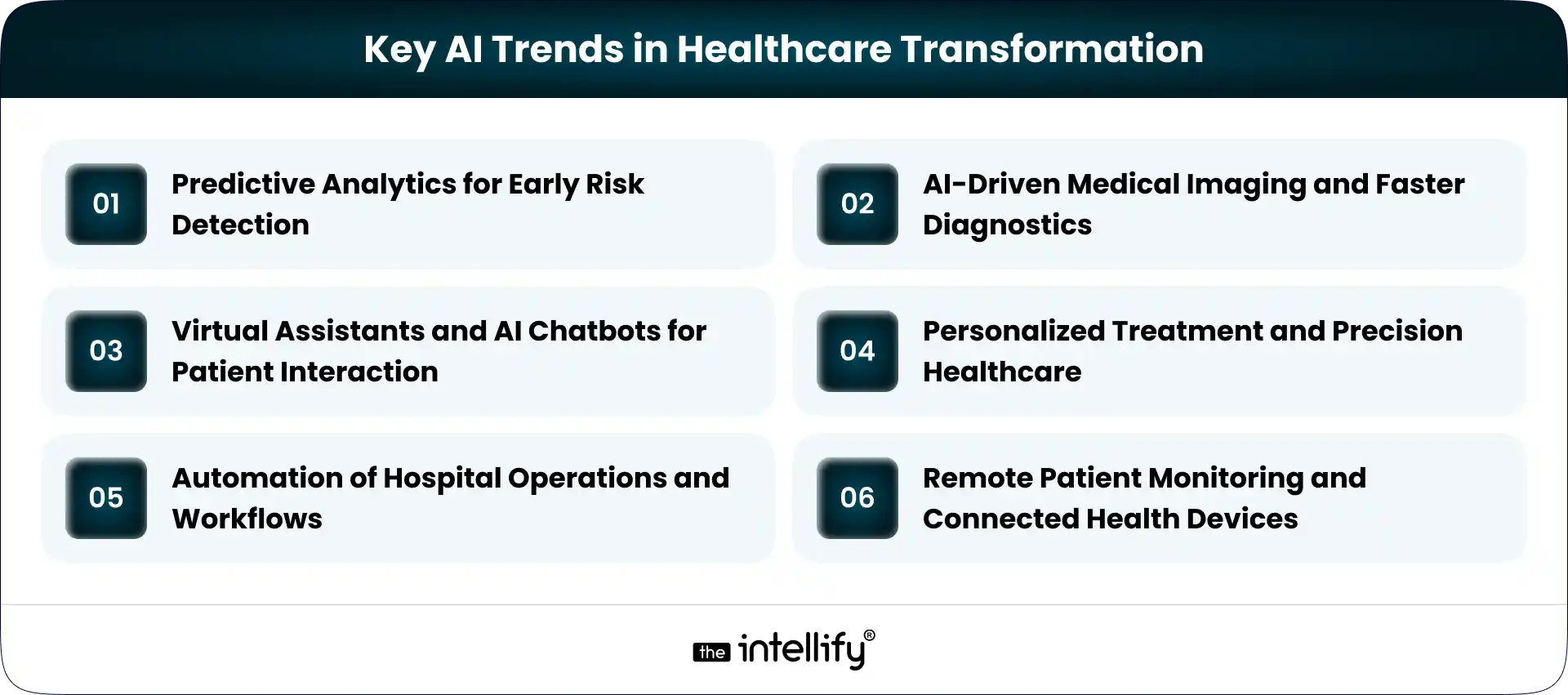
Key AI Trends in Healthcare Driving Digital Health Transformation
Key AI Trends in Healthcare Transformation

Predictive Analytics for Early Risk Detection

AI’s knack for identifying health risks before symptoms escalate is truly transformative. By analyzing patterns in patient data, healthcare providers can implement preventive measures rather than waiting for issues to arise. This proactive approach is significantly beneficial in chronic disease management and helps alleviate the burden on hospitals.

For example, AI can flag early signs of conditions like heart disease or diabetes based on patient history and lifestyle patterns. This helps hospitals reduce emergency cases and manage patient care more effectively.

AI-Driven Medical Imaging and Faster Diagnostics

AI is stepping up medical imaging, enhancing accuracy in scans like X-rays and MRIs while cutting down on diagnosis time and reducing human error. This assists specialists, offering faster insights that empower them to make well-informed decisions.

This not only improves accuracy but also reduces the workload on radiologists, allowing them to focus on complex cases. Faster diagnosis also means quicker treatment decisions for patients.

Virtual Assistants and AI Chatbots for Patient Interaction

AI chatbots are stepping in to boost patient engagement by delivering round-the-clock support without adding to staff workloads. From scheduling appointments to providing basic consultations, these tools enhance access to healthcare services and allow healthcare professionals to concentrate on critical tasks.

This improves patient convenience by reducing waiting times and makes basic healthcare support available anytime. It also reduces the pressure on hospital front desks and support teams.

Personalized Treatment and Precision Healthcare

AI dives into patient history, genetics, and lifestyle to create tailored treatment plans. This results in better outcomes with fewer unnecessary treatments, ushering in a more efficient, patient-centered healthcare experience.

Automation of Hospital Operations and Workflows

Thanks to AI, hospitals can automate mundane manual tasks like paperwork and administrative duties, substantially reducing the administrative load. This allows healthcare staff to dedicate more time to patient care, ultimately boosting the quality of service.

Automation also reduces the chances of manual errors in billing and records, while helping hospitals manage costs more efficiently over time.

Remote Patient Monitoring and Connected Health Devices

Wearables and IoT devices enable constant health monitoring, providing healthcare professionals with real-time alerts and updates about patients’ conditions. This capability leads to better management of long-term patients and those recovering post-treatment.

This is especially helpful for elderly patients and those with chronic conditions who need regular monitoring without frequent hospital visits.
 

AI for Healthcare operations


Real-World Applications of AI in Digital Healthcare

Several real-world applications are illustrating AI’s profound impact on digital healthcare:

  • AI Powered Telehealth Platform: These systems are making remote consultations more efficient and accessible. These platforms allow patients to consult doctors remotely, improving access to care.
  • Smart diagnostic systems used in hospitals: Hospitals are increasingly relying on AI for accurate diagnostic assistance. AI in healthcare helps doctors detect diseases faster and with better accuracy.
  • AI in drug discovery and clinical research: AI can shift through vast datasets, accelerating the drug discovery process. AI speeds up research by analyzing large datasets in less time.
  • Intelligent ICU systems: Utilizing AI, these systems monitor patients and enhance emergency response times. These systems monitor patients continuously and alert staff instantly in emergencies.


Impact of AI on Healthcare Businesses and Providers

Incorporating AI is enabling better resource management while alleviating operational pressures on healthcare providers. This allows them to scale services without significantly increasing costs, maintaining a competitive edge in the ever-evolving digital healthcare landscape. Higher patient satisfaction translates to increased trust and retention rates.

AI also helps healthcare organizations make better strategic decisions based on data insights and supports long-term scalability as patient demand grows.


Challenges in Adopting AI for Digital Health Transformation

While the advantages are evident, various challenges still need addressing:

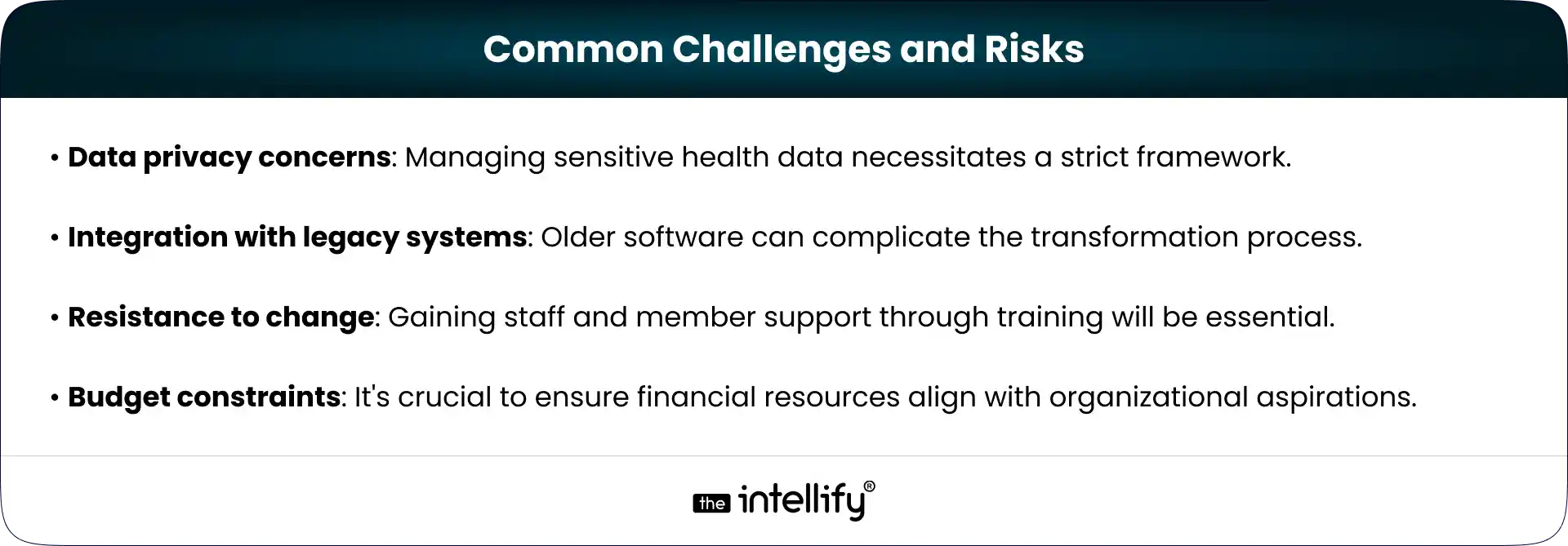
1. Data Privacy and Security Concerns: Safeguarding patient data is critical, and concerns over data security can complicate AI adoption.
2. Integration Issues: Existing legacy systems might clash with new AI solutions, leading to compatibility challenges.
3. High Intial Cost and Technical Complexity: The upfront costs for AI can be quite significant, which can deter some organizations.
4. Resistance to Change: Staff who are accustomed to traditional workflows might resist adopting new processes.


How to Successfully Implement AI in Healthcare Systems

To achieve successful AI integration, consider these strategic steps:

1. Start with clear, Pratical Use Cases: Target specific areas rather than trying to implement everything all at once.
2. Ensure Clean and Accessible Data: High-quality data is vital for the effectiveness of AI.
3. Choose Scalable and Flexible AI Solutions: Invest in technology that can adapt and grow with your organization.
4. Collaborate with Experienced Technology Partners: Working with experts will help ensure a smoother implementation process.
5. Train Teams for Digital Workflows: Proper training ensures that staff can effectively utilize new systems.


What’s Next for AI in Healthcare

We can anticipate an increasing use of predictive and preventive healthcare models that will further connect ecosystems involving hospitals, patients, and devices. As accuracy, speed, and personalization continue to improve, AI will undoubtedly become an integral part of every healthcare system.

As AI continues to evolve, we can expect more advanced and seamless integration into everyday healthcare processes, making it a standard part of modern healthcare systems.

 

AI solutions for Healthcare


Conclusion:

AI in healthcare is not just a supporting player in digital transformation; it’s at the forefront of driving it. Healthcare is evolving to be smarter, faster, and more patient-centric. Organizations that adapt early will help shape the future of healthcare, providing high-quality care while streamlining operations. Embracing AI isn’t just a choice anymore; It’s a necessity for any healthcare provider aiming for success.


Frequently asked questions (FAQs)

1. What makes AI a key driver behind digital health transformation today?

Digital systems alone manage data, but AI turns that data into useful insights. This ability to predict risks and support decisions is what makes AI central to real transformation in healthcare.

2. How is AI improving decision-making in modern healthcare systems?

AI analyzes large volumes of patient data in seconds, helping doctors make faster and more informed decisions. It reduces guesswork and supports better clinical outcomes without replacing human expertise.

3. In what ways are AI-driven healthcare solutions improving operational efficiency?

AI automates routine tasks like scheduling, billing, and data entry, reducing administrative workload. This allows healthcare teams to focus more on patient care while improving system efficiency.

4. How do AI trends support the shift toward personalized healthcare?

AI studies patient history, behavior, and medical data to suggest tailored treatments. This leads to more effective care plans and reduces the chances of unnecessary or ineffective treatments.

5. Why is integrating AI into existing healthcare systems still a challenge?

Many healthcare systems rely on outdated infrastructure, making integration complex. Along with that, concerns around data security and cost slow down adoption despite clear benefits.

6. How can healthcare organizations scale AI adoption without disrupting operations?

They can start with focused use cases like diagnostics or workflow automation and expand gradually. This step-by-step approach reduces risk and helps teams adapt more smoothly.

7. How are AI trends shaping the next phase of digital health transformation?

AI is pushing healthcare toward more connected, predictive, and patient-focused systems. Over time, it will become a standard layer across all digital healthcare solutions

How Digital Transformation in Healthcare Is Shaping the Industry’s Future

Summary:
Digital transformation in healthcare is changing how systems, data, and processes work together. It is helping improve coordination, reduce delays, and make operations more efficient. Healthcare organizations are using connected technologies and data to manage services better and respond faster. While there are challenges, many are moving forward step by step to improve their systems. Overall, it is shaping a more connected and efficient future for the healthcare industry.

Digital transformation in healthcare is changing how systems, data, and processes work together. It is helping improve coordination, reduce delays, and make operations more efficient. Healthcare organizations are using connected technologies and data to manage services better and respond faster. While there are challenges, many are moving forward step by step to improve their systems. Overall, it is shaping a more connected and efficient future for the healthcare industry.

It is not just improving how healthcare works today, but also shaping how systems will function in the coming years. As the industry evolves, digital transformation is becoming a key part of long-term healthcare growth.


How Healthcare Systems Are Becoming More Connected

In the past, healthcare often relied on outdated manual processes and isolated systems. Departments worked in silos, resulting in gaps in coordination and efficiency. As a consequence, managing the ever-growing sea of patient and operational data could feel like an uphill battle, leading to frustration for both providers and patients alike.

Nowadays, the demand for interconnected systems is surging. Healthcare providers are starting to understand that the secret to enhancing service delivery lies in building systems that foster communication and collaboration.

This level of connectivity reduces repeated work and improves the overall flow of services. It also helps different parts of the system work together more smoothly.


Digital Transformation in Healthcare as the New Foundation

Healthcare Digital Transformation

Digital transformation in healthcare isn’t just about switching to digital formats; it represents a fundamental change in how healthcare systems operate. This transformation aims to connect people, processes, and data into a smooth, cohesive flow.

  • Reducing operational gaps: Automation of workflows and system integration helps minimize delays and miscommunications, enabling better care delivery.
  • Modern foundation: This transformation forms the solid groundwork on which today’s healthcare systems are built, enhancing patient experiences and operational efficiencies.


What makes Digital Transformation Essential in Healthcare

The rapid pace of change in healthcare brings several challenges:

  • Managing Data: The amount of patient and operational data continues to grow. Digital transformation enables healthcare organizations to manage and harness this data for improved decision-making.
  • Faster Coordination: As healthcare teams expand, quick coordination across various systems becomes crucial. Digital tools offer real-time data sharing, ensuring everyone stays aligned.
  • Meeting Expectations: Today’s patients expect smooth, accessible services. Digital transformation equips healthcare providers to meet these rising expectations.

It also helps bring more consistency in how services are delivered across different systems. As operations grow, managing complexity without digital support becomes difficult.


Where Digital Healthcare Transformation Is Creating Real Impact

Digital healthcare transformation is delivering tangible benefits across the industry:

  • Improved coordination: Departments and teams can now communicate effectively, fostering trust and collaboration.
  • Faster Communication: Instant messaging systems and data-sharing platforms cut down on waiting times and speed up decision-making.
  • Efficient Workflows: Routine processes are now more structured, giving healthcare professionals more time to focus on what matters patient care.

It also improves visibility across systems, helping teams make quicker and more informed decisions.


Technologies Behind Digital Transformation in Healthcare Solutions

Several cutting-edge technologies drive the digital transformation in healthcare solutions:

  • AI: This technology speeds up analysis and supports quicker decision-making.
  • Cloud Systems: These enable secure access to and sharing of data.
  • Connected Devices: They allow for continuous monitoring of patient health.
  • Data Platforms: These help organize and simplify vast amounts of information.
  • Integration Tools: They link multiple systems, facilitating smooth operations.

Together, these technologies form the backbone of a transformed healthcare landscape, paving the way for smarter, more efficient practices.


Digital transformation Solutions


How healthcare Operations Are Being Reshaped Internally

Internally, healthcare operations are prioritizing efficiency:

  • Reduction in manual work: Automation takes over routine tasks, freeing staff to focus on vital issues.
  • Faster process Handling: Fewer bottlenecks in workflows enable healthcare facilities to quickly respond to patient needs.
  • Better Use of Resources: By optimizing staff time and hospital resources, organizations can provide improved care.
  • Improved Accuracy: Less manual intervention means fewer mistakes, boosting overall service quality.

This allows healthcare organizations to respond faster to changing needs and improve overall service delivery.


The Expanding Role of Data in Healthcare

Gone are the days when data was merely stored away. Now, it plays a vital role in everyday operations:

  • Real Time Access: Quick access to data enhances decision-making and planning processes.
  • Better Resource Management: Data analytics empower organizations to allocate staff and materials more effectively.
  • Connected Systems: A solid data strategy fosters informed systems that can dynamically respond to patient needs.

Over time, this is helping healthcare systems move toward more planned and proactive decision-making.


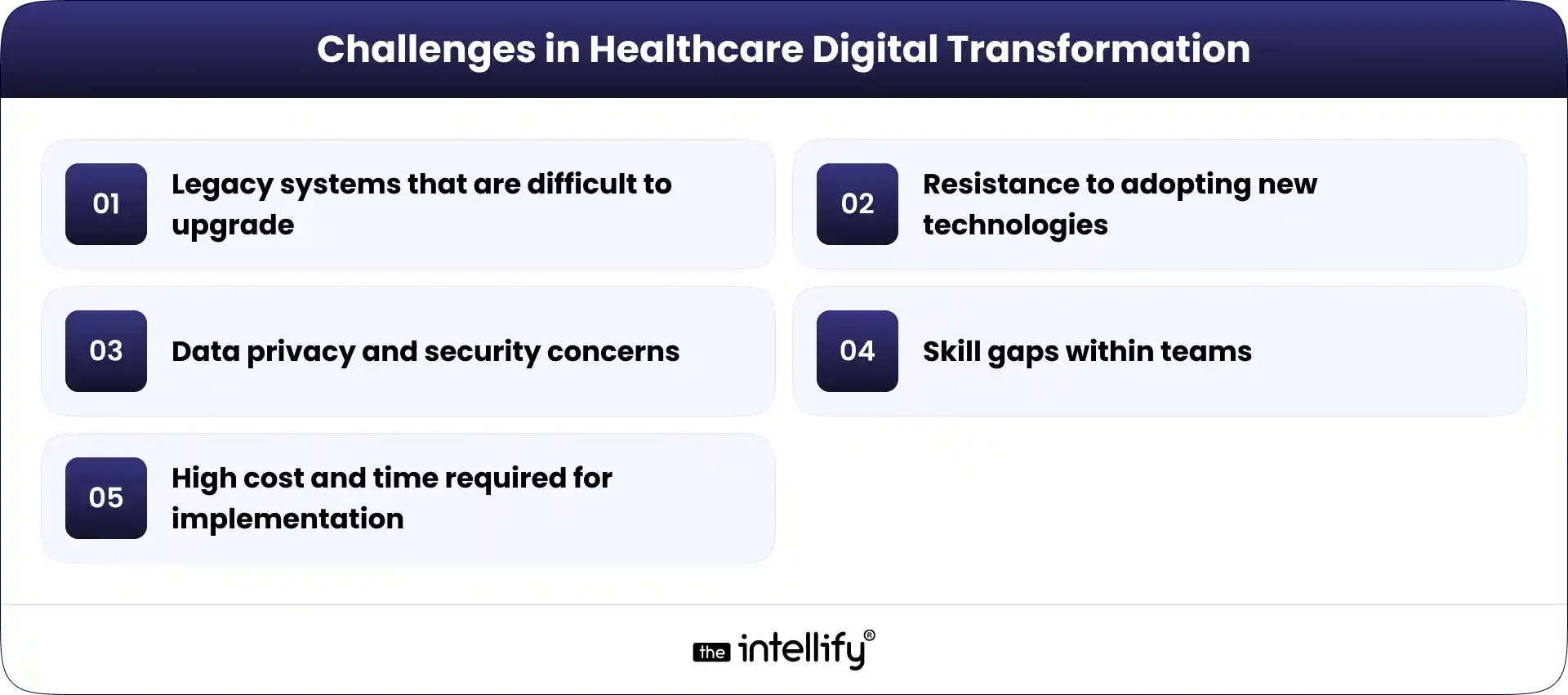
Challenges in Adopting Digital Transformation in Healthcare

Challenges in Healthcare Digital Transformation

Yet, the path to adopting digital transformation isn’t without its hurdles:

  • Legacy Systems: Many organizations struggle with outdated systems that aren’t easy to upgrade.
  • Privacy and Security Concerns: Safeguarding sensitive patient data is crucial and can slow technology adoption.
  • Resistance to Change: Some staff may be hesitant to embrace new technologies, which can stall progress.
  • Skill Gaps: Existing teams might lack the necessary skills for implementation, requiring additional training.
  • Implementation Costs: Upgrading systems can be costly and time-consuming, making many organizations hesitant to proceed.

These challenges can slow progress, but with the right approach, they can be managed over time.


How Healthcare Organizations Are Improving Their Systems

Healthcare organizations are cautiously progressing with strategies to enhance their frameworks:

  • Gradual adoption: Instead of a complete overhaul, many are choosing incremental improvements that minimize disruption.
  • Training Initiatives: Investing in staff training ensures teams are ready to tackle new systems effectively.
  • Scalable Solutions: Organizations focus on flexible technology that can adapt as their needs grow.
  • Partnerships with Tech Providers: Teaming up with experienced technology providers can lead to better outcomes.
  • Long Term Focus: Emphasizing ongoing improvements and results is crucial for sustainable transformation.

The focus is on making systems more stable, reliable, and easier to manage in the long run.


Real-World Applications in Healthcare Services

Digital transformation in healthcare services is already showing its worth in various areas:

  • Online Consultations: Telehealth is enhancing patient access to healthcare services.
  • Digital Health Records: Streamlined management of information reduces paperwork and makes care more efficient.
  • Remote Monitoring: Wearable tech supports continuous patient care, boosting health outcomes.
  • Automation: Routine tasks, from scheduling to billing, are increasingly automated to cut delays.
  • Better Coordination: Enhanced communication tools ensure smooth service across all touchpoints.

These applications are already changing how healthcare services are delivered and experienced.


How Healthcare Systems Are Changing for the Future

The future of healthcare is on a transformative path:

Connected Systems: Improved integration offers a more holistic view of patient care.

Faster Service Delivery: Automation and streamlined processes ensure prompt care.

Increased Automation: Smart tools and technologies are set to reshape daily operations further.

Improved Coordination: A more connected infrastructure will facilitate stronger relationships among providers.

Healthcare systems are expected to become more proactive rather than reactive in handling needs.


What Healthcare Organizations Need to Focus on Next

Looking ahead, healthcare organizations should concentrate on:

Scalability: Designing systems that can adapt to future challenges.

Digital Strategy: Making digital transformation a cornerstone of long-term planning.

Continuous Improvement: Prioritizing process refinement over merely implementing new tools.

Alignment of Teams: Ensuring that people, processes, and technology work in harmony.

Staying Adaptable: Keeping an open mind toward new technologies and changing patient expectations.

The goal is to build systems that can support continuous change and future growth.


Healthcare digital transformation solutions


Conclusion:

Digital transformation is no longer a choice; it’s central to how the healthcare industry operates. As organizations embrace these changes, they’re paving the way for more connected, efficient systems that ultimately benefit everyone from healthcare providers to patients.

The journey is just beginning, and healthcare organizations need to remain flexible and proactive to stay relevant in an ever-evolving landscape. By effectively implementing these changes, the future of healthcare looks bright, buoyed by innovation and progress.


Frequently Asked Questions

1. Why do traditional healthcare systems face limitations?

They depend on manual work and disconnected systems, which slows down processes. This makes it harder to manage data, coordinate teams, and deliver services efficiently.

2. How do connected systems improve healthcare services?

They allow information to move smoothly between departments and teams. This improves coordination, reduces errors, and helps deliver services faster.

3.. What changes do healthcare teams notice after going digital?

Teams experience faster workflows and less dependency on paperwork. They also see better accuracy and smoother coordination across different departments.

4. What are the common challenges in digital transformation for healthcare?

Many organizations struggle with outdated systems and data security concerns. They also need time and training to help teams adapt to new ways of working.

5. What should healthcare organizations focus on moving forward?

They should focus on building flexible systems that can adapt over time. Continuous improvement in processes and team readiness is also important for long-term success.

AI in Healthcare Administration: Streamlining Hospital Operations

Summary
The growing complexity of healthcare administration is driving the need for smarter, more efficient solutions. Automation technologies are helping streamline key processes such as scheduling, billing, and data management, reducing manual workload and improving accuracy. This enables faster operations, better coordination, and enhanced patient experiences. As adoption increases, healthcare organizations are moving toward more efficient, scalable, and patient-focused administrative systems.

In today’s fast-paced healthcare landscape, administrative tasks often take priority over direct patient care. With more patients seeking services and regulations tightening, tasks like scheduling, billing, and record management have become increasingly complex and time-consuming. That’s where AI in healthcare administration steps in. This blog will explore how AI is reshaping hospital operations, giving staff and patients a much-needed breather.


The Growing Administrative Burden in Healthcare

It’s striking how much time healthcare staff spend buried under paperwork instead of attending to patients. From registering patients to managing billing and navigating compliance requirements, these tasks are essential but can feel overwhelming.

  • Patient registration often means gathering and verifying a mountain of information.
  • Insurance processing can get tricky, frequently leading to frustrating delays.
  • Communication between departments is vital but can feel Herculean, especially as patient numbers swell.

As regulations tighten and patient volumes rise, hospitals find themselves grappling with an expanding list of administrative responsibilities. Manual processes can lead to delays, costly errors, and increased workloads for staff. This impacts both productivity and the bottom line.

To tackle these challenges, more healthcare organizations are embracing AI in healthcare administration to streamline operations and ease the burden on their teams.


Why Traditional Administrative Processes Are No Longer Sustainable

The issues facing healthcare administration often come from sticking to outdated models that can’t keep up with modern demands. Some notable challenges include:

  • Mounting patient demand combined with a shortage of administrative staff.
  • Frequent errors that crop up from repetitive manual tasks.
  • Delays in approvals and documentation that frustrate both staff and patients.
  • Staff burnout stemming from an unsustainable workload filled with non-clinical tasks.

In this context, it’s pretty clear that old-school administrative methods just aren’t cutting it anymore. A smarter, more efficient approach is essential.


What AI in Healthcare Administration Means Today

AI is emerging as a game-changer for healthcare administration. It’s not about replacing staff but enhancing their skills. Key features of AI in this area include:

  • Rapid processing of large volumes of data while minimizing errors.
  • Learning from patterns to help inform decision-making.
  • Seamless integration with the existing hospital system to improve workflow.
  • Enhancing efficiency, accuracy, and speed at every turn.

Thanks to these capabilities, AI can significantly declutter administrative tasks, letting healthcare professionals shift their focus back to what matters most: patient care.


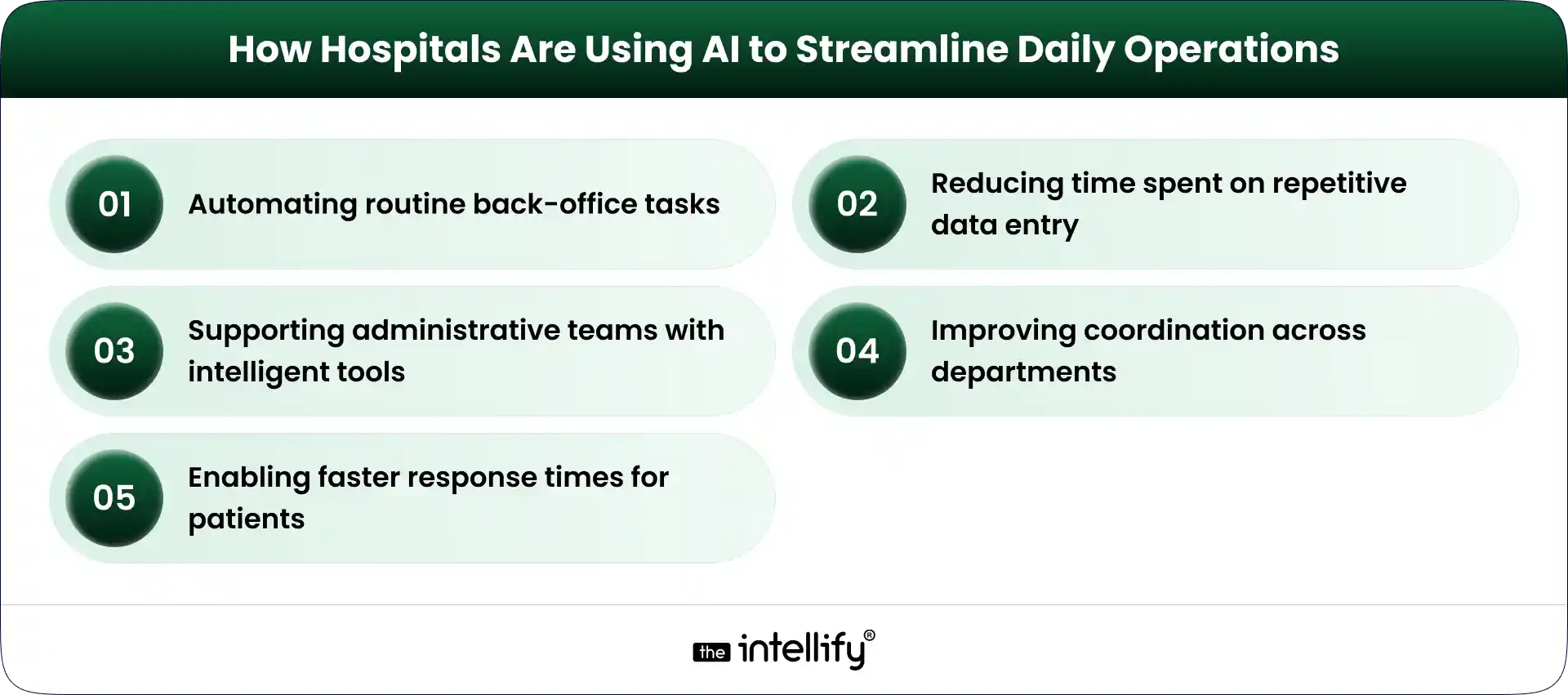
How Hospitals Are Using AI to Streamline Daily Operations

AI for Hospitals Daily Operations

  • Automating routine back-office tasks to reduce manual workload and free up staff time for higher-value activities
  • Reducing time spent on repetitive data entry by minimizing paperwork and improving data accuracy across systems
  • Supporting administrative teams with intelligent tools that simplify workflow management, task prioritization, and decision-making
  • Improving coordination across departments by enabling seamless communication and better alignment between teams

Enabling faster response times for patients and staff, from appointment scheduling to handling queries and internal processes
These improvements help hospitals operate more efficiently while creating a smoother, faster, and more patient-focused administrative experience.


Key Use Cases of AI in Healthcare Administration

Several specific applications demonstrate how AI in healthcare can be effectively deployed in healthcare administration:

Patient Scheduling and Appointment Management

  • Automated booking and rescheduling:- minimize missed appointments and optimize staff availability.
  • AI quickly allocates time slots based on various factors, leading to happier patients.

Billing, Claims, and Insurance Processing

  • Faster verification and claims handling speed up the revenue cycle.
  • Reduced paperwork errors contribute to better financial performance.

Medical Records Management

  •  AI assists in organizing and retrieving patient information swiftly.
  •  It cuts down on duplicate or incomplete records while ensuring secure data handling.

Communication and Support Services

  • Chatbots and virtual assistants offer quick answers to common patient inquiries.
  • Timely reminders for appointments and follow-ups enhance patient care.

Compliance and Reporting

  • AI supports monitoring documentation needs and auditing tasks.
  • It helps reduce the risk of non-compliance, ensuring adherence to regulations.


Automation in healthcare operations


Benefits for Hospitals, Staff, and Patients

Embracing AI in healthcare administration yields a slew of benefits:

  • Reduced administrative workload: for healthcare professionals, allowing them to focus less on paperwork and more on meaningful tasks
  • Faster processes and shorter waiting times,: leading to quicker service delivery and improved patient satisfaction
  • Improved operational efficiency: through streamlined workflows and fewer manual errors across administrative functions
  • More time for staff to focus on patient care: especially in areas that require human judgment, empathy, and attention
  • Better overall experience for patients: with smoother interactions, timely updates, and more responsive healthcare services.

These benefits collectively help create a more efficient, patient-centric healthcare system while easing the burden on medical and administrative staff.


Challenges and Considerations When Implementing AI

Challenges While Implementing AI in Healthcare

While the perks of AI are numerous, deploying it isn’t without its hurdles:

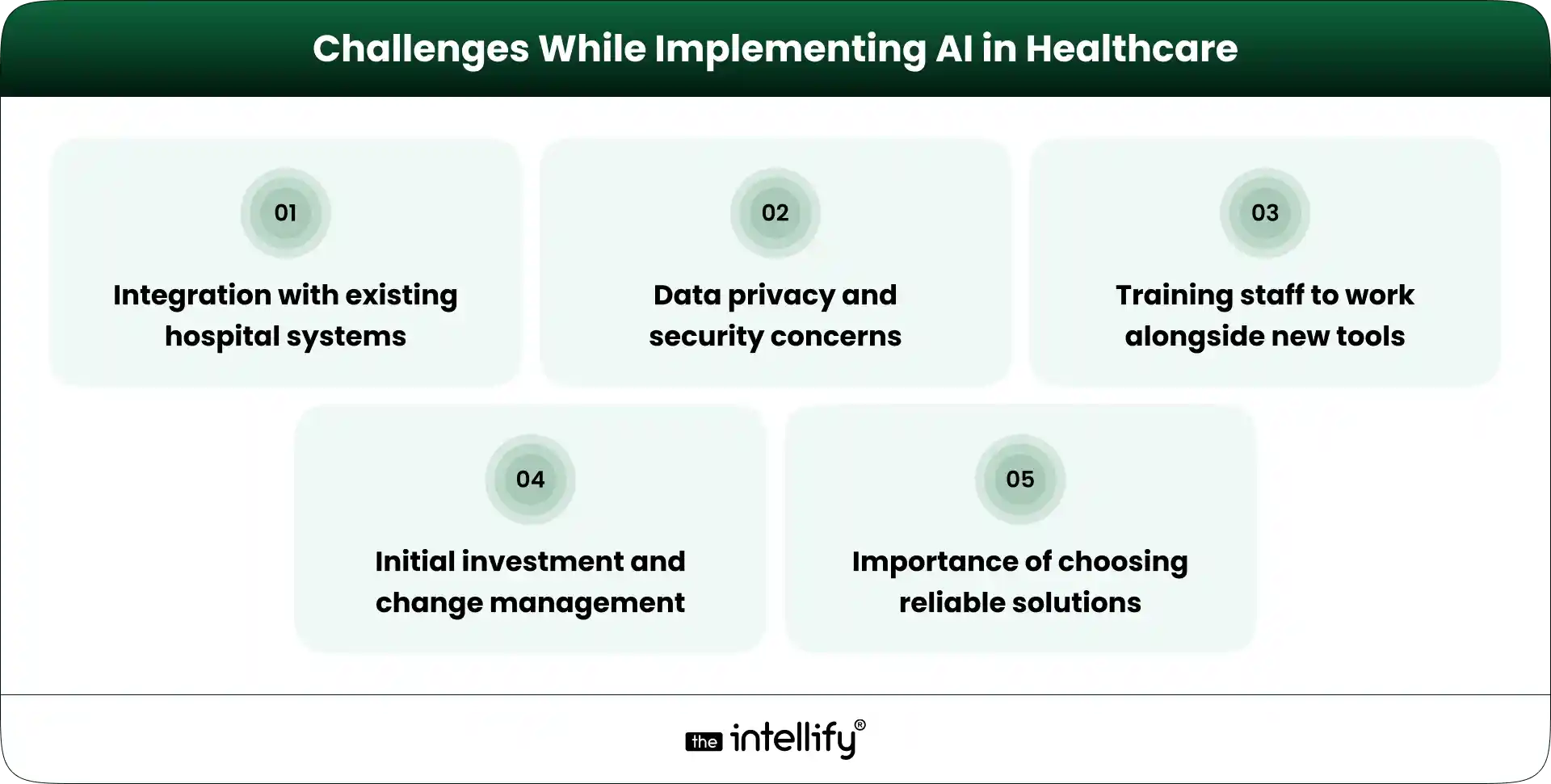
  • Integration with existing hospital systems can be complex, especially when dealing with legacy infrastructure and multiple data sources
  • Data privacy and security concerns must be addressed carefully to ensure compliance with healthcare regulations and protect sensitive patient information
  • Training staff to work alongside new tools is essential to ensure smooth adoption and maximize the value of AI solutions
  • Initial investment and change management require thoughtful planning to minimize disruption and ensure a seamless transition
  • Importance of choosing practical, reliable solutions that align with real operational needs rather than overly complex or unnecessary implementations

Addressing these challenges early helps healthcare organizations adopt AI more effectively and achieve long-term success.


How AI Helps Healthcare Staff, Not Replaces Them

The role of AI is to enhance, not replace healthcare staff. Here’s how:

  • Administrative work still requires judgment and empathy, which only healthcare professionals can provide
  • AI handles routine tasks, while humans manage complex situations, ensuring better decision-making and patient care
  • Collaboration between technology and staff enables more efficient workflows and improved outcomes
  • Building trust in automated systems is essential for smooth adoption and long-term success
  • Importance of oversight and accountability to ensure AI systems are used responsibly and accurately

AI works best as a support system empowering healthcare staff rather than replacing the human touch that patient care depends on.


What the Future of Healthcare Administration Looks Like

As we look ahead, it’s clear that AI will only become more entrenched in healthcare administration. We can expect to see:

  • Increasing adoption of intelligent automation to handle repetitive tasks and streamline administrative workflows at scale
  • More connected hospital systems enabling seamless data flow, better coordination, and improved operational efficiency
  • Predictive insights for planning and resource management, helping hospitals make smarter, data-driven decisions
  • Shift toward proactive rather than reactive administration, allowing issues to be identified and addressed before they escalate
  • Continued focus on efficiency and patient-centered operations, ensuring smoother experiences for both staff and patients.

The future of healthcare administration will be driven by smarter systems that enhance efficiency while keeping patient care at the center of every decision.


How Organizations Can Start Adopting AI in Administration

For organizations keen to integrate AI, consider these steps:

  • Identifying high-impact areas for automation where AI can quickly reduce manual workload, eliminate bottlenecks, and deliver measurable efficiency gains
  • Starting with small, practical use cases to test effectiveness, minimize risk, and demonstrate early success before scaling further
  • Evaluating technology partners carefully by considering their healthcare expertise, integration capabilities, and long-term scalability
  • Ensuring staff involvement and training to encourage adoption, improve usability, and help teams confidently work alongside new tools
  • Measuring outcomes and scaling gradually by tracking performance metrics, refining processes, and expanding AI implementation based on real results.

A phased, well-planned approach makes it easier for organizations to adopt AI successfully while ensuring long-term operational and clinical value.


Hospital operations with AI


Conclusion:

AI is clearly transforming the realm of healthcare administration. By boosting operational efficiency and enriching the patient experience, we can make significant strides toward sustainable healthcare systems. Thoughtful adoption of AI is crucial; rushing the implementation could stymie progress.

As we move forward, the importance of human oversight in managing AI systems can’t be overstated. Striking the right balance will enable healthcare organizations to flourish in the face of modern challenges. If you’re ready to unlock the potential of AI in healthcare administration, let us at The Intellify show you how to implement effective solutions for your organization.


Frequently Asked Questions (FAQs)

1. How is AI actually used in healthcare administration today?

AI is mainly used to handle routine tasks like appointment scheduling, billing checks, document processing, and patient communication. It helps staff complete work faster and reduces manual effort without changing clinical care.

2. Can AI reduce the paperwork burden in hospitals?

Yes. AI tools can automatically organize records, fill forms, and process documents, which significantly cuts down time spent on paperwork and reduces errors caused by manual entry.

3. Does AI in administration improve patient experience too?

Indirectly, yes. Faster scheduling, shorter waiting times, accurate billing, and quicker responses to queries all make the patient journey smoother, even though AI works behind the scenes.

4. Is AI replacing administrative staff in hospitals?

No. In most cases, AI supports staff by handling repetitive tasks, allowing them to focus on coordination, problem-solving, and patient interaction that require human judgment.

5. What administrative tasks benefit the most from AI automation?

Tasks that follow clear patterns benefit the most, such as appointment management, insurance verification, claims processing, reminders, reporting, and data entry.

6. Is AI in healthcare administration only for large hospitals?

Not anymore. Many modern solutions are scalable, meaning clinics and mid-sized hospitals can also adopt AI tools without major infrastructure changes.

7. How does AI help reduce operational costs in hospitals?

By automating routine work, hospitals need fewer manual hours for repetitive tasks, reduce errors that lead to financial losses, and improve overall efficiency, all of which lower operational expenses over time.

Digital Transformation in Healthcare: Strategy for Membership Platforms

Summary:
Digital transformation is helping healthcare organizations build modern membership platforms that improve patient experience and operational efficiency. This blog explains how technologies like telehealth, AI, secure patient portals, and subscription billing systems support the growth of membership-based healthcare models. It also explores key platform components, implementation strategies, industry challenges, and future trends. With the right digital approach, healthcare providers can create scalable platforms that deliver continuous care and strengthen long-term patient relationships.

Why Membership-Based Healthcare Is Rapidly Evolving

The healthcare landscape is experiencing significant changes. We’re seeing a leap from traditional care models to subscription and membership platforms, fundamentally reshaping how services are delivered and consumed. With patients increasingly demanding convenience, transparency, and digital access, healthcare providers are under pressure to boost operational efficiency and retain their clientele. As we gear up for 2026, this year stands as a pivotal moment for modernizing healthcare platforms, making it essential for decision-makers to craft effective strategies.

In this guide, we’ll delve into what digital transformation means for healthcare membership platforms and how you can navigate this shifting landscape to enhance patient outcomes and drive business performance.


What Digital Transformation in Healthcare Means for Membership Platforms

Digital transformation in healthcare goes beyond simple digitization; it’s about creating connected experiences that weave together clinical, administrative, and customer functions. This integration paves the way for smoother patient journeys, allowing for preventive, continuous, and personalized care models.

Aligning technology with your business goals and focusing on member value is crucial. When organizations do this, they’re better equipped to meet the needs of their subscribers and foster a more engaged and loyal patient base.


Key Drivers Accelerating Digital Transformation in Healthcare

Several key factors are pushing this transformation in healthcare:

  •  Demand for Virtual Care: More patients prefer remote access to healthcare services, prompting platforms to expand their telehealth options.
  • Value-Based Care models: As these models gain popularity, healthcare organizations must adopt data-driven approaches to improve care quality and patient outcomes.
  • Competitive pressure: Providers face growing competition from digital first health solutions that cater to modern patient needs more effectively.
  • Regulatory Requirements: Compliance mandates are driving the need for robust systems focusing on data management and security.
  • Workforce Shortages: The rising demand for healthcare services often surpasses available resources, making automation critical.


Core Components of a Modern Healthcare Membership Platform

A contemporary healthcare membership platform should feature several essential components:

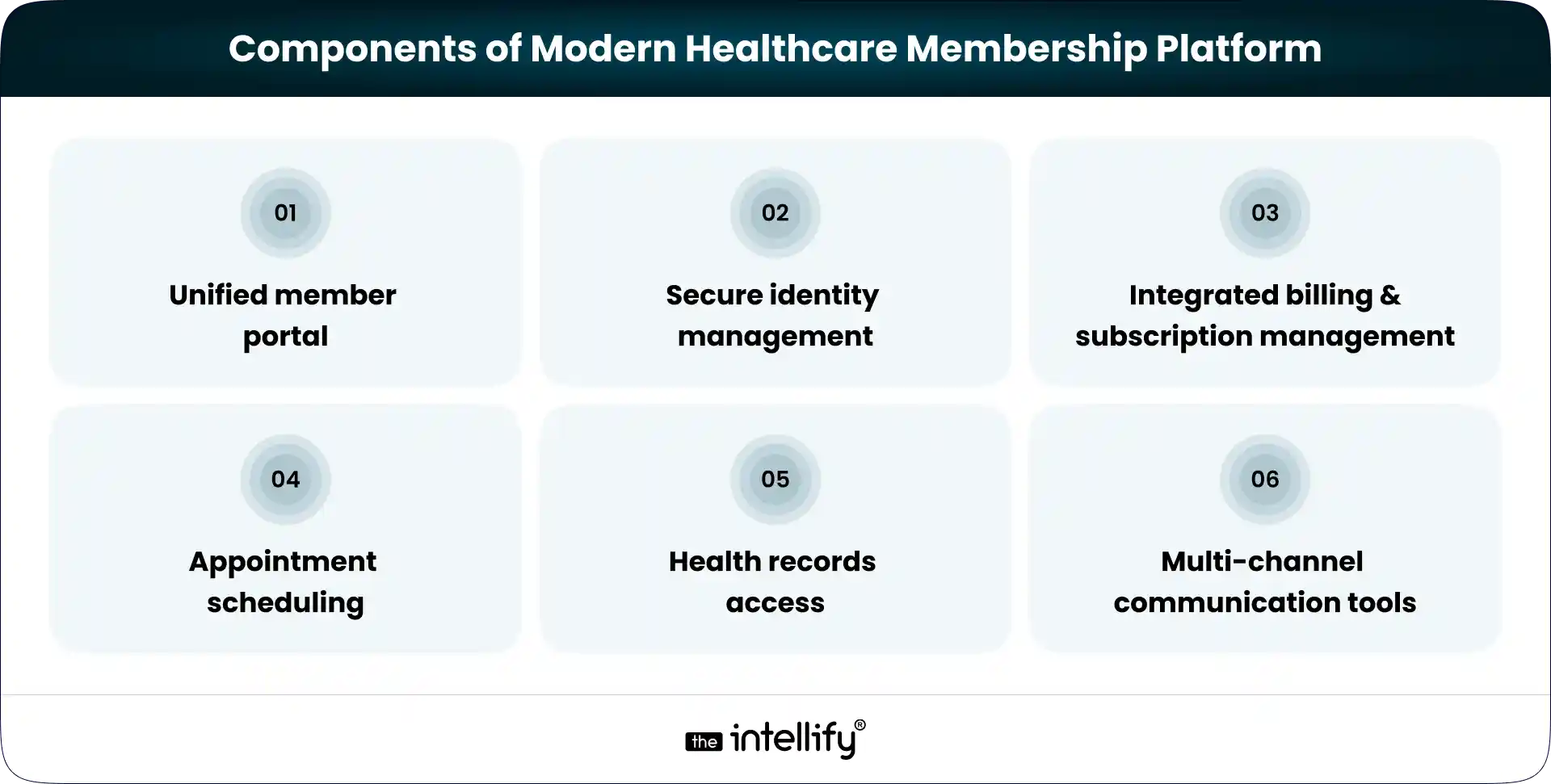
1. Unified member portal:- A central hub for services, plans, and communication can significantly enhance the user experience.

2. Secure identity management:- Safeguarding member information through secure access protocols is absolutely essential.

3. Integrated billing and subscription management:- Streamlined payment processes boost operational efficiency.

4. Appointment scheduling:- It should be easy for users to select telehealth services or in-person visits.

5. Health records access:- Allowing members to view and manage their health records fosters a sense of ownership.

6. Multi-channel communication tools:- Incorporating chat, messaging, and notifications keeps members engaged and informed.


Build Healthcare Membership Platform


Building a Practical Digital Transformation Strategy for Healthcare Organizations

To thrive in this transition, organizations should follow these key steps:

  • Assess current platform maturity: Identify any technology or workflow gaps that might be holding the organization back.
  • Define clear objectives: Understand what success looks like for you, improved patient satisfaction, or heightened engagement levels.
  • Prioritize improvements: Focus on high-impact changes that can deliver quick wins.
  • Secure leadership buy-in: Getting alignment across departments promotes unified efforts during this transition.
  • Plan budget and timelines: Having realistic financial and operational plans helps pave the way for smoother implementation.


Digital Healthcare Solutions That Deliver Real Member Value

The best digital healthcare solutions genuinely add value for members, including:
  • Mobile-first access: Make sure services are available on mobile devices, allowing patients to engage with healthcare wherever they are.
  • AI-supported tools: Such tools can assist in triaging symptoms and streamlining care.
  • Wellness tracking integration: Real-time health monitoring empowers patients to take charge of their wellness.
  • Simplified payment processes: Minimize the friction often encountered during claims processes.


Step-by-Step Implementation Plan

To implement a digital transformation strategy effectively, consider these phases:

Phase 1: Discovery: Engage stakeholders to gather requirements and align on clear objectives.

Phase 2: Technology selection: Select technologies that will work in harmony to support your goals.

Phase 3: Pilot programs: Begin with controlled rollouts to test systems and processes.

Phase 4: Staff training: Equip your team with the skills they’ll need for a successful transition.

Phase 5: Full deployment: Launch the platform in full and concentrate on ongoing optimization.

Navigating change management throughout this journey is vital.


Use Cases of Digital Transformation for Healthcare Membership Models

1. Concierge care:- Subscription based models that provide comprehensive care.

2. Corporate wellness programs:- Employee health initiatives that offer preventive care while lowering healthcare costs.

3. Chronic disease management:-  Memberships dedicated to managing long-term health conditions.

4. Integrated care networks:- Bundled services that enhance complementary care options.

5. Community based initiatives:- Programs focusing on public health and wellness.


Common Challenges and Risks


Measuring Success: KPIs That Actually Matter

To understand whether digital transformation is truly working, healthcare organizations need to track a few meaningful performance indicators rather than just surface level metrics. Some of the most useful KPIs include:

Member acquisition and retention: how effectively the platform attracts new members and keeps existing ones engaged over time.

Engagement and platform usage: how frequently members use features like appointments, messaging, or health records.

Operational efficiency: improvements in workflows, response times, and overall service delivery.

Reduction in administrative workload: the extent to which automation reduces manual tasks for staff.

Patient satisfaction and experience: feedback, ratings, and overall member experience with the platform.

Subscription revenue growth: whether membership programs are generating stable and increasing recurring revenue.


Future Trends Shaping Healthcare Membership Platforms in 2026 & Beyond

Healthcare membership platforms will keep evolving as patient expectations, technology, and care delivery models change. A few trends are already shaping what the next phase may look like.

Expansion of hybrid care models

Many providers are blending virtual consultations with in person visits. This hybrid approach gives patients flexibility while still allowing clinics to handle physical care when it’s needed.

Greater use of predictive analytics and AI

Healthcare platforms are starting to rely more on AI and predictive analytics to identify potential health risks early and support better clinical decisions.

Interoperability across healthcare ecosystems

Platforms will increasingly need to connect with labs, pharmacies, insurers, and other systems so patient information can move smoothly across the care journey.

Personalized preventive care programs

Membership models are gradually shifting toward prevention. Using patient data, providers can design wellness programs tailored to individual health needs.

Integration with wearables and home devices

Wearables and remote monitoring tools are becoming part of everyday healthcare. These devices help providers track health signals continuously and respond earlier.

Shift toward outcome-focused services

Rather than focusing only on the number of visits, healthcare organizations are paying more attention to long-term health outcomes and patient experience.


Healthcare digital transformation Solutions


Conclusion:

Digital transformation in healthcare is essential for organizations aiming to stand out in a competitive landscape. By implementing effective membership platforms, healthcare providers can enhance patient care and improve operational efficiency. As expectations continue to evolve, many organizations are also working with experienced digital teams like The Intellify to modernize systems in a way that supports both clinical and operational needs without disrupting existing services.

The strategic steps you take now will build a robust foundation for a patient centered future in healthcare. Over time, this approach helps build trust, improve outcomes, and ensure healthcare delivery remains sustainable in an increasingly digital world.


Frequently Asked Questions (FAQs)

1) Why are subscription and membership models becoming popular in healthcare?

Many patients want predictable costs, faster access to care, and ongoing support instead of one-time visits. Membership models offer scheduled checkups, preventive care, virtual consultations, and wellness services under a single plan, which feels more convenient and reassuring.

2) What are the first steps to start digital transformation for a healthcare membership platform?

Most organizations begin by evaluating their current systems, identifying gaps in patient experience, and defining clear goals. Instead of replacing everything at once, successful teams prioritize high-impact improvements like online scheduling, secure communication, and digital payments.

3) How can digital tools improve member retention in healthcare programs?

Digital tools make services easier to use and more responsive. Features like reminders, personalized health tips, quick support chat, and smooth renewals help members stay engaged. When people feel supported between visits, they are far more likely to continue their subscription.

4) Is digital transformation necessary for existing healthcare membership programs, or only for new ones?

Digital transformation benefits both. Established programs can modernize outdated systems, improve member experience, and reduce operational costs, while new programs can launch with scalable digital foundations from the start.

5) How can providers ensure patient data stays secure during transformation?

Security must be built into every stage, from system design to daily operations. This includes encryption, strict access controls, compliance with regulations, regular audits, and staff training. Trust is critical in healthcare, so privacy protection cannot be an afterthought.

6) What common mistakes should organizations avoid when modernizing their platforms?

A frequent mistake is focusing only on technology while ignoring user experience. Another is trying to implement too many changes at once. Successful transformations balance innovation with simplicity and involve both staff and patients in the process.

View
Case Study