Summary:
Healthcare organizations are increasingly using AI agents to automate administrative workflows that slow down operations and increase staff workload. From appointment scheduling and insurance verification to claims processing, patient communication, and care coordination, AI agents help streamline healthcare operations, improve efficiency, reduce costs, and support better patient experiences. This guide explores seven key workflows healthcare providers can automate, along with ROI considerations and implementation best practices.
Healthcare organizations are dealing with more operational pressure than ever before. Administrative workloads keep growing. Staffing shortages remain a challenge. Patients expect faster service, better communication, and seamless care experiences.
Behind every patient interaction is a long list of operational tasks. Scheduling appointments, verifying insurance, processing claims, coordinating care, and managing follow-ups all require time and resources.
Many healthcare providers have already adopted automation tools, but traditional systems often struggle with complex workflows that require decision-making and adaptability.
This is where AI agents are making a difference. Unlike basic automation, AI agents can understand requests, manage workflows, communicate with patients and staff, and take action across multiple systems. They help healthcare organizations reduce repetitive work while improving efficiency and patient satisfaction.
What Are AI Agents in Healthcare Operations?
AI agents are intelligent software systems designed to complete tasks, make workflow decisions, and coordinate actions with minimal human involvement. AI in healthcare operations acts like digital team members that help manage administrative and operational processes.
Many people assume AI agents are simply chatbots. They are not. A chatbot typically answers questions based on predefined rules. Traditional automation follows fixed workflows and performs actions only when specific conditions are met.
AI agents go beyond that. They can understand context, gather information, trigger actions, communicate with multiple parties, and adapt when situations change.
For example, an AI agent can:
- Schedule a patient appointment
- Verify insurance eligibility
- Send reminders
- Route requests to the correct department
- Follow up automatically
- Update operational systems
All within a single workflow. As AI in healthcare operations continues to evolve, more hospitals, clinics, and healthcare enterprises are using AI agents to streamline day-to-day operations and reduce administrative burden.
The Busywork Behind Healthcare Operations
Healthcare teams spend a significant portion of their day on administrative work. While these tasks are essential, they often slow down operations and take time away from patient-focused activities.
Common operational challenges include:
- Appointment scheduling delays
- Insurance verification bottlenecks
- Claims processing errors
- Patient communication gaps
- Documentation backlogs
- Workforce coordination issues
- Internal workflow inefficiencies
Many healthcare workflows still rely heavily on manual processes. Staff frequently switch between systems, make phone calls, send emails, and update records by hand. This creates delays, increases the risk of errors, and contributes to employee burnout.
Traditional automation tools help with simple repetitive tasks, but healthcare workflows rarely follow a predictable path.
Patients reschedule appointments. Insurance information changes. Prior authorizations require additional documentation. These real-world situations often require more flexibility than rule-based automation can provide. AI automation in healthcare helps solve this problem by reducing repetitive work while supporting more complex workflows.
Why AI Agents Work Better Than Traditional Healthcare Automation
Traditional automation follows a fixed set of rules. If a specific condition occurs, a specific action follows. While useful, these systems often struggle when workflows become more dynamic. Healthcare operations involve constant changes, exceptions, and human interactions. AI agents are designed to adapt. Instead of following rigid workflows, they analyze information, understand context, and determine the next best action.
Key advantages include:
Workflow Flexibility
AI agents can handle changing inputs and unexpected scenarios without extensive reconfiguration.
Conversational Intelligence
Patients and staff can communicate naturally instead of navigating rigid workflows.
Real-Time Decision Support
AI agents can analyze information instantly and trigger appropriate actions.
End-to-End Workflow Management
Rather than automating individual tasks, AI agents can coordinate entire workflows across multiple departments.
This adaptability is one reason healthcare organizations are investing more heavily in healthcare operations automation powered by AI.
7 Healthcare Operations Workflows AI Agents Can Automate
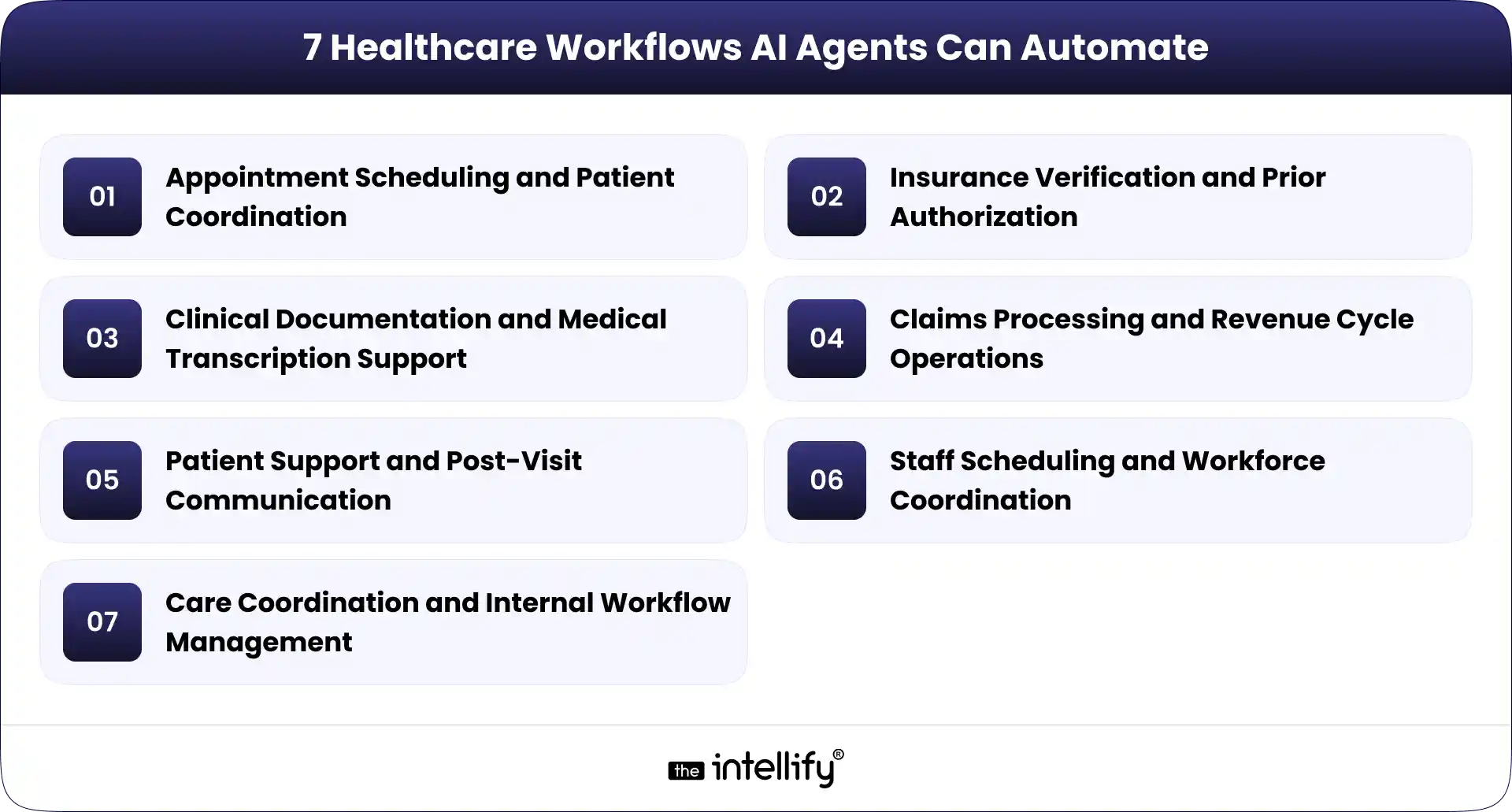
1. Appointment Scheduling and Patient Coordination
Appointment management remains one of the most resource-intensive administrative functions in healthcare.
AI agents can automate booking, rescheduling, cancellations, reminders, and follow-ups. Patients can interact through phone, SMS, email, or chat while AI agents update schedules in real time. These systems can also manage waitlists by automatically filling open appointment slots when cancellations occur.
Benefits include:
- Reduced no-shows
- Faster scheduling
- Improved patient communication
- Increased front-desk efficiency
- Better patient experiences
This is one of the most common use cases for AI agents for healthcare workflow automation.
2. Insurance Verification and Prior Authorization
Insurance verification is often a major source of delays. Staff members spend hours collecting insurance details, checking eligibility, and managing prior authorization requirements. AI agents can automate much of this work. They can gather patient information, verify coverage, identify missing details, and track authorization status. This helps reduce delays while improving operational efficiency.
Benefits include:
- Faster eligibility verification
- Reduced administrative workload
- Improved approval turnaround times
- Fewer manual errors
- Better patient access to care
3. Clinical Documentation and Medical Transcription Support
Documentation requirements continue to increase across healthcare organizations. Physicians and clinical staff often spend hours creating patient notes and updating records.
AI agents can assist with:
- Voice-to-text transcription
- Visit note generation
- Clinical summaries
- Documentation review
- Record organization
These tools help reduce administrative burden while improving documentation speed and consistency. The goal isn’t replacing clinicians. It’s helping them spend less time typing and more time caring for patients.
4. Claims Processing and Revenue Cycle Operations
Revenue cycle management depends on accurate and timely claims processing. Even small errors can result in delays, denials, and lost revenue. AI agents can automate several claims-related workflows. They can review submissions, identify missing information, validate records, and flag potential issues before claims are submitted.
Benefits include:
- Reduced claim denials
- Faster reimbursements
- Improved billing accuracy
- Lower rework costs
- Stronger revenue cycle performance
This is one of the most impactful examples of AI in healthcare operations.
5. Patient Support and Post-Visit Communication
Patient engagement doesn’t end after an appointment. Healthcare organizations must manage reminders, follow-ups, discharge instructions, and ongoing communication. AI agents can automate these interactions at scale.
They can:
- Send medication reminders
- Share care instructions
- Answer common questions
- Schedule follow-up visits
- Provide 24/7 assistance
Patients receive timely information while healthcare teams reduce call volumes and manual outreach efforts. The result is better engagement and stronger continuity of care.
6. Staff Scheduling and Workforce Coordination
Managing healthcare staffing is a constant challenge. Scheduling conflicts, shift changes, and fluctuating patient volumes can create operational headaches.
AI agents help by:
- Coordinating schedules
- Predicting staffing requirements
- Managing shift adjustments
- Reducing scheduling conflicts
- Supporting workforce planning
This improves workforce allocation while reducing the administrative burden on managers. Better scheduling often leads to improved staff satisfaction and operational efficiency.
7. Care Coordination and Internal Workflow Management
Healthcare delivery depends on smooth coordination between departments. When communication breaks down, delays follow. AI agents can automatically route information, assign tasks, escalate issues, and track workflow progress. This helps ensure the right information reaches the right people at the right time.
Benefits include:
- Faster handoffs
- Better departmental communication
- Reduced delays
- Improved workflow visibility
- More efficient operations
Organizations using AI agents in healthcare workflows often see significant improvements in care coordination.
How to Identify the Right Healthcare Workflow for AI Automation
Not every workflow should be automated immediately. The best approach is to start with processes that are repetitive, time-consuming, and easy to measure.
Look for workflows that:
- Require significant administrative effort
- Create operational bottlenecks
- Affect patient experiences
- Generate frequent errors
- Deliver measurable outcomes
Appointment scheduling, claims processing, insurance verification, and patient communication are often excellent starting points.
Starting small allows organizations to validate results before expanding automation initiatives across larger operational areas. Workflow readiness and integration requirements should also be evaluated early in the planning process.
What Healthcare Teams Gain From AI-Driven Workflows
Healthcare organizations implementing AI-driven workflows often experience benefits across multiple areas. These include:
- Faster workflow execution
- Reduced manual work
- Improved patient communication
- Lower operational costs
- Increased staff productivity
- Fewer administrative errors
- Better scalability
- More time for patient care
Perhaps the biggest advantage is allowing healthcare professionals to focus on work that truly requires human expertise.
Building an ROI Framework for AI in Healthcare Operations
Before implementing AI agents, organizations should establish clear success metrics. Measuring ROI helps healthcare leaders understand operational impact and justify future investments.
Common metrics include:
- Administrative hours saved
- Reduced appointment no-shows
- Faster claims processing
- Improved reimbursement rates
- Lower operational expenses
- Increased employee productivity
- Higher patient satisfaction
Simple ROI Example
A healthcare clinic spends 300 hours each month managing appointment scheduling. If AI agents reduce that workload by 40%, the clinic saves 120 staff hours monthly. Those hours can then be redirected toward patient support and other high-value activities.
Short-term ROI often comes from efficiency gains. Long-term ROI typically includes improved patient experiences, reduced burnout, and greater operational scalability.
Best Practices for Implementing AI Agents in Healthcare
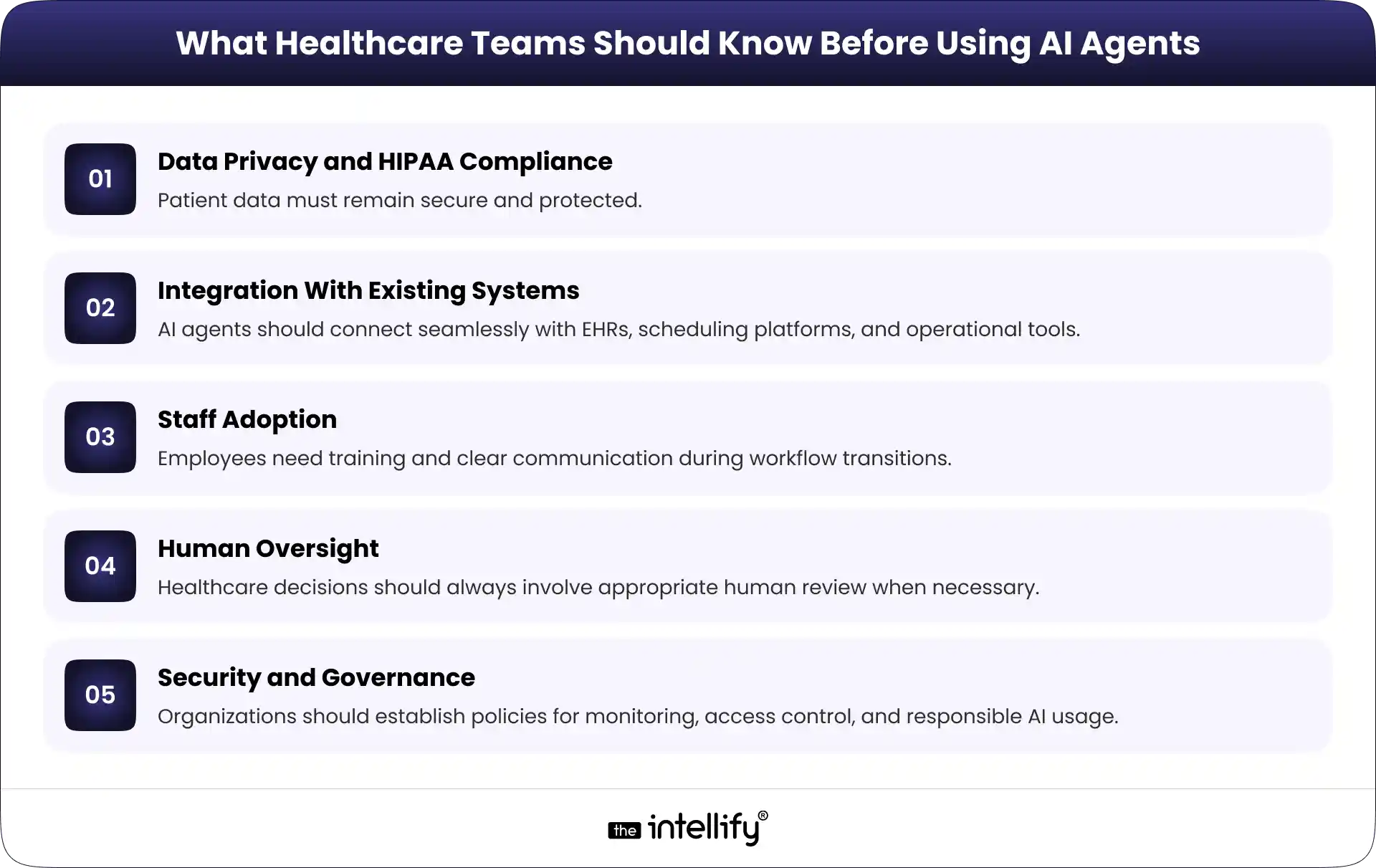
Healthcare organizations can improve success rates by following a structured implementation strategy.
- Start With One High-Impact Workflow: Focus on a process that delivers measurable value quickly.
- Define Clear Success Metrics: Set goals before deployment begins.
- Involve Teams Early: Operational and clinical stakeholders should participate throughout the implementation process.
- Train Employees: Help staff understand how AI supports their daily work.
- Monitor Performance Continuously: Track outcomes and refine workflows over time.
- Choose Scalable Solutions: Invest in platforms that can support future growth.
- Think Long-Term: The goal isn’t simply automation. The goal is continuous improvement across healthcare workflow operations.
Where AI Agents Could Take Healthcare Workflows Next
Healthcare automation is moving beyond individual tasks. The future lies in connected workflow orchestration. AI agents will increasingly help organizations:
- Predict operational needs
- Coordinate resources automatically
- Personalize patient communication
- Improve workforce planning
- Connect workflows across departments
- Support enterprise-wide operations
Rather than acting as standalone tools, AI agents will become intelligent operational support systems that work alongside healthcare teams every day.
Conclusion
AI agents are rapidly becoming a valuable part of healthcare operations. From appointment scheduling and insurance verification to claims management and care coordination, they help healthcare organizations reduce repetitive administrative work while improving efficiency.
The greatest value comes from automating the right workflows, not every workflow. Organizations that take a strategic approach, measure outcomes, and maintain human oversight will be better positioned to improve operations and patient experiences.
As healthcare continues to evolve, AI agents for healthcare operations will play an increasingly important role in building more scalable, efficient, and patient-focused healthcare systems.
Frequently Asked Questions (FAQs)
1. How are AI agents different from regular healthcare automation tools?
Traditional automation follows fixed rules, while AI agents can understand context, manage workflows, and handle more dynamic healthcare tasks.
2. Which healthcare workflows are easiest to automate with AI agents?
Scheduling, insurance verification, patient follow-ups, claims processing, and documentation are some of the easiest and most common starting points.
3. Can AI agents help reduce workload for healthcare staff?
Yes, AI agents reduce repetitive administrative work so healthcare teams can spend more time on patient care and daily operations.
4. Can AI agents work with existing healthcare systems?
Yes, many AI agents can integrate with EHRs, scheduling platforms, and healthcare management systems.
5. How is ROI measured for AI agents in healthcare?
Healthcare organizations usually track time saved, reduced operational costs, fewer errors, and improved workflow efficiency.