Top AI Development Company for Custom AI Solutions & Services

Summary:
Businesses are increasingly adopting AI to improve efficiency, automate workflows, enhance customer experiences, and make smarter decisions. This blog explains how an AI development company helps organizations build custom AI solutions, intelligent applications, and AI automation systems tailored to their needs. It also explores industry use cases, implementation best practices, emerging AI trends, and the key factors to consider when selecting the right AI development partner for long-term success.


Artificial Intelligence is no longer something businesses talk about as a future possibility. It’s already reshaping how companies operate, serve customers, and make decisions every day. A few years ago, businesses relied heavily on traditional software to manage operations. While those systems still play an important role, they often struggle when dealing with large volumes of data, changing customer expectations, or complex decision-making processes. That’s where AI comes in.

Organizations across healthcare, retail, finance, manufacturing, logistics, and many other industries are investing in intelligent systems that can learn from data, automate repetitive work, and deliver insights in real time. Instead of spending hours on manual tasks, teams can focus on strategic work that drives growth. From predicting customer behavior and automating workflows to creating personalized experiences and improving operational efficiency, AI is helping businesses solve challenges that traditional software simply wasn’t designed to handle.

However, building successful AI solutions requires much more than writing code. It demands expertise in machine learning, data engineering, automation, cloud infrastructure, and business strategy. This is why many organizations choose to work with an experienced AI development company that can design, build, and scale AI-powered systems aligned with their business goals.


What Is an AI Development Company and Why Does It Matter?

An AI development company specializes in creating software solutions powered by artificial intelligence technologies such as machine learning, natural language processing, computer vision, predictive analytics, and generative AI.
Unlike traditional software development, where applications follow predefined rules and instructions, AI systems are designed to learn from data, identify patterns, and continuously improve their performance over time.
For example, a traditional customer support platform may follow scripted workflows. An AI-powered platform, on the other hand, can understand customer intent, answer questions intelligently, and improve responses based on previous interactions.
Developing such systems requires specialized expertise in areas including:

  • Machine learning engineering
  • Data science
  • AI model training
  • Data architecture
  • Cloud computing
  • Automation technologies
  • AI governance and compliance

Many businesses initially assume that any software development team can build AI solutions. In reality, successful AI projects require unique skills, tools, and methodologies that differ significantly from conventional software development.
Partnering with a specialized AI development company provides access to experienced professionals who understand how to turn business challenges into scalable AI-driven solutions.


How Custom AI Solutions Help Businesses Solve Real Challenges
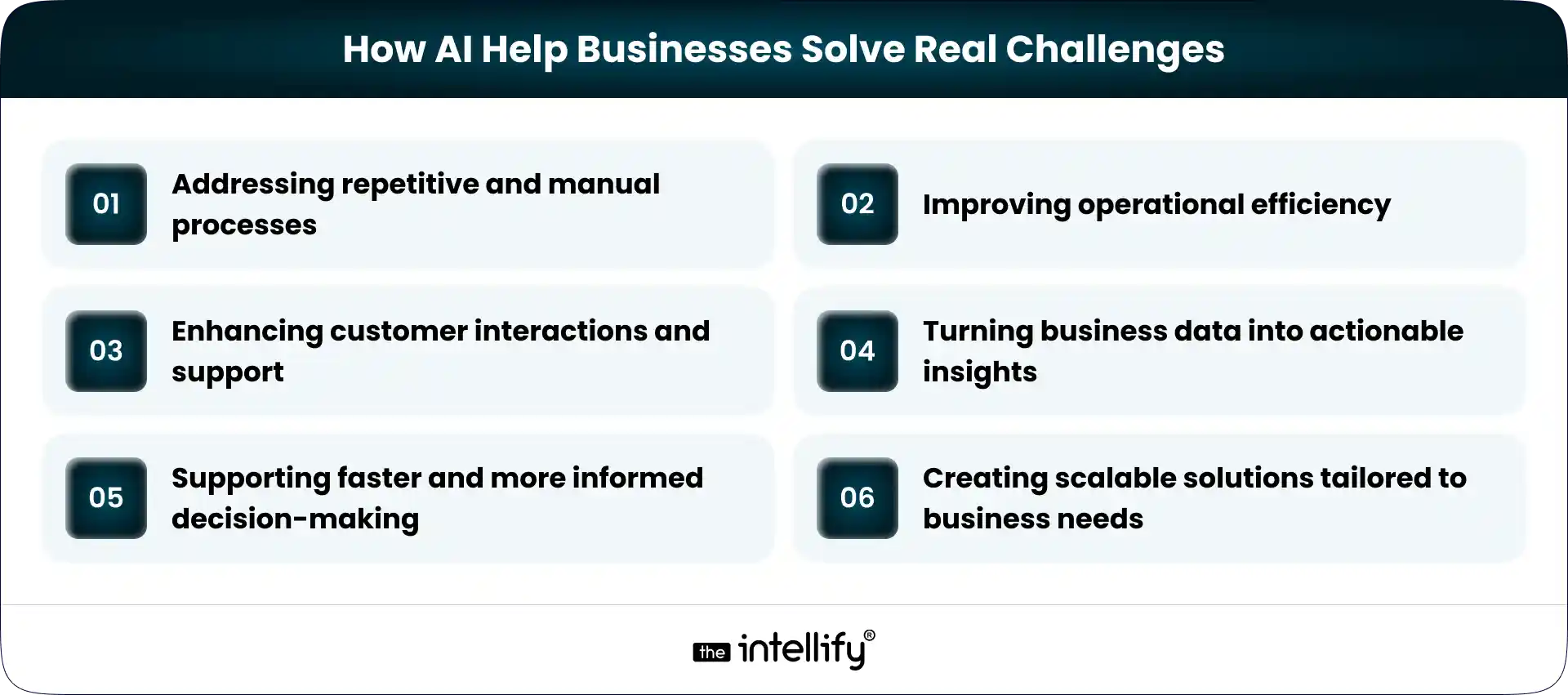
How AI Help Businesses Solve Real Challenges

Every business has unique processes, workflows, and operational challenges. Off-the-shelf software often forces organizations to adapt their operations around the software itself.
Custom AI solutions work differently. They are designed around specific business objectives, allowing companies to solve problems more effectively while maintaining flexibility as they grow.

Addressing Repetitive and Manual Processes

Many organizations still rely on employees to perform routine tasks such as data entry, document verification, scheduling, and report generation. AI can automate these activities, reducing workload and minimizing human error.

Improving Operational Efficiency

Intelligent systems help businesses complete tasks faster, streamline workflows, and eliminate bottlenecks across departments.

Enhancing Customer Interactions and Support

AI-powered chatbots, virtual assistants, and recommendation engines can provide instant responses, personalized experiences, and 24/7 customer support.

Turning Business Data Into Actionable Insights

Most companies collect massive amounts of data but struggle to use it effectively. AI solutions analyze data in real time and identify trends, risks, and opportunities that might otherwise go unnoticed.

Supporting Faster and More Informed Decision-Making

Executives and managers can use AI-generated insights to make smarter decisions based on facts rather than assumptions.

Creating Scalable Solutions Tailored to Business Needs

As organizations grow, AI systems can scale alongside operations, handling larger datasets and more complex workflows without significant increases in manual effort.


Core AI Development Services Businesses Should Look For

Choosing the right AI development partner starts with understanding the services they offer.

AI Consulting and Strategy Development

Before implementation begins, businesses need a clear AI roadmap. AI Consulting services help identify opportunities, define objectives, assess feasibility, and create implementation strategies.

Machine Learning Model Development

Machine learning models enable systems to recognize patterns, make predictions, and continuously improve through data analysis.

Natural Language Processing Solutions

Natural Language Processing (NLP) helps machines understand, interpret, and generate human language.

Common applications include:

  • Chatbots
  • Virtual assistants
  • Sentiment analysis
  • Document processing
  • Language translation

Computer Vision Applications

Computer vision enables systems to analyze images and videos for tasks such as:

  • Quality inspection
  • Facial recognition
  • Medical imaging analysis
  • Security monitoring

Generative AI Development

Generative AI solutions can create text, images, code, reports, and business content, helping organizations improve productivity and innovation.

Predictive Analytics Solutions

Predictive models help businesses forecast future outcomes, customer behavior, demand patterns, and operational risks.

AI Integration With Existing Business Systems

Successful AI projects must work seamlessly with CRM, ERP, HRM, and other enterprise systems.

AI Maintenance, Monitoring, and Optimization

AI systems require continuous monitoring, retraining, and optimization to maintain performance and accuracy over time.


AI App Development Services for Intelligent Digital Experiences

Modern users expect digital experiences that are personalized, responsive, and intelligent. This demand has fueled rapid growth in AI app development services across industries.

AI-Powered Mobile Application Development

Mobile apps can leverage AI to provide recommendations, automate tasks, and improve user engagement.

AI-Enabled Web Platforms

AI-powered web applications can personalize content, optimize user journeys, and deliver intelligent interactions.

Smart Business Applications

Organizations are increasingly building internal AI-powered tools that support operations, analytics, and decision-making.

Personalized User Experiences Through AI

AI can analyze user behavior and tailor experiences based on preferences, interests, and previous interactions.

Recommendation and Prediction Engines

Popular examples include:

  • Product recommendations
  • Content suggestions
  • Personalized marketing campaigns
  • Demand forecasting

Conversational AI and Virtual Assistants

Conversational AI solutions help businesses engage users through natural and intuitive interactions.

Benefits of Integrating AI Into Modern Applications

Key benefits include:

  • Higher customer engagement
  • Better user retention
  • Faster service delivery
  • Personalized experiences
  • Improved business intelligence
  • Increased operational efficiency


AI Automation Services That Drive Productivity and Growth

Automation has always been a business priority. AI takes automation several steps further by enabling systems to learn, adapt, and make decisions.

Business Process Automation

AI automates repetitive workflows that traditionally require manual intervention.

Intelligent Workflow Management

AI helps coordinate tasks, prioritize activities, and optimize process execution.

Document Processing and Data Extraction

Organizations can automate invoice processing, contract reviews, claims handling, and document classification.

Customer Service Automation

AI-powered assistants can resolve inquiries instantly while escalating complex issues when necessary.

Automated Reporting and Analytics

Instead of manually compiling reports, AI can generate insights automatically from multiple data sources.

Internal Operations Optimization

Departments such as HR, finance, procurement, and operations can benefit significantly from intelligent automation.

Key Business Benefits

  • Reduced Manual Effort: Employees spend less time on repetitive work and more time on strategic initiatives.
  • Faster Execution of Tasks: Processes that once took hours can often be completed within minutes.
  • Improved Accuracy: Automation reduces errors caused by manual processing.
  • Lower Operational Costs: Organizations can achieve significant cost savings through improved efficiency.
  • Better Resource Utilization: Teams can focus on higher-value activities while AI handles routine operations.
 

AI Development Services Solutions


Where AI Workflow Automation Creates the Most Impact

AI workflow automation is delivering measurable results across nearly every department.

Sales and Lead Management

  • Lead scoring
  • Opportunity prioritization
  • Sales forecasting
  • Automated follow-ups

Marketing and Campaign Optimization

  • Audience segmentation
  • Campaign personalization
  • Content recommendations
  • Performance analysis

Customer Support Operations

  • AI chatbots
  • Ticket routing
  • Customer sentiment analysis
  • Automated responses

Human Resources Processes

  • Resume screening
  • Candidate matching
  • Employee onboarding
  • Workforce analytics

Finance and Accounting Workflows

  • Invoice processing
  • Expense management
  • Financial forecasting
  • Compliance monitoring

Supply Chain and Logistics Management

  • Inventory optimization
  • Route planning
  • Demand forecasting
  • Vendor management

Project and Operations Management

  • Resource allocation
  • Project monitoring
  • Risk identification
  • Performance tracking


Industry Applications of AI Solutions

Healthcare

Healthcare organizations are using AI to improve patient care and operational efficiency.

  • Patient Engagement: AI assistants help patients schedule appointments and receive support.
  • Medical Data Analysis: AI can identify patterns across large medical datasets.
  • Diagnostic Support: Advanced algorithms assist clinicians in detecting conditions earlier and more accurately.

Retail and eCommerce

  • Product Recommendations: AI delivers personalized shopping experiences.
  • Demand Forecasting: Retailers can predict inventory requirements more accurately.
  • Customer Personalization: Businesses tailor promotions and experiences based on customer behavior.

Banking and Financial Services

  • Fraud Detection: AI identifies suspicious transactions in real time.
  • Risk Assessment: Financial institutions improve lending and investment decisions.
  • Customer Support Automation: Virtual assistants provide faster service and lower support costs.

Manufacturing

  • Predictive Maintenance: AI predicts equipment failures before they occur.
  • Quality Control: Computer vision systems identify defects during production.
  • Production Optimization: Manufacturers improve efficiency and reduce waste.

Insurance

  • Claims Processing: AI accelerates claim reviews and approvals.
  • Risk Analysis: Insurers can assess policy risk more accurately.
  • Customer Service Automation: Virtual agents provide policyholder support around the clock.
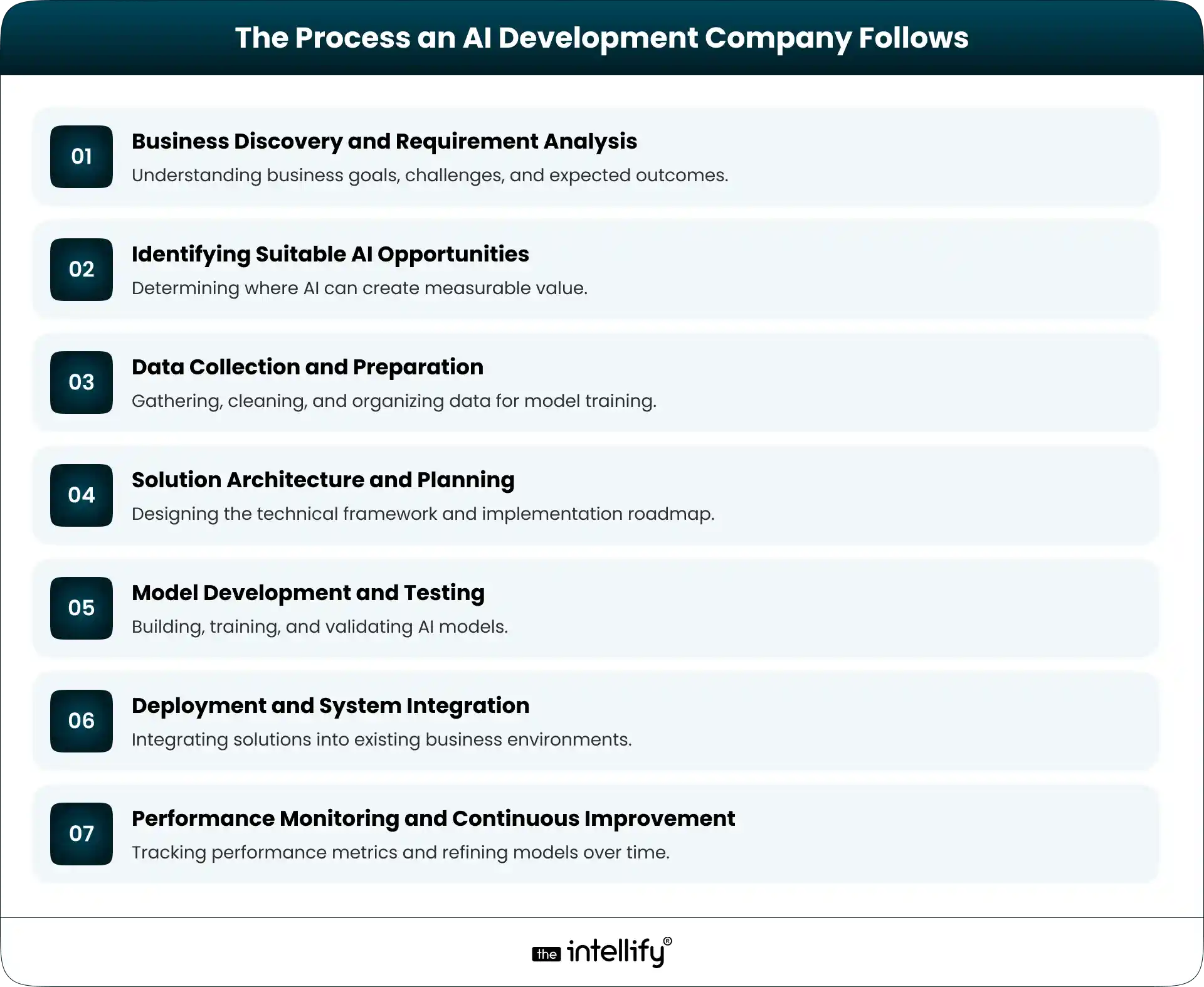
 

Process of AI Development Company


Key Factors That Determine the Success of AI Development Solutions

Several factors influence whether an AI initiative succeeds or struggles.

  1. Clearly Defined Business Objectives: AI should solve real business problems, not exist simply because it’s trendy.
  2. Availability of Quality Data: Even the best algorithms cannot compensate for poor-quality data.
  3. Scalability Considerations: Solutions should support future growth and evolving business needs.
  4. Integration With Existing Systems: Seamless connectivity improves adoption and usability.
  5. User Adoption and Change Management: Employees must understand and trust AI-driven processes.
  6. Ongoing Optimization and Support: AI requires continuous improvements to remain effective.
  7. Security, Compliance, and Governance Requirements: Strong governance ensures data privacy, compliance, and responsible AI usage.


How to Choose the Right AI Development Company

Selecting the right partner can significantly influence project outcomes.

Technical Expertise and AI Capabilities: Evaluate experience across machine learning, NLP, computer vision, and automation technologies.
Industry-Specific Experience: Industry knowledge often leads to faster implementation and better results.
Portfolio and Case Studies: Review previous projects and measurable outcomes.
Development Methodology and Transparency: Look for structured processes and open communication.
Security and Compliance Standards: Ensure the company follows recognized security frameworks and compliance requirements.
Scalability and Future Support: Choose a partner capable of supporting long-term growth.
Communication and Collaboration Approach: Strong collaboration often determines project success more than technology alone.

Questions to Ask Before Selecting a Partner

  • What industries have they worked with?
  • How do they measure project success?
  • What support is provided after deployment?
  • How do they ensure data security and compliance?


Emerging Trends Shaping the Future of AI Development

The AI landscape continues to evolve rapidly.

  • Generative AI Adoption Across Industries: Organizations are increasingly integrating generative AI into daily operations.
  • AI Agents and Autonomous Workflows: AI agents are beginning to manage tasks with minimal human intervention.
  • Hyperautomation Strategies: Businesses are combining AI, automation, and analytics to streamline operations end-to-end.
  • Industry-Specific AI Platforms: Purpose-built AI solutions are becoming more common across sectors.
  • Responsible and Ethical AI Practices: Organizations are prioritizing transparency, fairness, and accountability.
  • AI-Powered Decision Intelligence: AI is moving beyond predictions and supporting strategic decision-making.
  • The Growing Role of Human-AI Collaboration: The future isn’t humans versus AI. It’s humans working alongside AI to achieve better outcomes.


Why Businesses Are Partnering With AI Development Companies for Long-Term Innovation

Businesses aren’t adopting AI simply to follow a trend. They’re investing because it delivers measurable advantages.

  • Accelerating Digital Transformation Initiatives: AI helps organizations modernize processes faster.
  • Building Competitive Advantages Through AI: Companies that effectively use AI often outperform slower-moving competitors.
  • Scaling Operations More Efficiently: Growth becomes easier when repetitive work is automated.
  • Improving Customer Experiences: Personalized and intelligent interactions increase satisfaction and loyalty.
  • Unlocking New Revenue Opportunities: AI can create entirely new products, services, and business models.
  • Future-Proofing Business Growth: Organizations that embrace AI today are better positioned for tomorrow’s challenges.

 

Custom AI Solutions


Conclusion

Artificial intelligence is quickly becoming a core part of modern business strategy. From improving operational efficiency and automating repetitive tasks to enhancing customer experiences and supporting smarter decision-making, AI is transforming how organizations compete and grow.

Custom AI solutions, intelligent applications, and AI automation services enable businesses to address unique challenges while creating scalable systems that evolve alongside their needs. Whether it’s predictive analytics, workflow automation, generative AI, or conversational experiences, the opportunities continue to expand across every major industry.

The success of any AI initiative, however, depends heavily on choosing the right AI development company. An experienced partner like The Intellify can help identify opportunities, build tailored solutions, integrate AI into existing systems, and ensure long-term optimization. As AI adoption accelerates worldwide, businesses that invest strategically today will be better equipped to innovate, adapt, and achieve sustainable growth in the years ahead.


Frequently Asked Questions

Q1. How do I know if my business is ready for AI development?

If your business relies on repetitive processes, manual decision-making, or large amounts of data, AI can help improve efficiency, automate workflows, and generate valuable insights. An AI development company can assess your operations and identify the most impactful opportunities for AI adoption.

Q2. What are the benefits of choosing custom AI solutions over ready-made tools?

Custom AI solutions are designed specifically for your business goals, workflows, and data. Unlike off-the-shelf software, they offer greater flexibility, scalability, and long-term value while addressing unique operational challenges.

Q3. Can an AI development company integrate AI into existing business systems?

Yes. Most AI solutions can be integrated with existing platforms such as CRM, ERP, HR, and customer support systems. This allows businesses to enhance current processes without replacing their existing technology infrastructure.

Q4. What should I look for when selecting an AI development company?

Look for technical expertise, industry experience, successful project delivery, security standards, transparent communication, and ongoing support capabilities. Reviewing case studies and client success stories can also help evaluate a company’s capabilities.

Q5. How can businesses measure the return on investment from AI solutions?

Businesses can measure AI ROI through improvements in operational efficiency, productivity, customer satisfaction, cost savings, revenue growth, and process automation. Establishing clear KPIs before implementation helps track success more effectively.

AI in Real Estate: Benefits, Use Cases, & Future Tech

Summary
Thinking about the future of real estate? This blog will talk about how AI in real estate is shaping the future, from automation and lead generation to property valuations and smart listings. This guide will help you understand why AI is no longer a luxury but a necessity, whether you are a real estate agent, an investor, or a property tech startup.

Artificial intelligence (AI) is changing many industries around the world, and real estate is one of them. Data is the new fuel for business growth, and AI-powered technologies are helping real estate agents work smarter, serve clients better, and find new opportunities. AI in real estate is changing the way of work in many ways, such as by generating leads, valuing properties, giving virtual tours, and making personalized suggestions.
This blog will talk about how AI is used in real estate, its pros and cons, real-world examples, future trends, development costs, and more. This guide will help you understand why AI is no longer a luxury but a necessity, whether you are a real estate agent, an investor, or a property tech startup.


AI in Commercial Real Estate

AI has made a lot of progress in the commercial real estate (CRE) field. People who work in commercial real estate depend a lot on data to figure out how much a property is worth, how much rent it can bring in, and what investment opportunities are available. This process is faster and more accurate with AI.

Key Applications:

  • Predictive Analytics: AI models look at past sales, foot traffic, and market conditions to guess what will happen to property values and rents in the future.
  • Tenant Behavior Analysis: AI tools can look at tenant feedback, foot traffic, and lease patterns to help owners make the best use of their space.
  • Smart Building Management: AI and the Internet of Things (IoT) can make building systems (like HVAC and lighting) change in real time to save money and make buildings more environmentally friendly.
  • Risk Assessment: AI looks at market trends and economic conditions to figure out what kinds of risks come with commercial investments.


How to Use AI in Real Estate Industry

How to Use AI in Real Estate

There are many ways to use AI in real estate, whether you’re a single agent or a big company:

1. Lead Scoring and Qualification: AI tools give incoming leads a score based on their intent and behavior, which helps agents focus on the best prospects.

2. Chatbots for Customer Engagement AI chatbots answer questions, make appointments, and handle other customer service tasks 24/7, which makes customers happier.

3. Automated Valuation Models (AVMs): AI uses data from the local market, recent sales, and neighborhood trends to figure out how much a property is worth.

4. Property Recommendations: Machine learning algorithms suggest listings based on what users like and what they have searched for in the past.

5. Document Automation: AI helps make lease agreements, contract analyses, and due diligence documents automatically.

6. Marketing Optimization: AI platforms can make personalized email, social media, and paid ad campaigns.


AI Applications in Real Estate

AI Applications in Real Estate

Let’s look at the main areas where AI is having a real effect:

1. AI for Real Estate Agents

AI makes agents more productive by doing boring tasks for them and helping them make better choices.

  • Client Matching: AI finds properties for clients based on what they like and how they act.
  • Automated Follow-Ups: AI-powered CRMs send out automated reminders and follow-ups to keep prospects interested.
  • Market Intelligence: AI tools get real-time data from a lot of different places, like multiple listing services (MLS), news sites, and public records.
  • Performance Analytics: Agents can use AI dashboards to keep an eye on how many leads turn into sales, sales trends, and how happy customers are.

2. AI for Real Estate Lead

For real estate to be successful, it is very important to generate and nurture leads. AI makes this process easier and stronger:

  • Predictive Lead Scoring: Uses behavioral signals to find buyers and renters who are very interested.
  • Behavioral Analytics looks at what listings users spend time on and makes suggestions based on that.
  • AI-Powered Ads: Facebook and Google Ads use AI to find the right people to see your ads.

3. AI for Real Estate Listings

AI makes it easier to create and show listings:

  • Descriptions of smart properties: Tools for Natural Language Generation (NLG) Write property descriptions automatically.
  • Visual Recognition: AI can look at pictures of a property and tag its features, such as the pool, garage, or garden.
  • Price Optimization: AI is used by dynamic pricing engines to suggest listing prices based on how much demand there is and how much competition there is.


AI Agent for Real Estate

AI Agents in Real Estate

AI agents are like virtual assistants that help people who want to buy, sell, or rent by talking to them and doing tasks for them. AI Agents in Real Estate can do everything from making appointments and answering questions about listings to giving you real-time mortgage calculations.

  • 24/7 Availability: AI agents are always awake and ready to help clients.
  • Integrated Scheduling: Automatically books property tours or calls by syncing with calendars.
  • Scalability: An AI agent can handle hundreds of conversations at once.


Conversational AI for Real Estate

It includes conversational AI chatbots and virtual assistants that are trained to engage with users in real time. In real estate, these tools are used for:

  • Support for multiple channels: You can find it on websites, WhatsApp, Facebook Messenger, and more.
  • Lead Capture: Gets people to answer questions and gets good leads.
  • Localization: Can change conversations based on where and what language the user speaks.
  • Virtual Tour Navigation: Gives voice instructions to help people get around 360° tours.


Benefits of AI in Real Estate


The Future of AI in Real Estate Industry

Real estate will be smart, powered by AI, and put the customer first in the future.

  • AI and IoT Integration: AI will be used to control and keep an eye on smart homes and buildings.
  • AI-Driven Mortgage Lending: AI models can quickly approve loans and score risks.
  • Augmented Reality + AI: Use AI chatbots with AR tours to create guided, immersive experiences.
  • Sustainability Forecasting: AI will help design green buildings by analyzing energy, water, and carbon data.
  • Blockchain and AI will make transactions safer and contracts (smart contracts) will run themselves.


How to Develop AI Tools for Real Estate Industry

To make AI tools for real estate, domain experts, data scientists, and developers need to work together.

Key Steps:

  • Define Use Case: Pick a problem area, such as lead generation, listings, or valuation.
  • Collect Quality Data: Use MLS data, public records, user behavior, and IoT inputs to get good data.
  • Pick the Right AI Model: Depending on the situation, use machine learning, natural language processing, or computer vision.
  • Develop an MVP: Start with a Minimum Viable Product, like a price estimator or chatbot.
  • Test and Train: keep adding new data to make the model more accurate.
  • Deploy and Monitor: Make sure the system can grow, that the data is safe, and that it works well after launch.


Real Estate AI Development Cost

Depending on how complicated it is, what features it has, and how it needs to be integrated, the cost of making an AI tool can be different:

AI Solution Type Estimated Cost Range
AI Chatbot for Real Estate Website $10,000 – $30,000
AI Lead Scoring System $15,000 – $40,000
AI Property Valuation Tool $25,000 – $60,000
Personalized Listing Engine $20,000 – $50,000
Voice Assistant Integration $30,000 – $70,000
Maintenance & Support $1,000 – $5,000/month


Develop AI in Real Estate


Looking for a Real Estate AI Development Company?

It’s very important to work with an AI development company that has domain knowledge, tech skills, and product knowledge in real estate so that it can help you get to market faster and avoid making expensive mistakes.

Look for a company that offers:

  • End-to-End Real Estate Software Development (Ideation to Launch)
  • AI/ML and data science skills
  • Experience with PropTech, real estate CRMs, and smart property solutions
  • Following the Compliance of local real estate laws and data security standards


Conclusion

AI is not going to be the future of real estate; it is the present. AI is helping real estate agents stay competitive, efficient, and focused on the customer from finding properties to closing deals. AI tools give you a strategic edge as buyers and renters want more personalized, quick, and digital-first experiences.
Now is the time for people in the real estate business to look into AI-driven innovation. There are endless possibilities for you, whether you want to improve listings, automate lead follow-ups, or make your own AI platform.


Frequently Asked Questions (FAQs)

1. How is AI transforming the real estate industry?

Answer: AI is changing the way real estate works by helping agents, buyers, and investors make smarter decisions faster. It automates tasks like property valuation, lead scoring, and customer support. AI also helps analyze market trends, recommend properties, and match listings with potential buyers all in real-time.

2. Can AI really help generate more real estate leads?

Answer: Yes, AI can boost real estate leads significantly. It tracks visitor behavior on websites, predicts buyer intent, and sends personalized messages to engage potential clients. AI-powered CRMs and lead scoring tools also help agents focus on high-quality leads, saving time and increasing conversion rates.

3. How much does it cost to develop an AI tool for real estate?

Answer: The cost of developing an AI tool for real estate depends on its complexity.

  • A basic AI chatbot or lead generation tool: $10,000-$25,000
  • A smart property search engine or recommendation system: $30,000-$70,000
  • Advanced AI platforms with machine learning and predictive analytics: $75,000-$150,000+

Ongoing maintenance or cloud hosting may add extra monthly costs.

4. Is conversational AI useful in the real estate sector?

Answer: Absolutely. Conversational AI, like smart chatbots, can answer customer queries 24/7, schedule property visits, provide mortgage calculators, and suggest listings based on buyer preferences. It saves agents hours of manual work and improves customer experience.

5. What are some future trends of AI in real estate?

Answer: In the future, AI in real estate will focus more on:

  • Hyper-personalized property recommendations
  • Voice-enabled property search tools
  • Predictive analytics for real estate investments
  • Digital twins for property previews
  • Fully automated virtual assistants

These trends will make buying and selling homes faster, smarter, and more data-driven.

Top 25+ AI Use Cases & Applications Across Industries in 2025

In 2025, artificial intelligence (AI) is no longer a futuristic concept; it’s an indispensable part of how industries operate and innovate. From diagnosing diseases to optimizing supply chains, AI is transforming every sector by improving decision-making, efficiency, and customer experience.
In this blog, we’ll explore more than 25 industry-proven AI use cases and real-world AI applications across major industries, based on current market insights, enterprise adoption trends, and practical results. Whether you’re looking into enterprise AI use cases, AI in the metaverse, or generative AI use cases in retail industry, this guide is built to show how transformative the technology is for healthcare, finance, government, manufacturing, education, insurance, and beyond.


Why AI Is Everywhere in 2025

AI is everywhere

The global AI market is expected to reach $407 billion by 2027, with nearly every enterprise exploring its potential. But what’s driving this adoption?

  • The rise of generative AI and autonomous agents is enabling faster automation and personalized interactions.
  • Advancements in natural language processing (NLP) and computer vision are unlocking new capabilities in customer support, fraud detection, quality control, and education.
  • Cloud-native, scalable AI platforms and APIs have made AI accessible even to small and mid-sized businesses.
  • Organizations of all sizes, whether B2B or B2C, are using AI to unlock value from their data and transform operations.

Let’s now explore how AI is creating real value across the world’s major industries.


AI use cases across industries


AI in Healthcare: Diagnosis, Personalization & Drug Discovery

Transforming Diagnosis and Care Delivery AI is reshaping the healthcare landscape with impactful applications of AI in healthcare such as early disease detection, personalized treatment plans, and continuous patient monitoring. Real-world AI use cases in healthcare include AI-powered radiology tools, robotic surgeries, AI-enabled drug discovery, and virtual health agents that improve patient engagement while reducing the burden on human professionals.

Example:
IBM Watson and Google’s DeepMind are helping hospitals detect conditions like diabetic retinopathy and breast cancer early.

Impact:

  • Reduced diagnostic errors by 30%
  • Shorter treatment cycles
  • Improved patient satisfaction


AI in Retail & Ecommerce:

AI in Retail & Ecommerce

Hyper-Personalization and Smart Shopping AI use cases in ecommerce are enabling real-time personalization, smart inventory management, and automated support. In the retail space, generative AI use cases in the retail industry range from AI-written product descriptions to personalized outfit recommendations and visual search tools that improve the customer shopping experience.

Example:
Zara uses AI to analyze customer behavior and automate stock replenishment. Sephora’s AI tool suggests makeup based on facial recognition.

Impact:

  • 3X increase in customer engagement
  • 15–20% uplift in average order value (AOV)
  • Reduced returns and improved loyalty


AI in Banking & Financial Services: From Risk to Robo-Advisors

Safer, Smarter AI in finance industry covers credit risk modeling, fraud detection, and customer support automation. Banks are using AI in banking, like natural language chatbots, algorithmic trading platforms, and intelligent document processing to reduce risk, boost compliance, and improve client satisfaction.

Example:
JPMorgan’s COIN platform reviews legal documents using NLP, saving 360,000 hours annually.

Impact:

  • Enhanced compliance
  • Reduced operational cost
  • Improved customer trust


AI in Insurance: Smarter Claims & Risk Prediction

Risk Assessment to Claims Automation AI applications in the insurance sector are solving key challenges in underwriting, claims processing, and fraud prevention. Popular AI use cases in insurance include AI-powered chatbots for claims assistance, machine learning models for policy pricing, and automation tools that enhance customer service and reduce operational cost.

Example:
Lemonade’s AI bot “Jim” handles claims in under 3 minutes, using NLP and image recognition.

Impact:

  • Up to 75% reduction in claims processing time
  • Higher transparency and customer satisfaction


AI in Manufacturing: Predictive Maintenance & Digital Twins:

AI in Manufacturing

Smarter Operations and Product Quality AI use cases in manufacturing include predictive maintenance systems, real-time defect detection through computer vision, and AI-based production line optimization. Applications of AI in manufacturing are helping businesses reduce downtime, improve quality control, and enhance demand forecasting.

Example:
GE Digital uses AI to optimize equipment uptime and avoid failures in industrial plants.

Impact:

  • 30–50% reduction in downtime
  • Better energy efficiency and leaner operations


AI in Education: Smart Learning & Assessment Tools:

Intelligent Learning and Assessment AI use cases in education span adaptive learning systems, automated grading, and virtual classroom environments. The application of AI in education improves accessibility and personalization by tailoring learning pathways based on student performance, while AI-powered assistants help educators design effective curriculum strategies.

Example: Platforms like Coursera and Duolingo use AI to personalize courses, while tools like Gradescope apply AI for accurate grading and academic feedback.


AI in Procurement & Supply Chain:

Agile and Efficient Logistics AI use cases in procurement include intelligent contract analysis, spend categorization, and supplier risk prediction. Meanwhile, AI applications in the supply chain are enabling predictive demand forecasting, automated inventory management, and logistics optimization for resilient and cost-efficient operations.

Example:
Unilever uses AI to monitor over 60,000 supply chain variables and optimize distribution in 190 countries.

Impact:

  • 20–30% reduction in logistics cost
  • Reducing delays and waste
  • Better supplier performance and sourcing agility


AI in Business & IT Operations: Process Automation at Scale

Smarter Workflows Enterprise AI use cases are transforming business processes across departments. AI use cases in business include customer segmentation, sales forecasting, HR recruitment automation, and decision intelligence. AI use cases in IT operations (AIOps) involve anomaly detection, root cause analysis, and predictive alerting to reduce outages and streamline service management.

Example:
Companies like Salesforce embed AI in CRM for lead scoring and next-best-action recommendations, while ServiceNow uses AI to resolve IT tickets autonomously.

Impact:

  • 40% improvement in service delivery time
  • Reduced downtime and cost per ticket


AI in Government: Smart Cities & Public Service Delivery

AI in Government

Proactive and Predictive Public Services Governments are using AI to enhance citizen services and improve decision-making. Prominent AI use cases in government include smart traffic systems, AI-powered citizen service bots, and predictive analytics for urban planning, social welfare targeting, and fraud detection in public services.

Example:
Dubai and Singapore use AI to manage traffic congestion, permits, and utilities. while India’s AI-driven tax fraud analytics has reduced leakage by over 30%.


AI in Agriculture: Precision Farming & Yield Prediction

Smart and Sustainable Farming Farmers are adopting AI applications in agriculture such as crop monitoring via drones, weather-based irrigation optimization, and pest identification using machine vision. These AI use cases help maximize yields while ensuring more sustainable farming practices and resource utilization.

Example: Startups like CropIn and Taranis use AI and satellite imagery to forecast harvests, manage irrigation, and reduce crop loss through timely alerts.


AI in Construction & Real Estate:

AI in real estate and construction industry include project planning through predictive analytics, site safety monitoring using AI cameras, and automated equipment scheduling. These technologies enhance operational efficiency, reduce waste, and ensure project timelines are met.

Example:
Buildots applies AI to track construction progress using 360° cameras and dashboards.
Doxel uses AI to track construction progress and detect delays in real time.

Impact:

  • On-time project delivery
  • Lower cost overruns and enhanced safety


AI in Metaverse & Virtual Worlds:

AI in Metaverse & Virtual Worlds

Interactive Digital Realities AI in the metaverse enables hyper-realistic avatars, personalized environments, and natural conversation interfaces. AI applications in this domain power immersive experiences using voice recognition, real-time emotion detection, and behavioral analytics, helping brands engage users in virtual economies.

Example: Meta and NVIDIA are leading this space by combining AI with real-time 3D graphics, enabling lifelike simulations and digital twins within the metaverse.


AI in Marketing: Personalization & Campaign Optimization

Automated Creativity and Personalization Marketers are embracing AI applications in marketing to optimize campaigns and create content at scale. Generative AI use cases include email copy generation, product ad variations, and A/B testing automation. AI also helps with consumer sentiment analysis and predictive customer behavior modeling.

Example:
Tools like Jasper and Copy.ai use generative AI to speed up content production. Netflix uses AI for personalized thumbnails, trailers, and watchlist curation and Coca-Cola uses OpenAI’s tools for ad ideation and content creation.

Impact:

  • Faster time-to-market for campaigns
  • Higher engagement with personalized content


AI in Media & Entertainment

Creative and Real-Time Storytelling From personalized recommendations to automated content editing, AI use cases in media and entertainment are reshaping content creation. Applications include deepfake generation, auto-captioning, real-time language translation, and content personalization across streaming platforms.

Example: Spotify’s AI curates playlists by understanding moods and listening behavior, while Adobe’s AI tools simplify post-production workflows.


AI in Tourism & Hospitality: Smart Experiences

AI in Tourism & Hospitality

Next-Level guest experience AI in tourism industry focus on enhancing service quality and operational efficiency. Key use cases include travel planning assistants, personalized booking engines, emotion-aware customer support, and predictive pricing engines for hotels and airlines.

Example: Expedia uses conversational AI for trip planning, while Hilton’s connected rooms leverage AI to adapt settings based on guest preferences.


AI in Legal & Compliance

Smarter Document Intelligence AI is increasingly vital in legal and compliance functions. AI tools can scan, analyze, and interpret massive volumes of legal documents, contracts, and case law in seconds. Law firms use AI for case prediction, while enterprises apply it to maintain compliance and audit trails. Tools like Luminance and Kira Systems help streamline contract reviews with high accuracy.


Emerging AI Use Cases


Building an Enterprise AI Strategy

  • Identify the right use cases for your business model.
  • Invest in scalable, explainable AI models.
  • Ensure compliance with data and ethical AI guidelines.
  • Partner with AI specialists to reduce risk and time-to-market.

Recommended Tools & Platforms:

  • OpenAI, Google Vertex AI, AWS Bedrock
  • Custom AI models via LangChain, RAG frameworks

Pro Tip:
Start with small, ROI-driven pilots and scale gradually across the organization.


Conclusion: AI Use Cases Are Business Use Cases

Artificial Intelligence isn’t just “good to have” in 2025, it’s essential. Every industry now has concrete, proven AI use cases that can drive ROI, efficiency, and customer satisfaction. Whether it’s through smarter chatbots, predictive analytics, or generative content, AI is transforming the way businesses operate. The time to adopt is now.
To succeed with AI in 2025:

  • Start small with high-ROI use cases
  • Ensure data readiness and governance
  • Choose scalable, secure AI platforms
  • Partner with an expert AI Development Company for implementation.

Whether you’re starting small with AI pilots or ready to build enterprise-wide solutions, the opportunities are vast, and the time to act is now.


AI development company

About The Intellify

At The Intellify, we build custom AI solutions for businesses across sectors. From predictive modeling to generative AI agents, we help you accelerate innovation and scale intelligently.

View
Case Study