Why Healthcare Providers Miss Patient Calls (And How AI Fixes It)

Summary:
Healthcare providers frequently miss patient calls due to busy front desks, high call volumes, and administrative workloads. Every unanswered call can result in lost appointments, reduced patient satisfaction, and missed revenue. This blog explores the key reasons behind missed patient calls and explains how AI voice agents help healthcare organizations improve patient communication, automate appointment scheduling, and support staff more efficiently.


A patient calls your clinic to book an appointment, reschedule a visit, or ask a simple question. But no one answers. For healthcare providers, a missed patient call is more than just a missed conversation. It can lead to lost appointments, frustrated patients, and missed revenue. Most of the time, the problem isn’t poor service; it’s busy front desks, high call volumes, and staff managing multiple responsibilities at once.

To bridge this gap, many healthcare providers are adopting AI voice agents that answer calls instantly, schedule appointments, handle routine inquiries, and support patients 24/7. In this article, we’ll explore why healthcare providers miss patient calls, the hidden impact of those missed opportunities, and how AI voice agents are helping clinics deliver a better patient experience.


Why Healthcare Providers Miss Patient Calls

Most healthcare providers don’t miss patient calls because of poor service. They miss them because front-desk teams are managing multiple responsibilities at the same time. As patient demand continues to grow, answering every call has become increasingly difficult.

Busy Front Desks and Overwhelmed Staff

Receptionists do much more than answer phones. They check in patients, verify insurance, manage appointments, process payments, and support clinical teams. During busy hours, handling in-person patients often takes priority, causing incoming calls to be delayed or missed.

Limited Office Hours

Patients don’t only call during business hours. Many try to schedule appointments in the evenings, on weekends, or during holidays. If they reach voicemail instead of a person, many won’t wait for a callback and may contact another provider.

Multiple Administrative Responsibilities

Front-desk staff also manage referrals, prescription requests, billing inquiries, patient records, and other administrative tasks. With so many responsibilities competing for attention, answering every call immediately isn’t always possible.

High Call Volumes During Peak Hours

Morning rushes, lunch hours, and seasonal illness periods often bring a surge of incoming calls. When several patients call at once, long hold times become unavoidable, leading some callers to abandon the call and look elsewhere.


The Hidden Cost of Missed Patient Calls

A missed phone call may seem like a small issue, but its impact can quickly add up. From lost appointments to increased administrative work, unanswered calls affect both patient experience and clinic performance.

Lost Appointments

Every unanswered call is a missed opportunity to book an appointment. If patients can’t reach your clinic, many will simply contact another provider instead, resulting in lost revenue and fewer patients receiving timely care.

Patients Choosing Another Provider

Today’s patients expect quick responses. When a clinic doesn’t answer the phone, many assume communication will be difficult and choose a provider that’s easier to reach, even if the quality of care is comparable.

Lower Patient Satisfaction

The patient experience starts with the first interaction. Long hold times, missed calls, or delayed callbacks can create frustration and weaken trust before a patient even visits the clinic.

Increased Workload for Staff

Missed calls don’t disappear; they come back as voicemails, callback requests, and scheduling changes. This creates extra administrative work, increases staff stress, and reduces overall efficiency.


Why Traditional Solutions No Longer Work

Hiring more receptionists used to be the go-to solution for managing patient calls. Today, that’s becoming harder to sustain due to staffing shortages, rising labor costs, and employee turnover.
Even with a larger front-desk team, every call can’t always be answered. Staff are busy assisting patients, handling administrative tasks, taking breaks, or working within fixed office hours.
Many clinics have also turned to voicemail or outsourced answering services. While these options help capture calls, they often don’t provide the instant response patients expect.
As patient expectations continue to evolve, healthcare providers need a solution that can answer every call, support staff, and remain available 24/7not just during office hours.
 

AI for Clinic Front Desk


How AI Voice Agents Solve the Problem

Healthcare providers don’t need to replace their front-desk teams; they need technology that helps them work more efficiently. AI voice agents answer calls, automate routine tasks, and ensure patients receive timely support without adding to staff workload.

Answer Every Call Instantly

AI voice agents answer every incoming call within seconds, eliminating long hold times and ensuring patients always reach someone, even during peak hours or after the clinic has closed.

Book Appointments Automatically

Patients can book, reschedule, or cancel appointments through a natural voice conversation. The AI follows the clinic’s scheduling rules and updates the calendar automatically.

Handle Common Patient Questions

From office hours and insurance inquiries to provider availability and clinic directions, AI can answer routine questions instantly, allowing staff to focus on patient care.

Route Urgent Calls to Staff

When a patient requires immediate assistance or needs to speak with a specific department, the AI can identify the request and transfer the call to the appropriate team member.

Work 24/7 Without Breaks

Unlike traditional front desks, AI voice agents remain available around the clock. Whether it’s after hours, weekends, or holidays, patients can receive support whenever they call.


A Typical Patient Journey With AI

Here’s how a typical patient interaction flows when an AI voice agent handles the conversation:

Step 1: Patient Calls the Clinic

A patient calls to book an appointment, reschedule a visit, or ask a question, whether it’s during office hours or after the clinic has closed.

Step 2: AI Answers Instantly

Instead of reaching voicemail or waiting on hold, the AI voice agent answers the call immediately and understands the patient’s request through natural conversation.

Step 3: Appointment Is Scheduled

The AI checks real-time availability, books or reschedules the appointment based on the clinic’s scheduling rules, and captures any necessary patient information.

Step 4: Confirmation Is Sent

Once the appointment is confirmed, the patient automatically receives a confirmation via SMS or email with all the relevant details.

Step 5: Clinic Staff Stay Updated

The appointment is synced with the clinic’s scheduling system, allowing front-desk staff to view the latest bookings without any manual data entry.

Step 6: Automated Reminders & Follow-ups

Before the appointment, the AI sends reminders to reduce no-shows. If the patient needs to cancel or reschedule, the AI can handle that conversation as well.

The result? Patients receive quick, convenient support at any time, while healthcare teams spend less time managing phone calls and more time focusing on patient care.


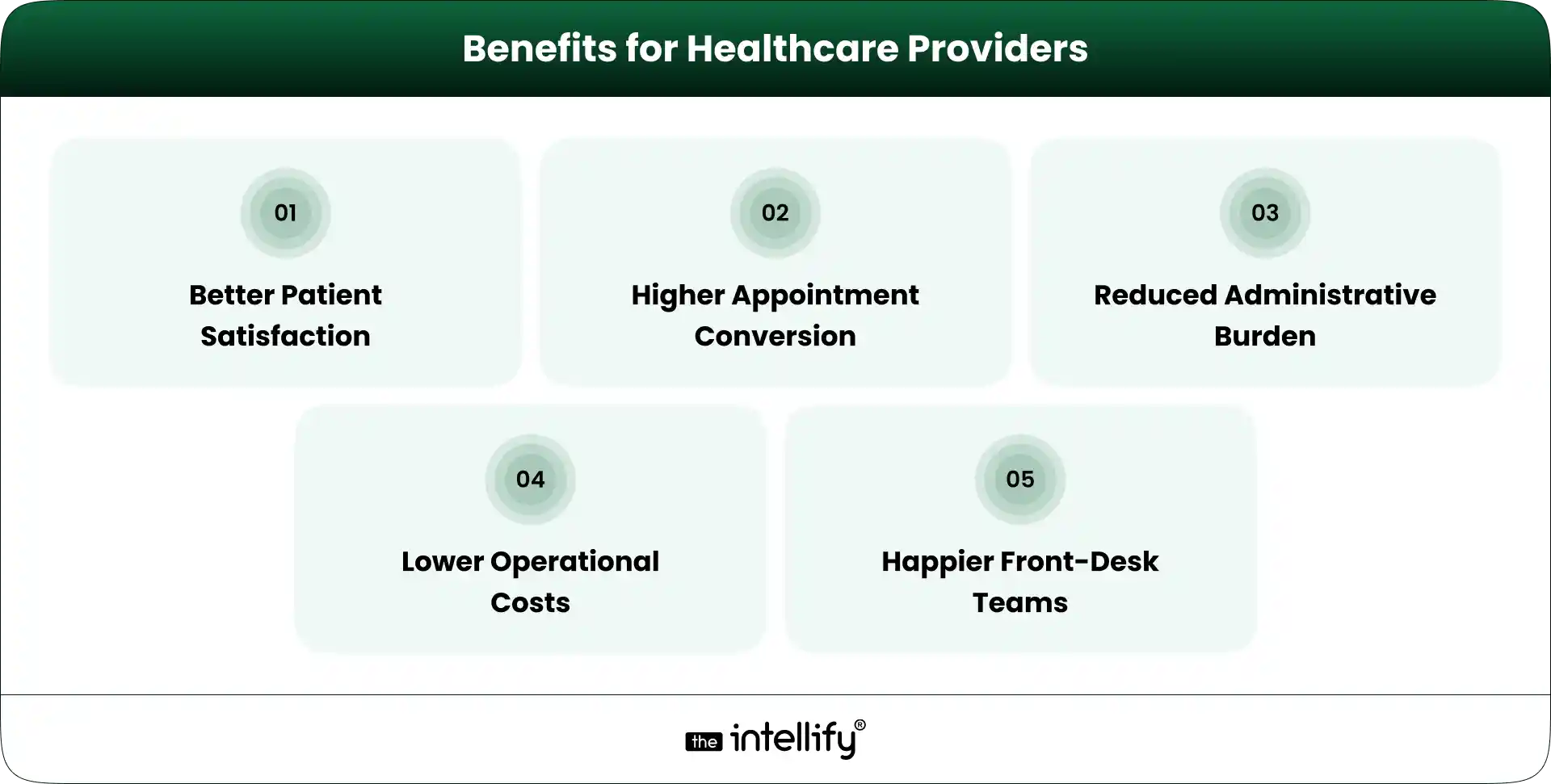
Benefits for Healthcare Providers
Benefits for Healthcare Providers

Adopting AI in healthcare isn’t just about answering more calls. It improves several areas of healthcare operations simultaneously.

Better Patient Satisfaction

Patients appreciate fast responses. When someone calls a clinic and immediately receives help instead of waiting on hold, the overall experience improves. Quick communication builds trust before the patient even walks through the door.

Higher Appointment Conversion

Every answered call creates an opportunity to schedule care. By responding instantly and simplifying the booking process, healthcare providers can convert more inquiries into confirmed appointments while reducing the number of abandoned calls.

Reduced Administrative Burden

Routine conversations consume a significant portion of a receptionist’s day. When AI handles appointment scheduling, FAQs, and basic requests, administrative teams can focus on patients who require personal attention, improving efficiency across the practice.

Lower Operational Costs

Hiring additional staff isn’t always practical. AI voice agents help healthcare providers manage increasing call volumes without expanding front-desk teams, making operations more scalable over time.

Happier Front-Desk Teams

Receptionists often feel overwhelmed when balancing in-person patients with constant phone calls. By handling repetitive conversations, AI reduces pressure on staff and allows them to concentrate on tasks that genuinely require empathy, judgment, and human interaction.


Can AI Replace Your Front Desk?

The short answer is no. Healthcare is built on trust and human relationships. Patients still value speaking with compassionate professionals, especially when discussing complex medical concerns.
AI isn’t designed to replace receptionists; it complements them. Think of it as another member of the administrative team that never misses a call, never gets overwhelmed during busy hours, and can manage repetitive conversations consistently.
This human-plus-AI approach allows clinics to improve efficiency while ensuring patients still receive personal care whenever it’s needed.


What to Look for in an AI Healthcare Voice Agent

Not every AI solution is built for healthcare. Before choosing a platform, healthcare providers should evaluate whether it meets both operational and compliance requirements.
Look for features such as:

  • HIPAA-ready architecture to support patient data privacy.
  • Natural, conversational voice interactions that don’t feel robotic.
  • Integration with EHR and practice management systems.
  • CRM connectivity for better patient communication.
  • Analytics dashboards to monitor call volumes and outcomes.
  • Multi-language support for diverse patient populations.
  • Fast deployment without disrupting existing workflows.

Solutions like Alris AI by The Intellify are designed around these requirements, helping healthcare organizations automate patient conversations while fitting into their existing operational processes.


Why Clinics Are Adopting AI Faster in 2026

Healthcare providers are increasingly adopting AI to improve patient communication and streamline daily operations. Here are the key reasons driving this shift:

  • Rising Patient Expectations: Patients expect quick responses, easy appointment scheduling, and support beyond regular office hours.
  • Ongoing Staffing Challenges: Many clinics continue to face front-desk staffing shortages, making it difficult to manage growing call volumes efficiently.
  • Increasing Competition: With more healthcare options available, clinics need to deliver faster and more convenient patient experiences to stay competitive.
  • Affordable AI Solutions: AI voice technology has become more accessible and cost-effective, making it practical for clinics of all sizes- not just large hospital systems.
  • Reduced Administrative Work: AI automates routine conversations, allowing healthcare staff to spend more time on patient care instead of repetitive administrative tasks.

 

 AI Receptionist for Clinics


Final Thoughts

Healthcare providers don’t lose patients because they deliver poor medical care. More often, they lose opportunities because patients can’t reach them when they need help.
As patient expectations continue to evolve, answering every call is no longer just a customer service goal- it’s an essential part of delivering accessible healthcare.
AI voice agents offer a practical way to bridge that gap. By answering calls instantly, automating appointment scheduling, handling routine inquiries, and supporting front-desk teams, they help healthcare providers improve both operational efficiency and the patient experience.
If your practice is exploring ways to reduce missed calls without adding more administrative burden, solutions like Alris AI by The Intellify can help create a more responsive and efficient communication workflow.


Frequently Asked Questions (FAQs)

1. Why do healthcare providers miss patient calls?

Healthcare providers often miss calls because front-desk staff manage multiple responsibilities simultaneously, including patient check-ins, scheduling, insurance verification, billing, and administrative tasks. High call volumes and limited office hours also contribute to missed calls.

2. How much revenue can missed calls cost a clinic?

The financial impact varies depending on the practice, but every unanswered call represents a potential missed appointment. Over time, even a small number of missed appointments each week can result in substantial revenue loss while also reducing patient retention.

3. Can AI schedule medical appointments?

Yes. Modern AI voice agents can schedule, reschedule, and cancel appointments by following predefined scheduling rules and integrating with existing healthcare systems.

4. Is an AI voice agent HIPAA compliant?

It depends on the provider. Healthcare organizations should choose AI solutions designed with HIPAA-ready security practices and appropriate safeguards for handling protected health information.

5. Does AI replace receptionists?

No. AI supports reception teams by handling repetitive conversations and routine administrative tasks. Human staff continues to manage complex situations that require empathy, judgment, and personalized assistance.

6. Can Alris AI integrate with existing healthcare systems?

Yes. Alris AI by The Intellify is designed to integrate with healthcare workflows and can connect with scheduling systems, CRM platforms, and other operational tools, helping providers automate patient communication without disrupting existing processes.
AI Appointment Scheduling in Healthcare: How It Works, Key Benefits & Costs in 2026

Summary:
AI appointment scheduling helps healthcare organizations automate booking, reduce no-shows, optimize provider schedules, and improve patient access to care. This guide explains how AI scheduling works, its key benefits, essential features, implementation costs, EHR integration requirements, and future trends shaping healthcare operations in 2026.

A missed appointment doesn’t just create an empty slot in a provider’s calendar. It can delay patient care, increase administrative workload, and reduce revenue. Now multiply that across hundreds or even thousands of appointments each month.

Healthcare organizations today face growing pressure to improve patient access while managing staffing shortages and rising operational costs. At the same time, patients expect the convenience of online booking, instant confirmations, and personalized communication.

This is why AI Appointment Scheduling is gaining traction across healthcare. By combining artificial intelligence, automation, and predictive analytics, healthcare providers can streamline scheduling, reduce no-shows, and improve the overall patient experience.

In 2026, AI-powered scheduling is no longer just a productivity tool. It has become an important part of modern healthcare operations, helping organizations deliver faster, more efficient, and patient-centric care.


Understanding AI Appointment Scheduling in Healthcare

What AI appointment scheduling is

AI appointment scheduling uses artificial intelligence to automate and optimize how healthcare appointments are booked, managed, and followed up.
Unlike traditional scheduling software that simply displays available time slots, AI-driven systems analyze provider availability, patient preferences, appointment types, historical scheduling data, and operational requirements to recommend the most suitable appointments.

How AI scheduling differs from traditional appointment management

Traditional scheduling relies heavily on administrative staff to manage bookings, cancellations, reminders, and rescheduling. AI scheduling platforms automate many of these tasks while continuously optimizing schedules. They can:

  • Recommend ideal appointment slots
  • Predict likely no-shows
  • Fill cancelled appointments automatically
  • Send personalized reminders
  • Manage waitlists in real time

Technologies powering intelligent scheduling systems

Several technologies make AI scheduling possible:

  • Machine Learning: Learns from historical scheduling data.
  • Predictive Analytics: Forecasts appointment demand and cancellation risks.
  • Conversational AI: Enables scheduling through chatbots and virtual assistants.
  • Workflow Automation: Automates reminders, confirmations, and follow-up actions.


How AI appointment scheduling works from booking to follow-up

Patients can book appointments through websites, apps, chatbots, or patient portals. The system analyzes scheduling factors and suggests the best available options.
After booking, automated reminders help reduce no-shows. If cancellations occur, AI can immediately offer those slots to patients on a waitlist. Following the appointment, the system can schedule follow-ups and trigger additional patient communication workflows.


Why Healthcare Organizations Need Smarter Scheduling Systems

Patient expectations have changed dramatically. Most people expect healthcare scheduling to be as simple as booking a flight or reserving a hotel room online. However, many healthcare organizations still struggle with:

  • Long call wait times
  • Scheduling conflicts
  • Double bookings
  • Appointment gaps
  • Last-minute cancellations
  • High no-show rates

These issues affect both patient satisfaction and operational performance.
Manual scheduling processes also place significant pressure on front-desk staff. As healthcare organizations grow, managing appointments across multiple providers and locations becomes increasingly difficult.
AI-powered healthcare software helps address these challenges by automating repetitive tasks, improving schedule utilization, and making it easier for patients to access care.


Key Benefits of AI Appointment Scheduling for Healthcare Providers

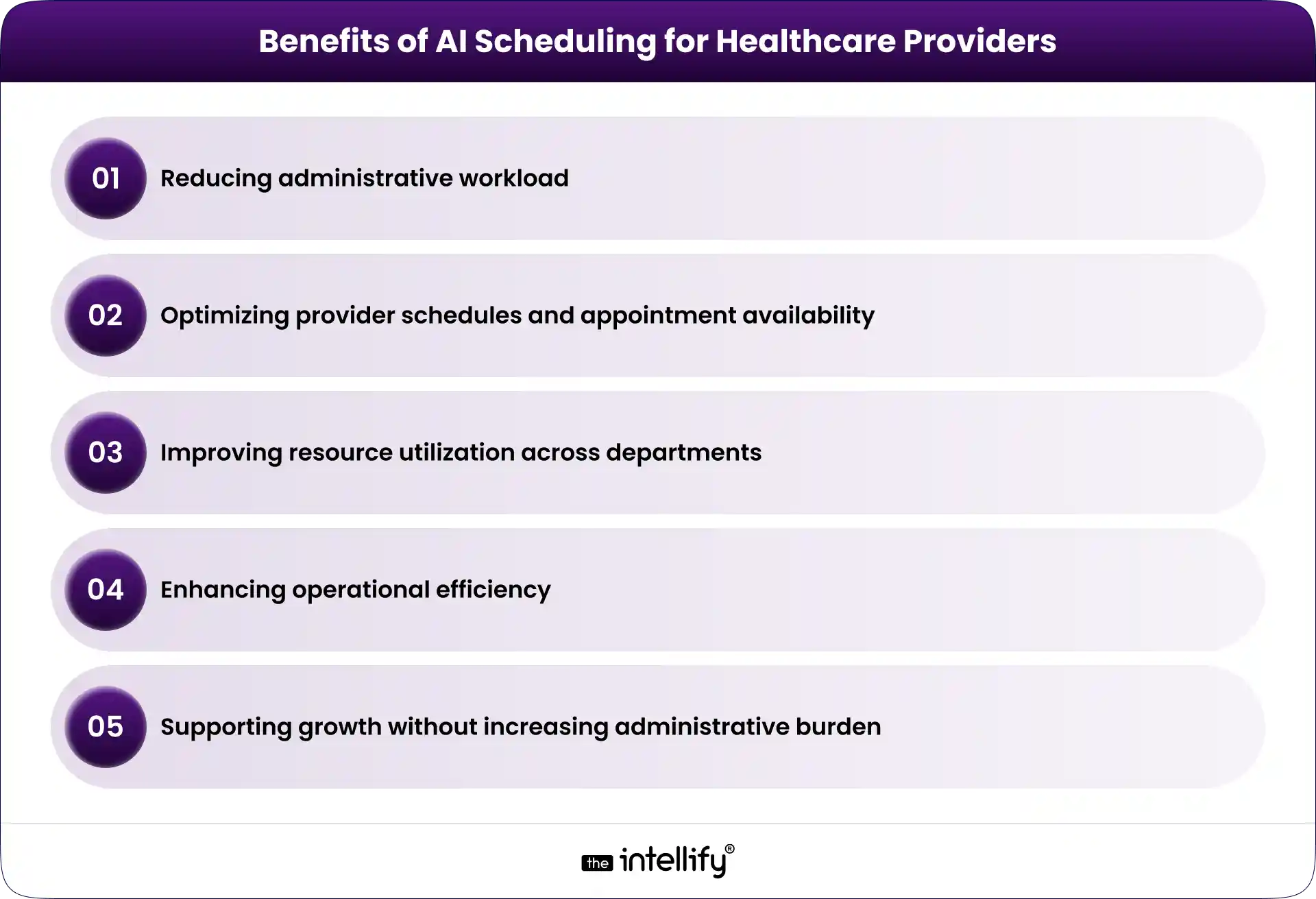
Benefits of AI Scheduling for Healthcare Providers

Reducing administrative workload

Administrative teams spend a large portion of their day handling scheduling-related tasks. AI in healthcare automation reduces the need for manual appointment booking, confirmations, reminders, and rescheduling. This allows staff to focus more on patient support and care coordination.

Optimizing provider schedules and appointment availability

AI scheduling systems help ensure providers’ calendars are used efficiently by minimizing gaps and balancing appointment demand. This can increase patient access without requiring additional clinical resources.

Improving resource utilization across departments

Healthcare scheduling often involves more than physicians. Exam rooms, imaging equipment, specialists, and support staff all need coordination. AI helps allocate these resources more effectively, reducing bottlenecks and operational inefficiencies.

Enhancing operational efficiency

Better scheduling leads to:

  • Fewer missed appointments
  • Reduced administrative costs
  • Faster patient access
  • Improved provider productivity

Even small improvements in scheduling efficiency can generate measurable operational benefits.

Supporting growth without increasing administrative burden

As healthcare organizations expand, AI scheduling allows them to manage larger patient volumes without proportionally increasing administrative staff. This scalability is one of the key reasons many providers are investing in intelligent scheduling solutions.


Features to Look for in AI Appointment Scheduling Software

When evaluating AI appointment scheduling software, healthcare organizations should prioritize features that improve both efficiency and patient experience.

Self-service patient scheduling

A strong AI appointment scheduling platform should allow patients to book, reschedule, and cancel appointments online at any time.

Intelligent appointment recommendations

AI should recommend appointments based on provider availability, appointment type, patient preferences, and urgency.

Automated reminders and notifications

Personalized reminders delivered through SMS, email, or voice calls help reduce missed appointments.

Smart waitlist management

Cancelled appointments can be automatically offered to patients seeking earlier availability.

Scheduling analytics and reporting

Look for dashboards that track appointment completion rates, cancellations, no-shows, and provider utilization.

Security, privacy, and compliance capabilities

The platform should support HIPAA-compliant workflows, secure data handling, audit trails, and role-based access controls.

Multi-location and multi-provider support

Organizations with multiple facilities should ensure the platform can manage scheduling across locations and providers from a centralized system.


AI Appointment Scheduling Cost in 2026: Pricing Models & ROI

Key factors that influence implementation costs

Several factors affect the cost of AI appointment scheduling:

  • Practice size
  • Number of providers
  • Integration requirements
  • Customization needs
  • Deployment model

Off-the-shelf vs custom scheduling solutions

Solution Type Estimated Cost
Small Clinic SaaS $100-$1,000/month
Multi-Location Practice $1,500-$5,000/month
Enterprise Health System $25,000-$250,000+ implementation
Custom AI Scheduling Platform $50,000-$300,000+

Understanding the total cost of ownership

Beyond software licensing, organizations should account for:

  • Implementation
  • Integration
  • Training
  • Maintenance
  • Ongoing support

Evaluating long-term return on investment

The ROI often comes from:

  • Reduced no-shows
  • Improved provider utilization
  • Lower administrative costs
  • Increased patient retention
  • Better scheduling efficiency

Hidden costs to watch out for

Organizations should also plan for data migration, workflow redesign, testing, and change management activities.


AI Appointment Scheduling Solutions


Reducing No-Shows and Scheduling Gaps

Missed appointments remain one of the biggest operational challenges in healthcare. AI scheduling platforms help reduce no-shows by identifying patients who are more likely to miss appointments and sending personalized reminders based on patient behavior.
Smart waitlists further improve efficiency by automatically filling cancelled slots with patients seeking earlier appointments. These capabilities help healthcare organizations:

  • Improve attendance rates
  • Reduce revenue loss
  • Increase provider utilization
  • Improve patient access to care

For many organizations, reducing no-shows alone can significantly improve scheduling performance.


Patient Impact: From Booking to Better Outcomes

The patient experience begins long before the appointment itself. AI-powered scheduling contributes to better outcomes by providing:

  • Faster appointment access
  • Reduced scheduling delays
  • Convenient self-service booking
  • Improved follow-up compliance
  • Personalized communication

When patients can access care quickly and easily, they are more likely to remain engaged throughout their treatment journey.
Improved engagement often translates into better adherence, stronger provider relationships, and higher satisfaction levels.


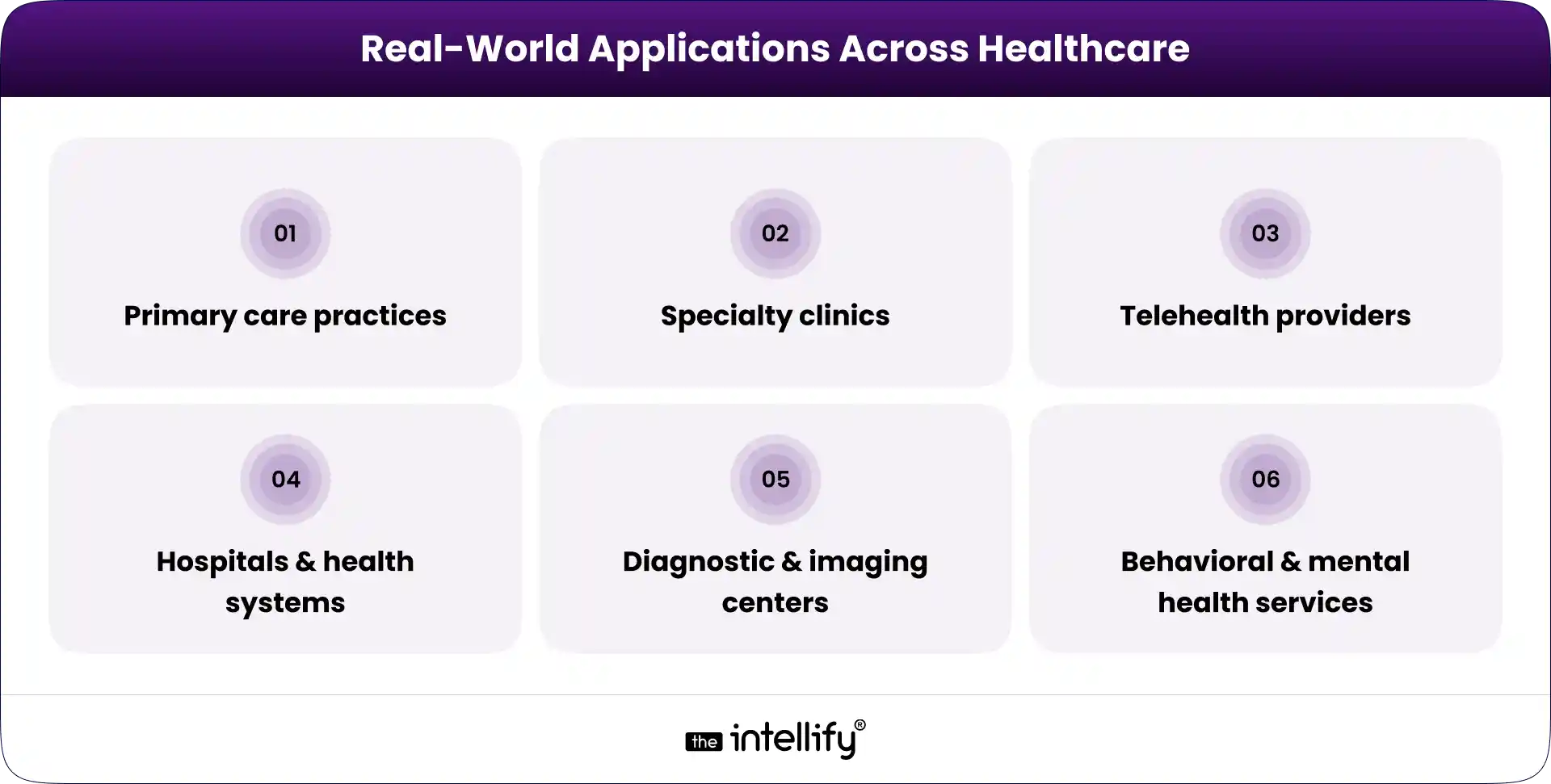
Real-World Applications Across Healthcare Settings

Real-World Applications Across Healthcare

AI appointment scheduling is not limited to one type of healthcare organization. Its value extends across multiple care environments.

Primary care practices

Primary care providers often manage high patient volumes and diverse appointment types. AI scheduling helps optimize calendars, reduce wait times, and improve access to preventive care.

Specialty clinics

Specialty practices often deal with complex scheduling requirements. Whether it’s cardiology, dermatology, orthopedics, or oncology, intelligent scheduling helps coordinate providers, resources, and patient demand more effectively.

Hospitals and health systems

Large healthcare systems face enormous scheduling complexity. AI supports enterprise-wide scheduling optimization across departments, facilities, and care teams.

Telehealth providers

Virtual care depends heavily on efficient scheduling. AI helps manage provider availability, virtual appointment coordination, and patient communications.

Diagnostic and imaging centers

Imaging services often require specialized equipment and coordinated staffing. AI scheduling improves resource utilization while reducing patient wait times.

Behavioral and mental health services

Mental health providers frequently encounter high cancellation rates and ongoing treatment plans. Intelligent scheduling helps maintain appointment continuity and improve patient engagement throughout long-term care programs.


AI Scheduling and EHR Integration: Building Connected Healthcare Workflows

Why EHR integration matters

Scheduling systems deliver the most value when connected to Electronic Health Records (EHRs). Integration allows appointment workflows to synchronize with patient records, provider availability, and care plans.

Benefits of combining scheduling and EHR systems

Organizations can benefit from:

  • Reduced duplicate data entry
  • Improved care coordination
  • Faster scheduling workflows
  • Better patient visibility
  • More accurate records

Important integration considerations for healthcare providers

Before implementation, providers should evaluate:

  • EHR compatibility
  • API availability
  • Data synchronization capabilities
  • Security requirements

HIPAA compliance and data security in EHR-connected workflows

Any AI scheduling solution handling patient data should support HIPAA-compliant processes, encryption, audit logging, access controls, and secure data management.
Organizations should also monitor evolving healthcare AI regulations, including requirements related to transparency and patient communication.


Measuring the Success of AI-Powered Scheduling

Healthcare organizations should establish performance metrics before implementation. Common KPIs include:

  • Appointment completion rates
  • No-show reduction percentages
  • Provider utilization levels
  • Schedule fill rates
  • Patient wait times
  • Patient satisfaction scores
  • Online scheduling adoption rates

Tracking these metrics helps organizations identify optimization opportunities and measure ROI.


Common Challenges & Best Practices for Successful Implementation

While AI scheduling offers significant benefits, implementation requires careful planning. Common challenges include:

  • Data privacy concerns
  • System integration complexity
  • Staff adoption issues
  • Workflow adjustments

Best practices include defining clear objectives, prioritizing patient experience, Training staff thoroughly, monitoring performance continuously, and maintaining strong governance and compliance processes.
Organizations that treat AI scheduling as a long-term operational initiative typically achieve the best results.


Future of AI Appointment Scheduling

The future of healthcare scheduling will become even more intelligent.

Predictive scheduling based on patient behavior

AI systems will increasingly anticipate scheduling needs based on patient history, treatment plans, and behavioral patterns.

Conversational scheduling assistants

Patients will book appointments through natural conversations using chatbots and virtual assistants.

Voice-enabled appointment management

Conversational Voice AI will make scheduling more accessible, particularly for older adults and patients who prefer phone interactions.

Personalized scheduling experiences

Future systems will tailor appointment recommendations based on individual preferences and healthcare needs.

The evolution of intelligent healthcare operations

Scheduling is becoming part of a broader healthcare automation strategy that includes patient engagement, workforce planning, care coordination, and operational optimization.


AI Scheduling Solutions


Conclusion

Appointment scheduling plays a bigger role in healthcare performance than many organizations realize. It affects patient access, provider productivity, operational efficiency, and revenue generation.
AI appointment scheduling helps healthcare providers move beyond manual processes by automating workflows, reducing no-shows, optimizing provider availability, and improving patient experiences.
As healthcare organizations continue their digital transformation in 2026, intelligent scheduling is becoming a strategic investment rather than simply an administrative upgrade.
Providers that embrace AI-driven scheduling today will be better positioned to deliver efficient, connected, and patient-centered care in the years ahead.


Looking to Build a Custom AI Appointment Scheduling Solution?

Every healthcare organization has unique scheduling challenges, workflows, compliance requirements, and patient engagement goals.
At The Intellify, we help healthcare providers design and develop custom AI-powered scheduling solutions that integrate with EHR systems, automate patient communications, reduce no-shows, and improve operational efficiency.
Whether you’re modernizing an existing scheduling process or building a fully connected patient access platform, our team can help create a solution tailored to your organization’s needs.


Frequently Asked Questions (FAQs)

1. How does AI make appointment booking easier for patients?

Patients can book appointments anytime, view available slots instantly, and avoid long phone calls or back-and-forth scheduling. AI-powered systems also provide automated confirmations, reminders, and rescheduling options, creating a more convenient healthcare experience.

2. Can AI scheduling software manage both in-person and virtual appointments?

Yes. Most AI scheduling solutions can manage in-person visits, telehealth appointments, and hybrid care models from a single platform. This helps healthcare organizations provide flexible scheduling options while maintaining a consistent patient experience.

3. Will AI appointment scheduling replace front-desk staff?

No. AI automates repetitive scheduling tasks such as appointment booking, reminders, and rescheduling. This allows front-desk staff to focus on patient support, care coordination, and other high-value responsibilities that require human interaction.

4. What should healthcare providers look for in an AI scheduling solution?

Healthcare providers should look for features such as EHR integration, automated reminders, self-service scheduling, reporting and analytics, HIPAA-compliant security, and scalability. The right solution should fit current operational needs while supporting future growth.

5. What is the biggest benefit of AI appointment scheduling in healthcare?

The biggest benefit is improved scheduling efficiency. AI helps reduce administrative workload, optimize provider availability, minimize no-shows, and make it easier for patients to access care. This leads to better patient experiences and more efficient healthcare operations.

View
Case Study