Telehealth App Development: A Complete Guide for Healthcare Providers

Summary:
Telehealth apps are reshaping how healthcare is delivered by making consultations, monitoring, and follow-ups more accessible and efficient. This guide covers essential features, benefits for providers and patients, and how AI reduces manual work. It also highlights the role of a reliable Telehealth App Development Company, along with the development process, cost factors, challenges, and future trends shaping modern, scalable, and patient-focused healthcare systems.

Healthcare is changing quickly, but not in a flashy way. It’s more of a steady shift that people working in the system can clearly notice.

Patients don’t want to wait weeks just to see a doctor. At the same time, healthcare providers are dealing with too much paperwork and packed schedules. It’s becoming harder for both sides to keep up. Because of this, there’s a growing need to make healthcare simpler and easier to access.

That’s where Telehealth App Development comes in. It’s not just a trend, it’s a practical way to help doctors and patients connect more easily and manage care better. Let’s get into it properly.


Why Telehealth Is Becoming a Core Part of Modern Healthcare

A few years back, telehealth felt like a backup plan. Now it’s becoming a default option in many cases.

Rising demand for remote care and convenience

People are used to doing everything from their phones banking, shopping, even therapy sessions. So, expecting them to travel for every consultation feels a bit outdated. Telehealth removes that friction.

Shift in patient expectations toward digital-first experiences

Patients today don’t just compare healthcare providers they compare experiences. If one clinic offers smooth online booking and instant consultations while another requires calls and waiting the choice is obvious.

Pressure on providers to improve access and efficiency

Hospitals and clinics are dealing with higher patient volumes than ever. Telehealth helps manage that load by handling non-critical consultations remotely, freeing up physical space for urgent care.

Role of AI automation in reducing manual workload

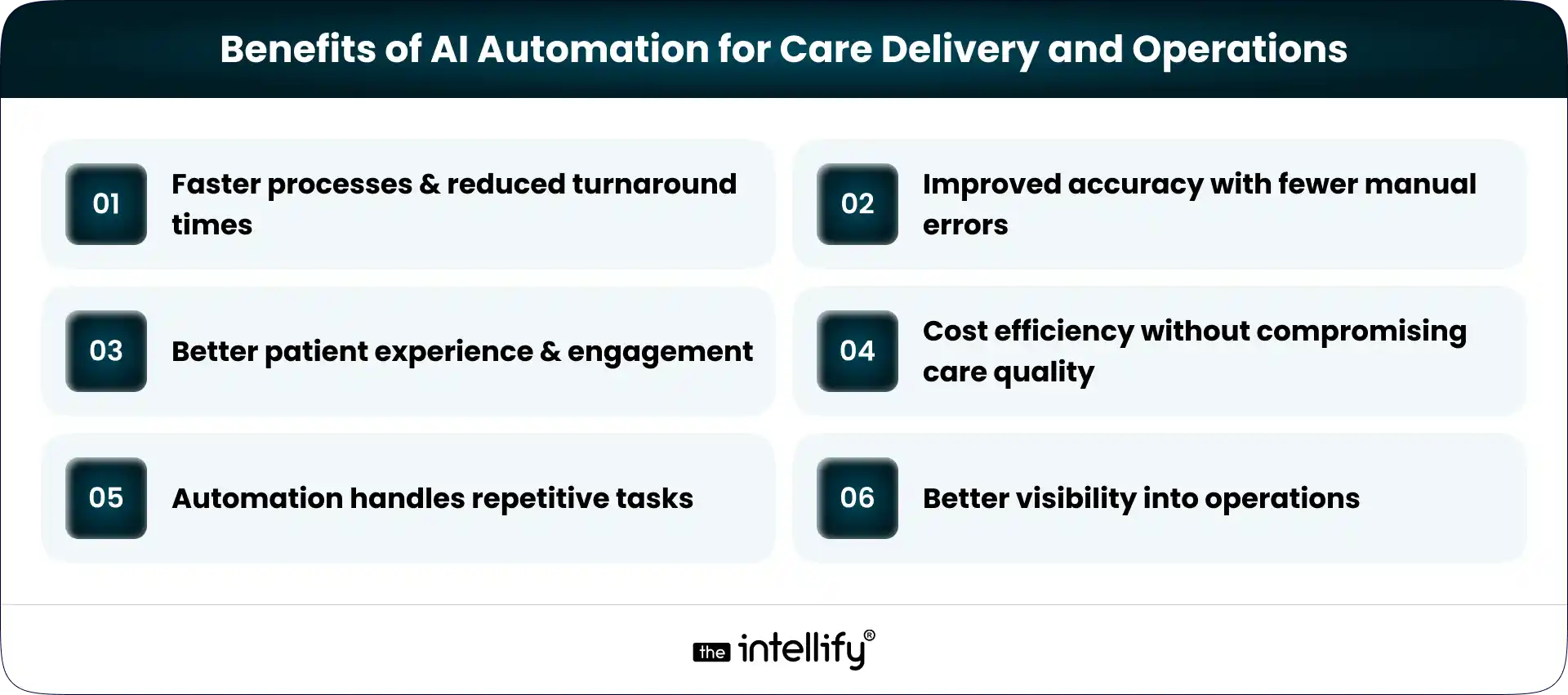
This part’s honestly a game changer. AI tools can manage scheduling, collect patient data, and even assist in documentation. It doesn’t replace human judgment, it just removes repetitive work that slows everything down.

How telehealth fits into long-term healthcare delivery models

We’re moving toward hybrid care. Some visits happen in person, others online. It’s not about replacing traditional care, it’s about making it more flexible and accessible.


Telehealth App Development: Understanding the Bigger Picture

When most people hear telehealth, they picture a video consultation. That’s just the surface. Healthcare App Development today is about building complete digital ecosystems that support the entire care journey.

What telehealth apps actually include beyond video calls

Think scheduling systems, patient records, billing, messaging, analytics, everything connected in one place.

Key stakeholders: patients, doctors, admins, care teams

It’s not just doctor and patient anymore. Nurses, coordinators, and admin staff all interact with the system. So the app has to work for everyone, not just one group.

Difference between basic telemedicine and advanced digital care platforms

Basic telemedicine = consultation.
Advanced platforms = continuous care, monitoring, data insights, follow-ups the whole journey.

Where AI automation enhances decision-making and workflows

AI can flag high-risk patients, suggest next steps, and even prioritize cases. It’s not replacing doctors, it’s helping them move faster and smarter.


Core Features Every Telehealth Platform Should Include

Features of Telehealth Platform

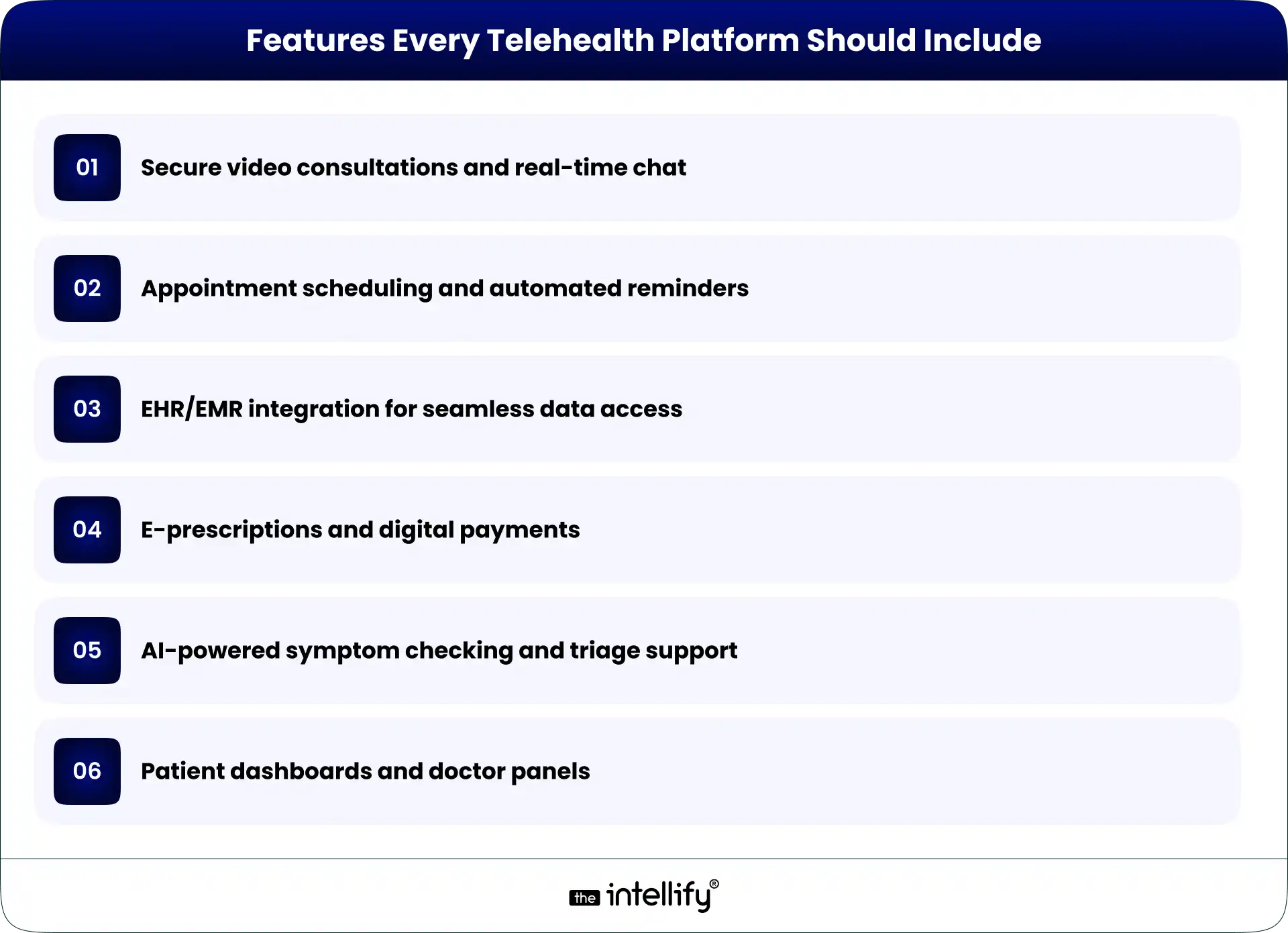
If you’re building a telehealth platform, these features aren’t optional, they’re foundational.

  • Secure video consultations and real-time chat: This is the core experience. Video calls should be stable, clear, and secure. Even small lags or glitches can frustrate users.
  • Appointment scheduling and automated reminders: Manual scheduling is messy. Automated systems reduce missed appointments and help providers manage time better.
  • EHR/EMR integration for seamless data access: Doctors need context. Without access to patient history, even simple consultations become inefficient.
  • E-prescriptions and digital payments: Patients shouldn’t have to switch between systems. Everything from consultation to payment should happen in one smooth flow.
  • AI-powered symptom checking and triage support: Before even meeting a doctor, patients can input symptoms. This helps prioritize cases and saves time during consultations.
  • Patient dashboards and doctor panels: Dashboards keep everything organized: appointments, reports, prescriptions. Doctors and patients both need clear visibility.


Benefits for Providers and Patients

Telehealth isn’t just about convenience, it improves how healthcare works on both sides.

  • Improved access to care: Patients in remote areas or with mobility issues can get medical help without traveling long distances.
  • Reduced operational burden: Less paperwork, fewer physical visits, and better scheduling systems make operations smoother.
  • Better patient engagement: When care is easier to access, patients are more likely to follow up, attend appointments, and stay involved.
  • Cost efficiency: Providers save on infrastructure costs, while patients save on travel and time.
  • Faster decision-making with AI support: AI tools help doctors process information quickly, leading to faster and often more accurate decisions.


Telehealth App Development Company


How AI Automation Is Transforming Telehealth App Solutions

AI isn’t just an add-on anymore, it’s becoming a core part of Telehealth app solutions.

Smart appointment scheduling and no-show reduction

AI can analyze patterns and suggest optimal appointment slots. It can even predict when patients might miss appointments.

AI chatbots for patient support and intake

Basic queries don’t need human intervention. AI Chatbots can handle FAQs, onboarding, and initial data collection instantly.

Clinical decision support systems

AI can assist doctors by analyzing patient data and suggesting possible diagnoses or treatments. It’s not perfect, but it’s useful.

Automated documentation and voice-to-text notes

Doctors spend less time typing and more time interacting with patients. Conversations can be converted into structured medical notes.

Predictive analytics for patient monitoring

AI can detect early warning signs by analyzing trends in patient data. This helps in proactive care.

Personalized care recommendations

Treatment plans can be tailored based on patient behavior, history, and real-time data.


Ensuring Compliance, Security, and Data Privacy

Healthcare data is sensitive. There’s no room for mistakes here.

Importance of regulatory compliance (HIPAA, GDPR, etc.): Healthcare apps must follow strict regulations depending on the region.

Non-compliance can lead to serious consequences: Secure data storage and encryption practices: Patient data must be encrypted at all stages of storage, transmission, and access. No exceptions.

User authentication and access control: Different users need different levels of access. Role-based permissions help protect sensitive data.

Risks of non-compliance and how to avoid them: Legal issues, fines, and loss of trust all of it can happen if compliance is ignored.

Building trust with patients through transparent data handling: Patients are more likely to use digital healthcare if they trust how their data is handled.


Telehealth App Development Process: From Idea to Launch

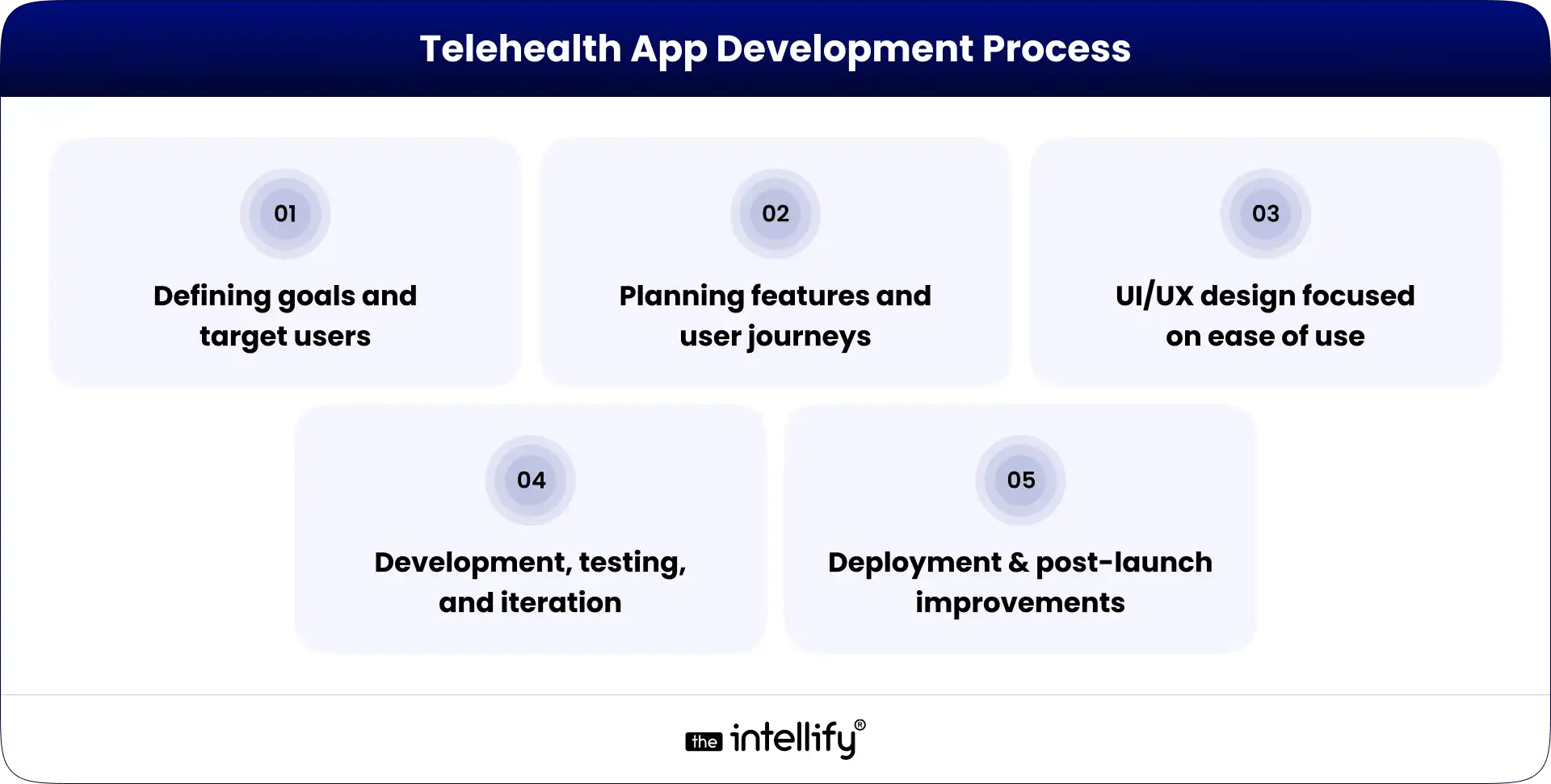
Telehealth App Development Process

Building a telehealth app isn’t just about writing code, it’s about solving real problems step by step, with a clear plan from the start.

Defining goals and target users

Everything begins with clarity. You need to understand who the app is for patients, doctors, or both and what exact problem you’re trying to solve. Without this, it’s easy to build something that looks good but doesn’t really help anyone.

Planning features and user journeys

Once the goals are clear, the next step is mapping how users will move through the app. From booking an appointment to completing a consultation, every step should feel simple and natural. If the journey feels confusing, users will drop off.

UI/UX design focused on ease of use

Design matters more than people think. Healthcare apps are used by all age groups, so the interface needs to be clean, clear, and easy to navigate. If users have to “figure things out,” it usually means the design needs improvement.

Development, testing, and iteration

This is where the actual build happens, but it’s not a one-time process. The app is developed in phases, tested regularly, and improved based on feedback. Issues will come up that’s normal. The key is fixing them early.

Deployment and post-launch improvements

Launching the app isn’t the end, it’s just the beginning. Real users will interact with it in unexpected ways, and their feedback helps shape future updates. Continuous improvements are what keep the app relevant and useful over time.


Cost Factors That Influence Telehealth App

Costs can vary a lot. And yeah, it depends on what you’re building.

  • Feature complexity and customization level: More advanced features increase development time and cost.
  • Integration requirements (EHR, payment systems, etc.): Connecting with existing systems adds layers of complexity.
  • AI capabilities and data infrastructure: AI requires data, processing power, and continuous tuning.
  • Development team structure and location: Costs differ based on whether you’re working with in-house teams or external partners.
  • Ongoing maintenance and updates: Apps need regular updates, security patches, and improvements.


Common Challenges in Building Telehealth Platforms

It’s not all smooth. Some challenges are kinda unavoidable.

  • Integration with legacy healthcare systems: Older systems aren’t built for modern integrations. APIs and middleware help bridge the gap.
  • Managing data security at scale: As your user base grows, so do security risks. Planning early helps avoid bigger issues later.
  • Ensuring a smooth user experience for all age groups: Not everyone is comfortable with technology. Simplicity matters more than design trends.
  • Handling real-time communication without lag: Video and chat systems need a strong infrastructure. Even slight delays can affect user experience.
  • Balancing innovation with compliance requirements: You can’t move fast and break things in healthcare. Everything needs to be controlled and compliant.


Real-World Use Cases Across Healthcare Segments

Telehealth is already being used across different areas, and it’s only expanding as providers find more practical ways to apply it.

Virtual consultations for general practice

Patients can handle routine check-ups, minor illnesses, and follow-ups without visiting a clinic. It saves time for both patients and doctors, especially for non-urgent cases.

Remote patient monitoring for chronic conditions

For conditions like diabetes or hypertension, continuous monitoring helps doctors track progress without frequent in-person visits. It also allows early intervention if something seems off.

Mental health and therapy platforms

Online therapy has made mental health support easier to access. Patients often feel more comfortable attending sessions from home, which improves consistency.

Post-surgery follow-ups and rehabilitation

Recovery doesn’t always require hospital visits. Patients can share updates, attend follow-ups, and receive guidance remotely while recovering at home.

Rural and underserved area healthcare access

Telehealth helps bridge the gap where medical facilities are limited. Patients in remote areas can connect with specialists without long travel, improving overall access to care.


What to Look for in a Telehealth App Development Company

Choosing the right Telehealth App Development Company can make or break your project. It’s not just about technical skills, it’s about understanding healthcare, users, and long-term goals.

Experience in healthcare and compliance standards

Healthcare is complex, with strict regulations and workflows. You need a team that already understands compliance requirements like HIPAA or GDPR, not one that’s learning on the go.

Ability to integrate AI automation effectively

AI should simplify processes like scheduling, patient intake, and documentation. A good team knows where AI adds value, and where it might just create confusion.

Strong portfolio and proven case studies

Past work gives you a clear picture of what the company can deliver. Look for real projects, not just concepts, especially in healthcare or similar regulated industries.

Focus on scalability and long-term support

Your app shouldn’t feel limited after launch. It should be built to scale as your user base grows, with ongoing support for updates, security, and new features.

Clear communication and transparent processes

If communication feels unclear or slow in the early stages, that’s usually a sign of bigger issues later. You want a team that keeps things simple, honest, and easy to follow. Healthcare-focused companies like The Intellify  are often involved in projects where ongoing collaboration and clarity matter throughout development.


Future Trends in Telehealth and AI-Driven Healthcare

This space is evolving quickly, and honestly, it’s not slowing down anytime soon. What we’re seeing right now is just the early version of what telehealth can actually become. A lot of things that felt “advanced” a few years ago are now becoming standard.

Expansion of AI-powered diagnostics

AI will support doctors by analyzing data faster and spotting patterns early. It won’t replace clinical decisions but will help improve accuracy and speed.

Integration with wearable devices and IoT

Health data from devices like smartwatches will connect directly with telehealth apps, giving doctors a more continuous view of patient health.

Real-time health analytics and alerts

Systems will track patient data in real time and send alerts when something seems off, helping providers act earlier.

Hyper-personalized patient experiences

Care plans will become more tailored based on individual health data, making treatment more relevant.

Growth of decentralized and home-based care models

More care will shift from hospitals to homes, supported by telehealth platforms and connected devices.


Telehealth app development solutions


Final Thoughts

Building a telehealth app isn’t about adding more features; it’s about solving real problems. If patients struggle to book appointments or join consultations, the tech doesn’t really matter.

The key is balancing innovation with usability and trust. Healthcare apps need to feel simple and reliable, not complicated. AI automation will keep playing a role by reducing manual work and helping providers make faster decisions, but it has to be used carefully.

In the end, a well-built telehealth platform improves access, reduces effort for providers, and makes care more efficient. That’s what actually matters.


Frequently Asked Questions (FAQs)

1. How long does it usually take to build a telehealth app?

It depends on the features and complexity. A basic version can take 3-4 months, while a fully integrated platform with AI, EHR, and advanced features may take 6-9 months or more.

2. What makes a telehealth app actually successful in real use, not just in launch?

Ease of use, reliable video quality, strong data security, and smooth doctor-patient workflows matter more than just features. If users find it simple and trustworthy, they stick with it.

3. How do telehealth apps handle sensitive patient data securely?

They use encryption, secure cloud storage, and strict access controls. Following regulations like HIPAA or GDPR ensures patient data is handled safely and responsibly.

4. Can a telehealth app integrate with existing hospital systems?

Yes, most modern solutions are built to integrate with EHR/EMR systems, payment gateways, and other healthcare tools through APIs. This helps avoid data silos.

5. What are the biggest mistakes to avoid when building a telehealth solution?

Overloading with features, ignoring user experience, and not planning for compliance early on are common mistakes. Simplicity and clarity always win.

6. How much does it cost to develop a telehealth platform?

Costs vary widely based on features, integrations, and technology. A basic app may start lower, while a scalable, AI-enabled solution can require a larger investment.

7. Who should consider investing in telehealth app development today?

Hospitals, clinics, startups, and even individual practitioners looking to expand reach, improve patient care, or streamline operations can benefit from it.

Top AI Trends in Healthcare: Transforming Digital Health in 2026

Summary:
AI trends in healthcare are helping systems become smarter and more data-driven instead of just digital. They support early disease detection, personalized treatments, and remote patient monitoring. This is improving how care is delivered while making hospital operations more efficient. AI also helps reduce the workload on healthcare providers and improves overall patient experience. Despite some challenges, it is becoming an important part of modern, connected healthcare systems.


Why AI is Becoming the Driving Force Behind Digital Health

Healthcare isn’t just going digital anymore; it’s becoming smarter. As technology keeps advancing, artificial intelligence (AI) is reshaping the healthcare landscape in ways we never imagined. With hospitals facing increasing demands to enhance speed, accuracy, and overall patient care, AI is proving to be a crucial ally in bridging the gap between vast amounts of data and actionable decision-making.

In this blog, we’ll delve into AI trends in healthcare that are actively revolutionising digital health. From predictive analytics to personalised treatment plans, these trends are dramatically transforming our approach to healthcare.


Digital Health Transformation in Modern Healthcare Systems

So what does “digital health” really mean today? It goes beyond just having software and applications; it’s about establishing a connected, data-driven healthcare system that genuinely meets patient needs. Modern healthcare systems aren’t just digitizing existing processes; they’re harnessing technology to create a more responsive, integrated, and efficient environment.

Patients today have higher expectations regarding speed, access, and personalized care. They want more than just scheduled visits; they’re looking for tailored health experiences. Digital transformation alone isn’t sufficient adding a robust AI layer is essential to fully leverage the potential of this shift.


The Growing Role of AI in Healthcare Industry

The surge of data in healthcare from electronic health records (EHRs) to wearables and diagnostic tools is monumental. Yet, traditional human-led systems can no longer manage this volume alone. AI isn’t here to replace healthcare professionals; it’s designed to support them. It serves as the backbone of modern healthcare systems, delivering insights and analytics that lead to better patient outcomes.

Today, AI is being used across multiple touchpoints in healthcare, from analyzing patient records to assisting in diagnosis and treatment planning. This shift is helping healthcare professionals rely more on data-backed insights rather than assumptions.


Key AI Trends in Healthcare Driving Digital Health Transformation

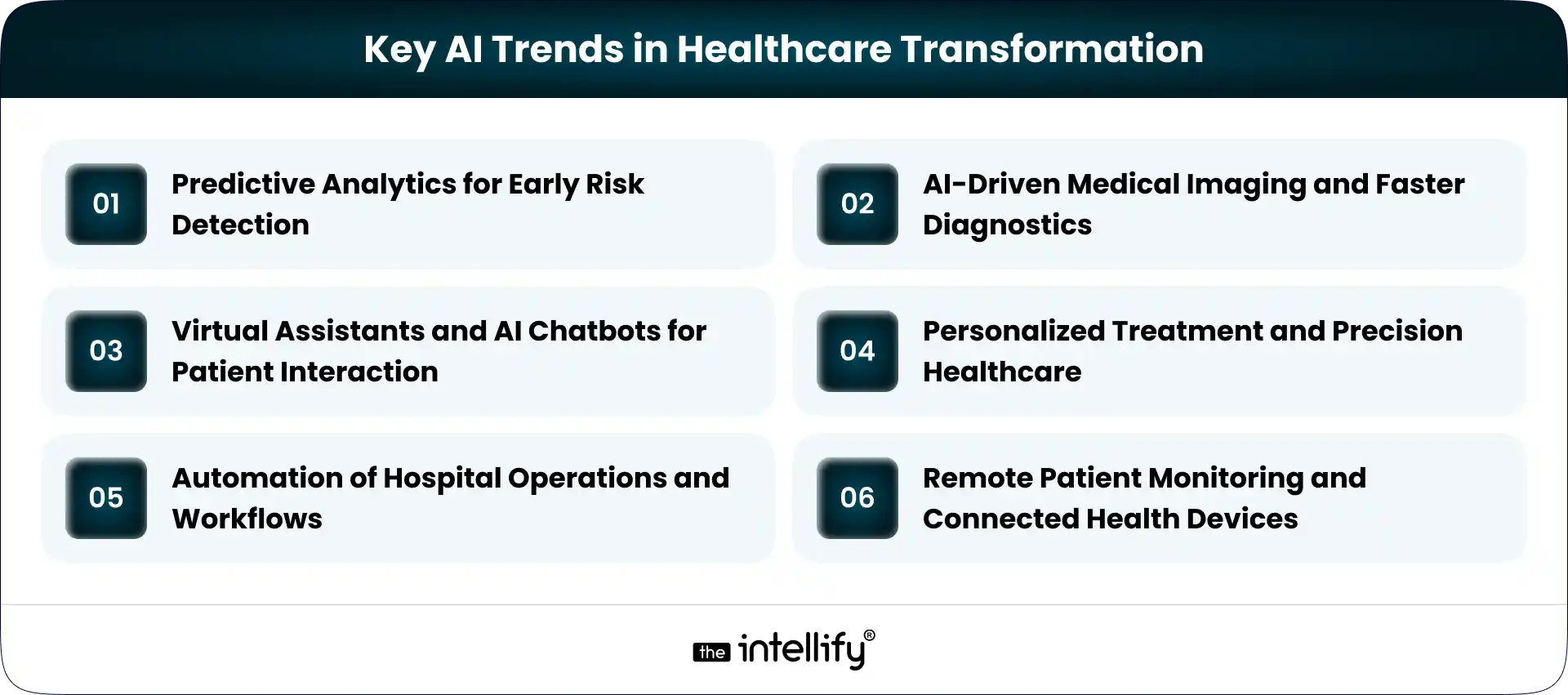
Key AI Trends in Healthcare Transformation

Predictive Analytics for Early Risk Detection

AI’s knack for identifying health risks before symptoms escalate is truly transformative. By analyzing patterns in patient data, healthcare providers can implement preventive measures rather than waiting for issues to arise. This proactive approach is significantly beneficial in chronic disease management and helps alleviate the burden on hospitals.

For example, AI can flag early signs of conditions like heart disease or diabetes based on patient history and lifestyle patterns. This helps hospitals reduce emergency cases and manage patient care more effectively.

AI-Driven Medical Imaging and Faster Diagnostics

AI is stepping up medical imaging, enhancing accuracy in scans like X-rays and MRIs while cutting down on diagnosis time and reducing human error. This assists specialists, offering faster insights that empower them to make well-informed decisions.

This not only improves accuracy but also reduces the workload on radiologists, allowing them to focus on complex cases. Faster diagnosis also means quicker treatment decisions for patients.

Virtual Assistants and AI Chatbots for Patient Interaction

AI chatbots are stepping in to boost patient engagement by delivering round-the-clock support without adding to staff workloads. From scheduling appointments to providing basic consultations, these tools enhance access to healthcare services and allow healthcare professionals to concentrate on critical tasks.

This improves patient convenience by reducing waiting times and makes basic healthcare support available anytime. It also reduces the pressure on hospital front desks and support teams.

Personalized Treatment and Precision Healthcare

AI dives into patient history, genetics, and lifestyle to create tailored treatment plans. This results in better outcomes with fewer unnecessary treatments, ushering in a more efficient, patient-centered healthcare experience.

Automation of Hospital Operations and Workflows

Thanks to AI, hospitals can automate mundane manual tasks like paperwork and administrative duties, substantially reducing the administrative load. This allows healthcare staff to dedicate more time to patient care, ultimately boosting the quality of service.

Automation also reduces the chances of manual errors in billing and records, while helping hospitals manage costs more efficiently over time.

Remote Patient Monitoring and Connected Health Devices

Wearables and IoT devices enable constant health monitoring, providing healthcare professionals with real-time alerts and updates about patients’ conditions. This capability leads to better management of long-term patients and those recovering post-treatment.

This is especially helpful for elderly patients and those with chronic conditions who need regular monitoring without frequent hospital visits.


AI for Healthcare operations


Real-World Applications of AI in Digital Healthcare

Several real-world applications are illustrating AI’s profound impact on digital healthcare:

  • AI Powered Telehealth Platform: These systems are making remote consultations more efficient and accessible. These platforms allow patients to consult doctors remotely, improving access to care.
  • Smart diagnostic systems used in hospitals: Hospitals are increasingly relying on AI for accurate diagnostic assistance. AI in healthcare helps doctors detect diseases faster and with better accuracy.
  • AI in drug discovery and clinical research: AI can shift through vast datasets, accelerating the drug discovery process. AI speeds up research by analyzing large datasets in less time.
  • Intelligent ICU systems: Utilizing AI, these systems monitor patients and enhance emergency response times. These systems monitor patients continuously and alert staff instantly in emergencies.


Impact of AI on Healthcare Businesses and Providers

Incorporating AI is enabling better resource management while alleviating operational pressures on healthcare providers. This allows them to scale services without significantly increasing costs, maintaining a competitive edge in the ever-evolving digital healthcare landscape. Higher patient satisfaction translates to increased trust and retention rates.

AI also helps healthcare organizations make better strategic decisions based on data insights and supports long-term scalability as patient demand grows.


Challenges in Adopting AI for Digital Health Transformation

While the advantages are evident, various challenges still need addressing:

1. Data Privacy and Security Concerns: Safeguarding patient data is critical, and concerns over data security can complicate AI adoption.
2. Integration Issues: Existing legacy systems might clash with new AI solutions, leading to compatibility challenges.
3. High Intial Cost and Technical Complexity: The upfront costs for AI can be quite significant, which can deter some organizations.
4. Resistance to Change: Staff who are accustomed to traditional workflows might resist adopting new processes.


How to Successfully Implement AI in Healthcare Systems

To achieve successful AI integration, consider these strategic steps:

1. Start with clear, Pratical Use Cases: Target specific areas rather than trying to implement everything all at once.
2. Ensure Clean and Accessible Data: High-quality data is vital for the effectiveness of AI.
3. Choose Scalable and Flexible AI Solutions: Invest in technology that can adapt and grow with your organization.
4. Collaborate with Experienced Technology Partners: Working with experts will help ensure a smoother implementation process.
5. Train Teams for Digital Workflows: Proper training ensures that staff can effectively utilize new systems.


What’s Next for AI in Healthcare

We can anticipate an increasing use of predictive and preventive healthcare models that will further connect ecosystems involving hospitals, patients, and devices. As accuracy, speed, and personalization continue to improve, AI will undoubtedly become an integral part of every healthcare system.

As AI continues to evolve, we can expect more advanced and seamless integration into everyday healthcare processes, making it a standard part of modern healthcare systems.


AI solutions for Healthcare


Conclusion:

AI in healthcare is not just a supporting player in digital transformation; it’s at the forefront of driving it. Healthcare is evolving to be smarter, faster, and more patient-centric. Organizations that adapt early will help shape the future of healthcare, providing high-quality care while streamlining operations. Embracing AI isn’t just a choice anymore; It’s a necessity for any healthcare provider aiming for success.


Frequently asked questions (FAQs)

1. What makes AI a key driver behind digital health transformation today?

Digital systems alone manage data, but AI turns that data into useful insights. This ability to predict risks and support decisions is what makes AI central to real transformation in healthcare.

2. How is AI improving decision-making in modern healthcare systems?

AI analyzes large volumes of patient data in seconds, helping doctors make faster and more informed decisions. It reduces guesswork and supports better clinical outcomes without replacing human expertise.

3. In what ways are AI-driven healthcare solutions improving operational efficiency?

AI automates routine tasks like scheduling, billing, and data entry, reducing administrative workload. This allows healthcare teams to focus more on patient care while improving system efficiency.

4. How do AI trends support the shift toward personalized healthcare?

AI studies patient history, behavior, and medical data to suggest tailored treatments. This leads to more effective care plans and reduces the chances of unnecessary or ineffective treatments.

5. Why is integrating AI into existing healthcare systems still a challenge?

Many healthcare systems rely on outdated infrastructure, making integration complex. Along with that, concerns around data security and cost slow down adoption despite clear benefits.

6. How can healthcare organizations scale AI adoption without disrupting operations?

They can start with focused use cases like diagnostics or workflow automation and expand gradually. This step-by-step approach reduces risk and helps teams adapt more smoothly.

7. How are AI trends shaping the next phase of digital health transformation?

AI is pushing healthcare toward more connected, predictive, and patient-focused systems. Over time, it will become a standard layer across all digital healthcare solutions

How Digital Transformation in Healthcare Is Shaping the Industry’s Future

Summary:
Digital transformation in healthcare is changing how systems, data, and processes work together. It is helping improve coordination, reduce delays, and make operations more efficient. Healthcare organizations are using connected technologies and data to manage services better and respond faster. While there are challenges, many are moving forward step by step to improve their systems. Overall, it is shaping a more connected and efficient future for the healthcare industry.

Digital transformation in healthcare is changing how systems, data, and processes work together. It is helping improve coordination, reduce delays, and make operations more efficient. Healthcare organizations are using connected technologies and data to manage services better and respond faster. While there are challenges, many are moving forward step by step to improve their systems. Overall, it is shaping a more connected and efficient future for the healthcare industry.

It is not just improving how healthcare works today, but also shaping how systems will function in the coming years. As the industry evolves, digital transformation is becoming a key part of long-term healthcare growth.


How Healthcare Systems Are Becoming More Connected

In the past, healthcare often relied on outdated manual processes and isolated systems. Departments worked in silos, resulting in gaps in coordination and efficiency. As a consequence, managing the ever-growing sea of patient and operational data could feel like an uphill battle, leading to frustration for both providers and patients alike.

Nowadays, the demand for interconnected systems is surging. Healthcare providers are starting to understand that the secret to enhancing service delivery lies in building systems that foster communication and collaboration.

This level of connectivity reduces repeated work and improves the overall flow of services. It also helps different parts of the system work together more smoothly.


Digital Transformation in Healthcare as the New Foundation

Healthcare Digital Transformation

Digital transformation in healthcare isn’t just about switching to digital formats; it represents a fundamental change in how healthcare systems operate. This transformation aims to connect people, processes, and data into a smooth, cohesive flow.

  • Reducing operational gaps: Automation of workflows and system integration helps minimize delays and miscommunications, enabling better care delivery.
  • Modern foundation: This transformation forms the solid groundwork on which today’s healthcare systems are built, enhancing patient experiences and operational efficiencies.


What makes Digital Transformation Essential in Healthcare

The rapid pace of change in healthcare brings several challenges:

  • Managing Data: The amount of patient and operational data continues to grow. Digital transformation enables healthcare organizations to manage and harness this data for improved decision-making.
  • Faster Coordination: As healthcare teams expand, quick coordination across various systems becomes crucial. Digital tools offer real-time data sharing, ensuring everyone stays aligned.
  • Meeting Expectations: Today’s patients expect smooth, accessible services. Digital transformation equips healthcare providers to meet these rising expectations.

It also helps bring more consistency in how services are delivered across different systems. As operations grow, managing complexity without digital support becomes difficult.


Where Digital Healthcare Transformation Is Creating Real Impact

Digital healthcare transformation is delivering tangible benefits across the industry:

  • Improved coordination: Departments and teams can now communicate effectively, fostering trust and collaboration.
  • Faster Communication: Instant messaging systems and data-sharing platforms cut down on waiting times and speed up decision-making.
  • Efficient Workflows: Routine processes are now more structured, giving healthcare professionals more time to focus on what matters patient care.

It also improves visibility across systems, helping teams make quicker and more informed decisions.


Technologies Behind Digital Transformation in Healthcare Solutions

Several cutting-edge technologies drive the digital transformation in healthcare solutions:

  • AI: This technology speeds up analysis and supports quicker decision-making.
  • Cloud Systems: These enable secure access to and sharing of data.
  • Connected Devices: They allow for continuous monitoring of patient health.
  • Data Platforms: These help organize and simplify vast amounts of information.
  • Integration Tools: They link multiple systems, facilitating smooth operations.

Together, these technologies form the backbone of a transformed healthcare landscape, paving the way for smarter, more efficient practices.


Digital transformation Solutions


How healthcare Operations Are Being Reshaped Internally

Internally, healthcare operations are prioritizing efficiency:

  • Reduction in manual work: Automation takes over routine tasks, freeing staff to focus on vital issues.
  • Faster process Handling: Fewer bottlenecks in workflows enable healthcare facilities to quickly respond to patient needs.
  • Better Use of Resources: By optimizing staff time and hospital resources, organizations can provide improved care.
  • Improved Accuracy: Less manual intervention means fewer mistakes, boosting overall service quality.

This allows healthcare organizations to respond faster to changing needs and improve overall service delivery.


The Expanding Role of Data in Healthcare

Gone are the days when data was merely stored away. Now, it plays a vital role in everyday operations:

  • Real Time Access: Quick access to data enhances decision-making and planning processes.
  • Better Resource Management: Data analytics empower organizations to allocate staff and materials more effectively.
  • Connected Systems: A solid data strategy fosters informed systems that can dynamically respond to patient needs.

Over time, this is helping healthcare systems move toward more planned and proactive decision-making.


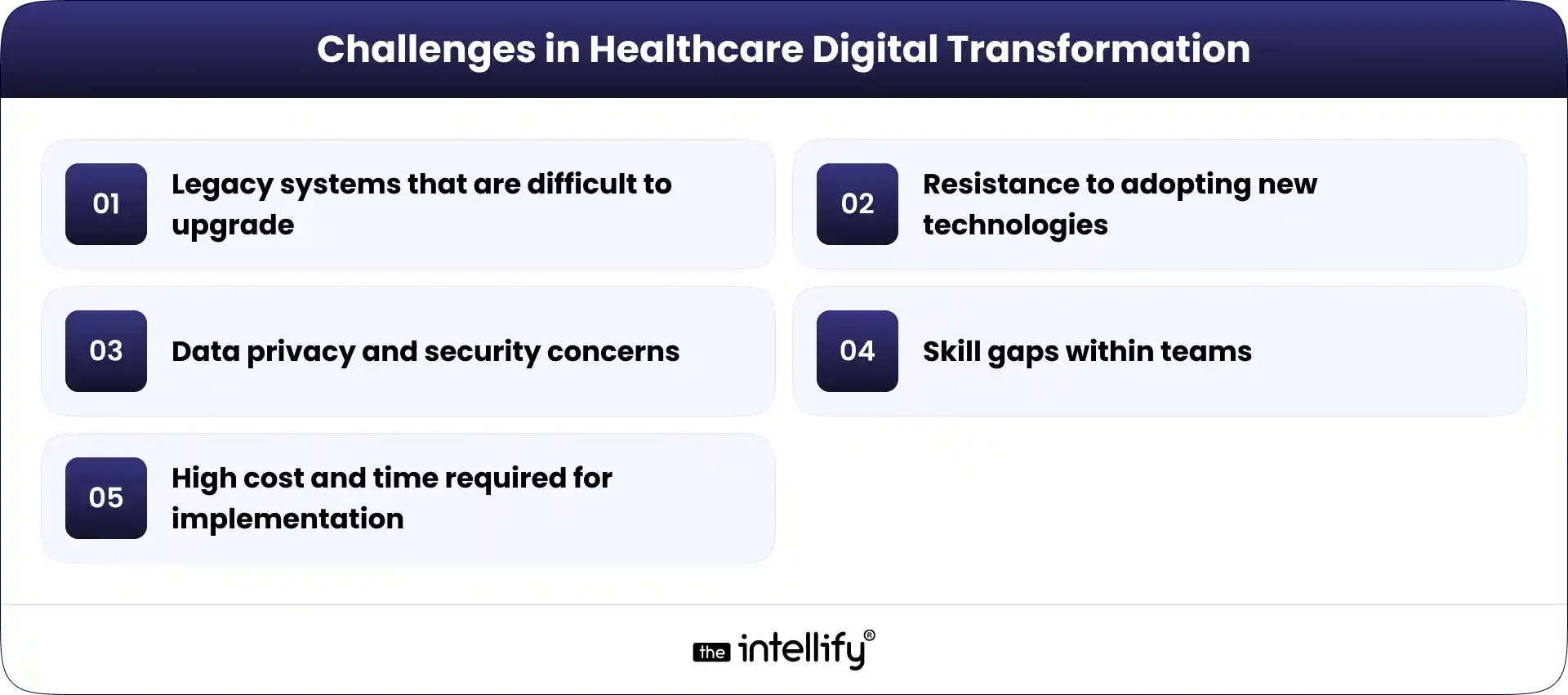
Challenges in Adopting Digital Transformation in Healthcare

Challenges in Healthcare Digital Transformation

Yet, the path to adopting digital transformation isn’t without its hurdles:

  • Legacy Systems: Many organizations struggle with outdated systems that aren’t easy to upgrade.
  • Privacy and Security Concerns: Safeguarding sensitive patient data is crucial and can slow technology adoption.
  • Resistance to Change: Some staff may be hesitant to embrace new technologies, which can stall progress.
  • Skill Gaps: Existing teams might lack the necessary skills for implementation, requiring additional training.
  • Implementation Costs: Upgrading systems can be costly and time-consuming, making many organizations hesitant to proceed.

These challenges can slow progress, but with the right approach, they can be managed over time.


How Healthcare Organizations Are Improving Their Systems

Healthcare organizations are cautiously progressing with strategies to enhance their frameworks:

  • Gradual adoption: Instead of a complete overhaul, many are choosing incremental improvements that minimize disruption.
  • Training Initiatives: Investing in staff training ensures teams are ready to tackle new systems effectively.
  • Scalable Solutions: Organizations focus on flexible technology that can adapt as their needs grow.
  • Partnerships with Tech Providers: Teaming up with experienced technology providers can lead to better outcomes.
  • Long Term Focus: Emphasizing ongoing improvements and results is crucial for sustainable transformation.

The focus is on making systems more stable, reliable, and easier to manage in the long run.


Real-World Applications in Healthcare Services

Digital transformation in healthcare services is already showing its worth in various areas:

  • Online Consultations: Telehealth is enhancing patient access to healthcare services.
  • Digital Health Records: Streamlined management of information reduces paperwork and makes care more efficient.
  • Remote Monitoring: Wearable tech supports continuous patient care, boosting health outcomes.
  • Automation: Routine tasks, from scheduling to billing, are increasingly automated to cut delays.
  • Better Coordination: Enhanced communication tools ensure smooth service across all touchpoints.

These applications are already changing how healthcare services are delivered and experienced.


How Healthcare Systems Are Changing for the Future

The future of healthcare is on a transformative path:

Connected Systems: Improved integration offers a more holistic view of patient care.

Faster Service Delivery: Automation and streamlined processes ensure prompt care.

Increased Automation: Smart tools and technologies are set to reshape daily operations further.

Improved Coordination: A more connected infrastructure will facilitate stronger relationships among providers.

Healthcare systems are expected to become more proactive rather than reactive in handling needs.


What Healthcare Organizations Need to Focus on Next

Looking ahead, healthcare organizations should concentrate on:

Scalability: Designing systems that can adapt to future challenges.

Digital Strategy: Making digital transformation a cornerstone of long-term planning.

Continuous Improvement: Prioritizing process refinement over merely implementing new tools.

Alignment of Teams: Ensuring that people, processes, and technology work in harmony.

Staying Adaptable: Keeping an open mind toward new technologies and changing patient expectations.

The goal is to build systems that can support continuous change and future growth.


Healthcare digital transformation solutions


Conclusion:

Digital transformation is no longer a choice; it’s central to how the healthcare industry operates. As organizations embrace these changes, they’re paving the way for more connected, efficient systems that ultimately benefit everyone from healthcare providers to patients.

The journey is just beginning, and healthcare organizations need to remain flexible and proactive to stay relevant in an ever-evolving landscape. By effectively implementing these changes, the future of healthcare looks bright, buoyed by innovation and progress.


Frequently Asked Questions

1. Why do traditional healthcare systems face limitations?

They depend on manual work and disconnected systems, which slows down processes. This makes it harder to manage data, coordinate teams, and deliver services efficiently.

2. How do connected systems improve healthcare services?

They allow information to move smoothly between departments and teams. This improves coordination, reduces errors, and helps deliver services faster.

3.. What changes do healthcare teams notice after going digital?

Teams experience faster workflows and less dependency on paperwork. They also see better accuracy and smoother coordination across different departments.

4. What are the common challenges in digital transformation for healthcare?

Many organizations struggle with outdated systems and data security concerns. They also need time and training to help teams adapt to new ways of working.

5. What should healthcare organizations focus on moving forward?

They should focus on building flexible systems that can adapt over time. Continuous improvement in processes and team readiness is also important for long-term success.

View
Case Study