Summary:
This guide explains how to develop HIPAA-compliant software in 2026. It covers key requirements such as data encryption, access controls, audit logs, secure APIs, cloud security, BAAs, risk assessments, and security testing. It also includes a practical checklist to help healthcare organizations build secure software while addressing current HIPAA Security Rule requirements and emerging cybersecurity expectations.
Healthcare software now handles far more than patient records.
Patient portals, telehealth platforms, healthcare CRMs, mobile apps, remote monitoring tools, insurance systems, AI applications, and connected healthcare platforms all process sensitive information. When protected health information (PHI) or electronic protected health information (ePHI) is involved, security and privacy need to be considered from the beginning.
That is where HIPAA-compliant software development comes in.
HIPAA compliance is not a feature that can simply be switched on before launch. It involves how software collects, stores, accesses, transmits, and protects health information, along with the policies, processes, contracts, and safeguards surrounding the system.
There is also an important 2026 update.
The current HIPAA Security Rule remains in effect. HHS has proposed changes that would strengthen cybersecurity requirements for regulated entities, including proposed requirements around multi-factor authentication, encryption, vulnerability scanning, penetration testing, network segmentation, written risk analyses, and backup and recovery. These proposals are not the current Security Rule.
So, what should healthcare organizations and software teams actually check when developing or modernizing a healthcare application?
HIPAA Compliance in Healthcare Software Development
HIPAA compliance in healthcare software development means designing and maintaining software in a way that supports the HIPAA requirements applicable to the organization, the data it handles, and its role in the healthcare ecosystem.
HIPAA applies to covered entities and business associates. A software company can become a business associate when it performs certain functions or services involving PHI on behalf of a covered entity or another business associate.
The HIPAA Security Rule requires appropriate administrative, physical, and technical safeguards to protect ePHI and support its confidentiality, integrity, and availability.
For a software development team, this can translate into:
- Secure authentication
- Role-based access control
- Encryption
- Audit controls
- Secure data transmission
- Data integrity controls
- Backup and recovery
- Vulnerability management
- Incident response
- Secure APIs
- Cloud security
- Vendor management
- Workforce security and training
- Regular risk assessments
The important part is that these controls work together.
For example, an encrypted database does not solve the problem if unauthorized users can still access it. Similarly, signing a BAA with a vendor does not automatically make an application HIPAA compliant.
HIPAA compliance is a combination of technology, people, processes, and contractual responsibilities.
HIPAA Compliance Statistics
Healthcare organizations continue to face serious cybersecurity threats, particularly ransomware and hacking.
HHS reported that from 2018 to 2023, reports of large breaches increased by 102%, while the number of individuals affected increased by 1,002%. HHS reported that more than 167 million individuals were affected by large breaches in 2023.
The enforcement activity has continued in 2026.
In April 2026, HHS’s Office for Civil Rights announced four HIPAA Security Rule ransomware settlements involving breaches affecting more than 427,000 individuals. The settlements brought OCR’s completed ransomware investigations to 19 at that time.
There is also a software-specific example worth paying attention to.
In March 2026, OCR announced a settlement with MMG Fusion, a software company that operated as a business associate. The investigation involved PHI belonging to approximately 15 million individuals. OCR identified potential violations involving risk analysis, authentication, encryption, breach notification, and workforce training.
For healthcare software companies, the message is pretty clear:
Security and HIPAA responsibilities cannot simply be passed to the healthcare organization using the software.
HIPAA: A Brief Outline and Its Importance to Software Developers
HIPAA was enacted in 1996, but the way healthcare organizations create, store, exchange, and process health information has changed dramatically since then.
For software developers, the most relevant HIPAA areas include the Privacy Rule, Security Rule, and Breach Notification Rule.
HIPAA Privacy Rule
The HIPAA Privacy Rule establishes standards for protecting PHI and governs certain uses and disclosures of that information.
From a software perspective, this means applications should be designed so that users can access only the information appropriate for their role and purpose.
That connects closely with the principle of limiting access to what is necessary for the intended task.
HIPAA Security Rule
The Security Rule specifically addresses electronic protected health information.
It requires covered entities and business associates to implement appropriate administrative, physical, and technical safeguards. The technical safeguards include areas such as:
- Access controls
- Audit controls
- Integrity controls
- Person or entity authentication
- Transmission security
The current Security Rule remains in effect in 2026.
HIPAA Breach Notification Rule
The Breach Notification Rule establishes requirements for notifying affected individuals, HHS, and, in certain circumstances, the media following breaches of unsecured PHI.
This is why an incident response plan should be considered during software architecture and operational planning rather than after an incident occurs.
Does HIPAA apply to every healthcare software application?
No. A software application being used in healthcare does not automatically mean the same HIPAA requirements apply to every situation.
The answer depends on factors such as:
- Who operates the software
- Whether the organization is a covered entity
- Whether the software company is a business associate
- What information does the system handle
- What services does the company perform
- How PHI is created, received, maintained, or transmitted
- What contractual relationships exist
For a specific product or business model, legal and compliance counsel should determine the applicable obligations.
Steps To Make Software HIPAA-Compliant
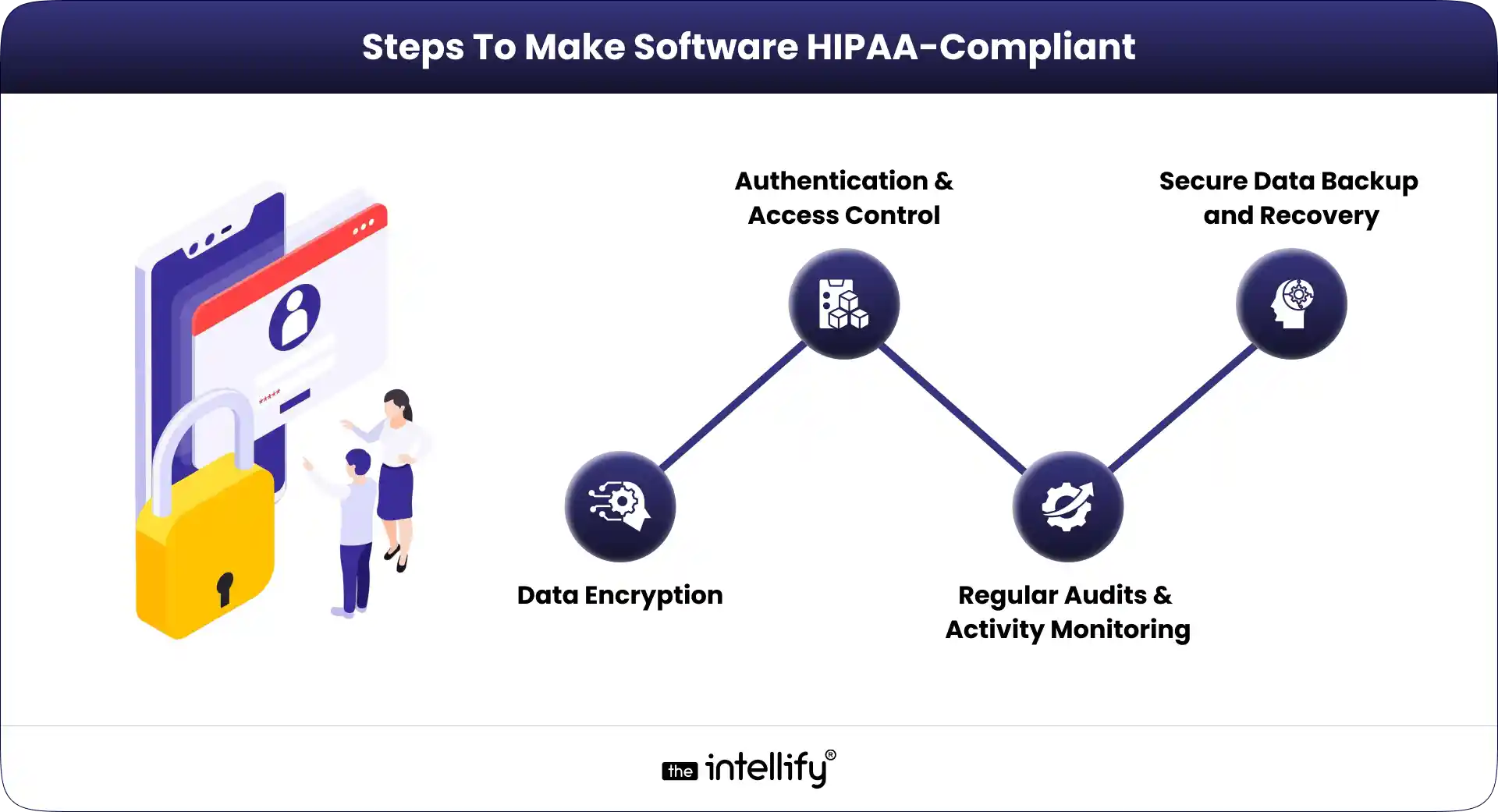
There is no single technology stack, certification, or cloud platform that automatically makes software HIPAA compliant. Instead, development teams need to build appropriate safeguards into the application’s architecture and operations.
1. Data Encryption
Encryption helps protect sensitive information from unauthorized access. For healthcare applications, consider encryption for:
- Data in transit
- Data at rest
- Databases
- File storage
- Backups
- Application secrets and credentials
- Communication between services
For data transmitted over networks, use modern secure transport protocols such as TLS.
For stored information, encryption should be implemented according to the organization’s risk assessment, architecture, and applicable requirements.
Encryption alone, however, is not enough. You also need to think about encryption keys.
- Who can access them?
- Where are they stored?
- How are they rotated?
- Can application developers access production keys?
These details can make a major difference to the security of the system.
2. Authentication and Access Control
Healthcare applications should make sure that only authorized users can access ePHI. Common controls include:
- Strong authentication
- Multi-factor authentication
- Role-based access control
- Least-privilege permissions
- Session management
- Account provisioning and deprovisioning
- Privileged-access controls
- Periodic access reviews
For example, a physician may need access to clinical information, while a billing employee may only need access to billing information.
Those permissions should be enforced by the application rather than relying on employees to decide what they should or should not open.
MFA is particularly worth considering for modern healthcare systems. HHS’s proposed Security Rule would require multi-factor authentication with limited exceptions, but that proposal has not replaced the current Security Rule.
3. Regular Audits and Activity Monitoring
A healthcare application should provide visibility into activity involving sensitive information.
A well-designed audit system should help answer questions such as:
- Who accessed the record?
- When was it accessed?
- What action did the user take?
- Was information changed?
- Was information exported?
- Were permissions modified?
- Was the activity unusual?
The current Security Rule requires audit controls that record and examine activity in information systems containing or using ePHI.
Logging is only part of the process, though. Organizations also need a reasonable approach to reviewing important events and responding to suspicious activity.
4. Secure Data Backup and Recovery
Healthcare organizations need reliable access to their systems and information. A ransomware attack, infrastructure failure, accidental deletion, or other incident can disrupt operations very quickly.
A healthcare application should therefore have a documented backup and recovery strategy.
Consider:
- Encrypted backups
- Automated backup schedules
- Multiple recovery points
- Separate backup environments
- Access controls for backup infrastructure
- Backup integrity checks
- Recovery testing
- Defined recovery priorities
- Documented disaster recovery procedures
And test those backups. A backup that cannot be restored when needed is not much help.
HHS’s proposed Security Rule includes more specific requirements for backup and recovery controls. Again, these are proposed changes rather than current requirements.
Functionalities That Characterize The HIPAA-Compliant Software
HIPAA-conscious software needs more than a login page and an encrypted database.
Its functionality should support controlled access, accountability, data integrity, secure communication, and protection throughout the data lifecycle.
1. Role-Based Access Control (RBAC)
Role-Based Access Control lets organizations assign permissions based on a user’s responsibilities.
For example:
| User Role | Example Access |
|---|---|
| Physician | Clinical records and relevant patient information |
| Nurse | Assigned patient records and clinical information |
| Billing Staff | Billing and payment-related information |
| Receptionist | Scheduling and limited demographic information |
| Administrator | Technical administration based on assigned privileges |
| Patient | Their own permitted health information |
The exact model will depend on the application.
The principle is simple: Users should receive the access they need to perform their role, and no more than necessary.
2. Data Integrity Controls
Healthcare information needs to remain accurate and trustworthy. Software can support data integrity through:
- Input validation
- Database constraints
- Transaction controls
- Change tracking
- Version history where appropriate
- Authorization checks
- Data validation rules
- Controlled record modification workflows
The system should also make it possible to identify important changes and investigate them when necessary.
3. Audit Logs and Monitoring
Audit logs provide a record of important system activity. Depending on the application, logs may capture events such as:
- Login attempts
- Successful authentication
- Failed authentication
- Patient record access
- Record changes
- Data exports
- Permission changes
- Administrative actions
- API requests
- Configuration changes
- Security events
Logs should also be protected from unauthorized alteration.
More importantly, organizations need a process for reviewing relevant events and responding to suspicious activity.
4. Data Transmission Security
Healthcare applications often connect with external systems. A patient portal may communicate with an API. A healthcare CRM may connect with an EHR. A telehealth application may use external communication infrastructure. Every integration introduces another potential attack surface.
Consider:
- TLS
- API authentication
- API authorization
- Secure tokens
- Rate limiting
- Input validation
- Secrets management
- Secure error handling
- API monitoring
- Data minimization
Third-party integrations deserve particular attention.
Before sending PHI to a third-party platform, determine what information is being transferred, why it is required, who receives it, and what contractual and technical safeguards apply.
5. Data Storage Security
Protecting stored healthcare information involves more than database encryption. Review:
- Database permissions
- Storage permissions
- Encryption
- Backup security
- Network isolation
- Credential management
- Secrets management
- Administrative access
- Data retention
- Data deletion
- Logging and monitoring
The goal is to understand where ePHI resides and who can access it throughout the application’s lifecycle.
Business Associate Agreements (BAAs): HIPAA Rules – The Legal Foundation
A Business Associate Agreement, or BAA, establishes certain permitted uses and disclosures of PHI and assigns responsibilities between a covered entity and its business associate.
A software company may become a business associate when it performs certain services involving PHI on behalf of a covered entity or another business associate.
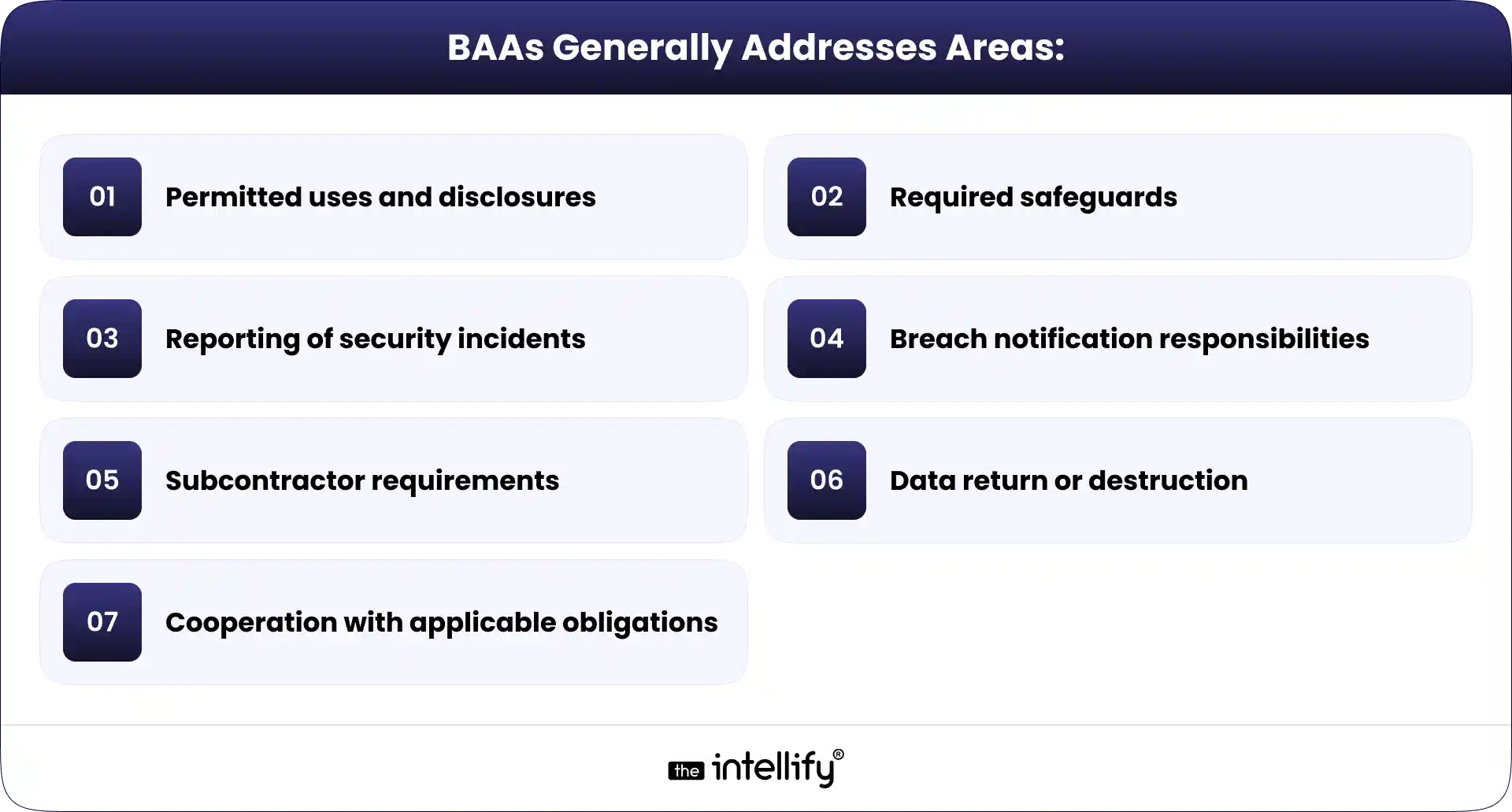 But remember: A BAA does not make insecure software HIPAA compliant.
It establishes contractual responsibilities. The software still needs appropriate technical and operational safeguards.
The same applies to cloud providers. HHS states that a cloud service provider that creates, receives, maintains, or transmits ePHI on behalf of a covered entity or business associate can be a business associate, and an appropriate BAA is required.
The Role that Cloud Services Play in HIPAA Compliance
Cloud computing has become a normal part of modern healthcare software architecture. Healthcare applications may use cloud infrastructure for:
- Application hosting
- Databases
- File storage
- Backups
- APIs
- Analytics
- Machine learning
- Disaster recovery
- Monitoring
Using the cloud does not automatically make a system non-compliant.
But it also does not automatically make it compliant. You need to understand how the cloud environment is configured and who is responsible for each security control.
What should you check with a cloud provider?
Before using a cloud service for a HIPAA-regulated workload, consider:
- Whether the provider will enter into a BAA where applicable
- Which services are covered
- Where ePHI will be stored
- How data is encrypted
- How keys are managed
- Who can access the environment
- How logs are maintained
- How backups are handled
- How incidents are reported
- How data is returned or deleted
- What security responsibilities remain with your organization
HHS notes that a cloud service provider can be a business associate even when it does not have access to the encryption key for encrypted ePHI, depending on the circumstances and services provided.
This is why simply asking, “Is this cloud provider HIPAA compliant?” is not always the right question.
Ask instead: “How will this specific cloud architecture protect the ePHI we are responsible for?”
That leads to a much more useful conversation.
HIPAA Compliance for the Development of Healthcare CRM Software
Healthcare CRM platforms can handle a wide range of information, including:
- Patient demographics
- Appointment information
- Communication history
- Referral information
- Insurance information
- Billing-related information
- Patient engagement activity
- Support conversations
- Outreach records
If PHI is involved, the CRM architecture needs to account for the applicable HIPAA requirements.
Secure patient profiles
Patient records should be protected through appropriate authentication, authorization, encryption, and access controls.
Permission-based workflows
Different teams may need different information.
A receptionist may need scheduling information.
A billing employee may need payment-related information.
A clinician may need clinical information.
The system should reflect those differences.
Secure communication
Healthcare CRM systems frequently include email, SMS, chat, notifications, and other communication channels.
Before using any communication channel for PHI, assess whether the channel and workflow provide appropriate protections and meet the organization’s legal and compliance requirements.
Auditability
The system should provide appropriate visibility into important access and modification events involving sensitive information.
Secure integrations
Healthcare CRMs often connect with EHRs, scheduling systems, payment platforms, patient portals, analytics tools, and other services. Each integration should be assessed for:
- Authentication
- Authorization
- Encryption
- Data minimization
- Logging
- Error handling
- Vendor security
- Contractual requirements
Ongoing Compliance: HIPAA Compliant Software Development – Lessons from the Field
HIPAA compliance is not a one-time development task. Applications change. Infrastructure changes. Employees change roles. Vendors change. New vulnerabilities appear.
A healthcare security program needs to change with them.
1. Employee Training
Employees are part of the security environment. Training should help people understand:
- How to handle PHI
- How to protect credentials
- How to identify suspicious activity
- How to report incidents
- How to use healthcare systems securely
- What their role-specific responsibilities are
Recent HHS enforcement activity involving MMG Fusion included workforce training as part of its corrective action plan, reinforcing that technical controls are only one part of a security program.
2. Risk Assessments
Risk analysis is a core requirement of the current Security Rule.
HHS states that regulated entities must conduct an accurate and thorough assessment of potential risks and vulnerabilities to the confidentiality, integrity, and availability of ePHI.
A useful assessment should look at:
- Application architecture
- Cloud infrastructure
- APIs
- User access
- Devices
- Third-party vendors
- Data flows
- Backup systems
- Network architecture
- Security monitoring
- Incident response
- Vulnerabilities
- Unpatched components
HHS’s proposed Security Rule would make several risk-analysis expectations more specific, including written assessments, technology asset inventories, and network maps.
3. Incident Response Plan
A security incident is not the time to decide who should respond. A documented incident response plan should define:
- How incidents are detected
- Who is responsible for responding
- How affected systems are isolated
- How evidence is preserved
- How compromised accounts are secured
- How the incident is investigated
- How affected parties are notified
- How breach notification obligations are handled
- How systems are recovered
- How lessons learned are incorporated into future security improvements
HHS’s recent enforcement actions repeatedly highlight the importance of risk analysis, incident response, safeguards, and documented security processes.
4. Secure Software Development and Testing
Security testing should be part of the development lifecycle. Depending on the application and risk profile, this may include:
- Secure code reviews
- Dependency scanning
- Static application security testing
- Dynamic application security testing
- API security testing
- Vulnerability scanning
- Penetration testing
- Authentication testing
- Authorization testing
- Cloud configuration reviews
- Secrets scanning
- Backup recovery testing
HHS’s proposed Security Rule would require vulnerability scanning at least every six months and penetration testing at least once every 12 months. These remain proposed requirements, but they provide a useful benchmark for organizations strengthening their security programs.
5. Keep Track of Third-Party Vendors
Your application may be well protected while a connected vendor introduces another risk. Review vendors that handle or receive sensitive information, including:
- Cloud providers
- Communication platforms
- Analytics tools
- AI services
- Payment providers
- CRM platforms
- EHR integrations
- Storage providers
- Customer support platforms
For every important vendor, understand:
- What information they receive
- Why they receive it
- Where it is processed
- How long is it retained
- How is it protected
- Whether a BAA is required
- What happens after the relationship ends
This is especially important when introducing AI into healthcare workflows.
If an AI service receives PHI, evaluate its data flows, retention, access controls, contractual terms, and security practices before sending production healthcare data to it.
Conclusion
HIPAA-compliant software development in 2026 is about much more than adding encryption and a secure login.
Healthcare organizations and software vendors need to think about the complete lifecycle of PHI from collection and transmission to storage, access, monitoring, backup, incident response, and disposal.
HIPAA-Compliant Software Development Checklist for 2026
- Determine whether HIPAA applies to the software and organization
- Identify covered entity and business associate relationships
- Map where PHI and ePHI enter, move, and reside
- Conduct an accurate and thorough risk analysis
- Implement appropriate access controls
- Use strong authentication
- Evaluate MFA based on the application’s security requirements
- Implement appropriate encryption based on risk and applicable requirements
- Maintain audit controls
- Secure APIs and third-party integrations
- Protect databases, storage, and backups
- Review cloud architecture and responsibilities
- Establish BAAs where required
- Evaluate third-party vendors
- Maintain backup and recovery procedures
- Test security and recovery processes
- Maintain an incident response plan
- Train relevant workforce members
- Review access permissions regularly
- Monitor security events
- Reassess risks as systems and environments change
The current HIPAA Security Rule remains in effect, while HHS’s proposed updates show the direction of federal healthcare cybersecurity policy. At the same time, current OCR enforcement demonstrates that risk analysis, security safeguards, breach response, and workforce responsibilities are already important compliance issues.
If you’re building a healthcare platform, modernizing an existing application, developing a healthcare CRM, connecting multiple systems, or introducing AI into a workflow that may involve PHI, security should be part of the architecture from the start.

Frequently Asked Questions (FAQs)
1. What makes software HIPAA compliant?
HIPAA-compliant software is designed and operated with appropriate safeguards for protected health information. Depending on the system and applicable requirements, this can include access controls, authentication, audit controls, integrity protections, transmission security, encryption, risk management, incident response, workforce policies, and appropriate vendor agreements.
2. Is encryption required for HIPAA compliance?
HIPAA’s Security Rule requires appropriate safeguards based on the applicable requirements and risk environment. Encryption is an important security measure for protecting ePHI, and HHS’s proposed Security Rule would make encryption of ePHI at rest and in transit more explicit, subject to limited exceptions. The proposed requirements are not currently the effective Security Rule.
3. Does a software company need a HIPAA BAA?
A software company may need a Business Associate Agreement when it qualifies as a business associate and handles PHI on behalf of a covered entity or another business associate. Whether a BAA is required depends on the specific services, data, and relationship.
4. How often should HIPAA security risk assessments be performed?
The HIPAA Security Rule requires an accurate and thorough assessment of potential risks and vulnerabilities to ePHI. Organizations should also reassess risks when their systems, technology, vendors, workflows, or threat environment changes. HHS’s proposed Security Rule would establish more specific requirements around written risk analyses.
5. Does HIPAA apply to healthcare mobile apps?
Not every healthcare mobile app is automatically subject to HIPAA. Applicability depends on factors such as who operates the application, whether the organization is a covered entity or business associate, what information the app handles, and how that information is used or disclosed.
6. Can AI software be HIPAA compliant?
AI software can be designed for use in HIPAA-regulated environments, but the technology itself is not automatically “HIPAA compliant.” Organizations need to evaluate the AI system’s data flows, access controls, security, retention, vendor relationship, contractual requirements, and how PHI is processed.
7. What is the biggest mistake when developing HIPAA-compliant software?
One common mistake is treating HIPAA compliance as a final-stage security review. Security requirements should influence the architecture, data model, access controls, APIs, cloud environment, logging, vendor selection, and operational processes from the beginning.
8. Is HIPAA compliance a one-time process?
No. HIPAA compliance requires ongoing risk management, security controls, policies, training, monitoring, testing, and updates. Healthcare applications change over time, and new vulnerabilities and operational risks can emerge.
Disclaimer: This article is intended for general informational purposes and does not constitute legal advice. HIPAA obligations depend on the specific organization, services, data flows, contracts, and circumstances involved. Consult qualified legal and compliance professionals for advice about your specific situation.
Sources & References:
2. HIPAA Security Rule NPRM – HHS
3. HIPAA and Cloud Computing – HHS
4. Covered Entities and Business Associates – HHS
6. HIPAA Breach Notification Rule – HHS
7. HIPAA and Online Tracking Technologies – HHS