HIPAA-Compliant AI for Healthcare Platforms: Architecture, Security & Practices

Summary:
Healthcare organizations are increasingly using AI to improve diagnostics, operations, and patient engagement. However, handling sensitive medical data requires strict privacy and regulatory safeguards. This guide explains how to design HIPAA compliant AI systems for healthcare platforms. It covers key AI architecture components, security measures, compliance practices, and common challenges organizations face when using patient data. The article also explores how healthcare providers can safely adopt AI in healthcare while maintaining patient privacy and regulatory compliance.


Why AI in Healthcare Must Be Built Around Compliance

AI is quietly becoming part of everyday healthcare. Hospitals use it to analyze scans, clinics rely on it to manage appointments, and digital health platforms use it to guide patients through symptoms or treatment plans. Just a few years ago, many of these things sounded futuristic. Now they’re slowly becoming normal.

But healthcare data isn’t like other types of data. A person’s medical history, prescriptions, mental health records, and diagnostic reports are deeply personal. Patients share this information because they trust providers to protect it. Break that trust, and the consequences go far beyond a technical failure.

That’s why privacy and compliance sit at the center of modern healthcare technology. Regulations around HIPAA compliance in healthcare have grown stricter over time, and for good reason. Data breaches in the healthcare sector remain one of the most damaging types of cyber incidents. A single leak can expose thousands or sometimes millions of patient records.

AI introduces even more complexity. Machine learning systems need data to learn patterns, improve predictions, and generate insights. But if that data includes protected health information (PHI), the way it is collected, stored, processed, and shared must follow strict security rules.
In other words, compliance isn’t something you “add later.” It has to be built into the foundation.

This guide explains how healthcare organizations and technology providers can design AI systems that respect privacy, meet regulatory expectations, and still deliver meaningful innovation. We’ll walk through architecture decisions, security practices, and real-world considerations involved in building HIPAA compliant AI platforms.


The Role of AI in Modern Healthcare Platforms
Role of AI in Modern Healthcare Platforms

Healthcare has always generated enormous amounts of data lab results, imaging scans, patient records, treatment outcomes, and more. For years, much of that information sat in systems that were difficult to analyze or connect. AI is changing that

Today, AI in Healthcare is helping providers turn raw data into useful insights.

For example, diagnostic AI systems can analyze medical images and highlight patterns that might indicate disease. Virtual assistants can help patients schedule appointments or get medication reminders. Hospitals use AI to optimize staffing and predict patient admissions. Even administrative tasks like insurance processing and documentation are becoming more automated.

These tools are pushing healthcare toward more data-driven decision making. Instead of relying only on manual reviews or intuition, clinicians can use AI-powered insights to support diagnoses, treatment planning, and patient monitoring.

But there’s another shift happening too.

Healthcare technology is moving away from isolated tools toward integrated platforms. A hospital might use one platform to manage electronic health records (EHR), another for telemedicine, and another for analytics. AI needs to work across these systems—not just within one small application.

That’s where architecture becomes important. AI models must connect with patient records, clinical workflows, and operational systems without breaking compliance rules. Designing that infrastructure properly is what allows healthcare platforms to scale safely.


What HIPAA Compliance Means for AI Systems

To understand compliance in healthcare AI, it helps to start with the basics.

The Health Insurance Portability and Accountability Act (HIPAA) is a U.S. regulation designed to protect patient health information. Its primary goal is to ensure that sensitive medical data is handled securely and only accessed by authorized individuals. The law specifically focuses on protecting Protected Health Information (PHI). This includes:

  • Patient names
  • Addresses
  • Medical records
  • Test results
  • Insurance details
  • Treatment histories

If a piece of information can identify a patient and is related to their healthcare, it usually falls under PHI protection.

For traditional healthcare systems, compliance mainly involves secure storage and controlled access. AI systems introduce new concerns.
Machine learning models often require large datasets for training. If those datasets contain PHI, developers must carefully control how the data is used, processed, and stored. There’s also the risk that AI models could unintentionally expose sensitive information through logs, outputs, or data pipelines.

Another important distinction is responsibility.

Healthcare providers, insurance companies, and hospitals are considered “covered entities” under HIPAA. Technology vendors that process or manage healthcare data on their behalf are considered “business associates.” Both groups share responsibility for protecting patient information.

Non-compliance can have serious consequences. Organizations may face financial penalties, legal investigations, and reputational damage. In healthcare, losing trust is often harder to recover from than paying a fine.


Key Challenges of Using AI with Sensitive Health Data

Using AI in healthcare sounds promising, and in many ways it is, but it also brings several challenges that technology teams must navigate carefully.

Data access limitations and fragmentation.

Healthcare data is often fragmented across multiple systems. Hospitals may store records in different databases, labs use separate systems, and imaging tools operate on their own infrastructure. Bringing all that data together for AI training can be complicated, both technically and legally.

Risk of data leakage during model training

Machine learning models learn patterns from datasets. If those datasets contain identifiable patient information, there’s a risk that the model could memorize sensitive data. That creates potential exposure if the model outputs or logs reveal details from training data.

Bias and ethical concerns challenge

Healthcare datasets sometimes reflect historical inequalities in treatment or access to care. If AI models are trained on biased data, they may produce unfair or inaccurate recommendations for certain patient groups.

Integration with legacy systems

Integration with legacy healthcare systems also creates friction. Many hospitals still rely on older software that wasn’t designed for modern AI workflows. Connecting these systems securely requires careful planning and sometimes significant upgrades.

Balancing innovation with strict compliance rules

Finally, organizations must balance innovation with compliance. Healthcare teams often want to experiment with new technologies, but regulatory requirements limit how data can be used. Navigating that balance takes both technical expertise and strong governance.


Foundations of HIPAA-Compliant AI in Healthcare Platforms

Building HIPAA-compliant AI starts with a simple mindset:

Privacy-first design approach

Instead of designing AI systems and then trying to make them compliant later, organizations should begin with privacy and security principles from the start. This approach is often called “privacy-first design.”

Minimum necessary data usage

AI systems should only access the data required for a specific task. If a model only needs anonymized medical records for pattern analysis, there’s no reason to include patient names or addresses.

Data de-identification and anonymization practices

De-identification removes personal identifiers from datasets so individuals cannot easily be recognized. In many cases, AI models can be trained on anonymized data without compromising accuracy.

Secure data handling across the AI lifecycle

Security must also be maintained across the entire AI lifecycle:

  • Data collection
  • Data storage
  • Model training
  • Model deployment
  • Continuous monitoring

Each stage introduces potential risks that need to be controlled.

Importance of governance and accountability

Governance is another critical piece. Organizations need clear policies defining who can access data, how models are trained, and how compliance is monitored. Without accountability structures, even well-designed systems can drift into risky territory over time.


Designing Secure AI Architecture for Healthcare

A well-designed AI architecture acts as the backbone of a healthcare platform. It ensures that data moves safely through each stage of processing while maintaining compliance and performance.

Most healthcare AI architectures include several key layers.

1. Data ingestion:- This layer collects information from sources such as EHR systems, medical devices, imaging platforms, and patient apps. Because these sources may contain PHI, secure transfer protocols are essential.

2. Data storage:-  Healthcare data often lives in encrypted databases or data lakes that enforce strict access controls. Storage systems must support compliance requirements while still allowing data scientists to work with datasets efficiently.

3. Processing layer:- Handles data preparation, cleaning, and transformation. AI models rely on structured, well-organized data, so this stage is critical for both performance and compliance.

4. Model layers are where machine learning models are trained and deployed. Secure environments should isolate training pipelines from external access and log all activity.

Healthcare platforms also need to decide between cloud-based and on-premise infrastructure.

  • Cloud environments offer scalability and modern security tools, but organizations must ensure their cloud providers support healthcare compliance standards.
  • On-premise systems provide more direct control but can be harder to scale.

Finally, interoperability is essential. AI systems must integrate with EHR platforms, clinical decision tools, and hospital management systems without exposing sensitive data.


HIPPA compliant AI for Healthcare


Security Measures Required for Compliance

Even the best architecture needs strong security controls to protect patient data.

Encryption for data at rest and in transit

Healthcare platforms should encrypt data both at rest (when stored) and in transit (when being transferred between systems). Encryption ensures that even if data is intercepted, it cannot be read without the proper keys.

Access controls and identity management

Systems should use identity management tools that restrict access based on roles. A data scientist may need anonymized datasets for model training, while a clinician may need full patient records for treatment decisions. Each user should only access the data necessary for their role.

Audit logs and monitoring

Audit logs also play a critical role. These logs track who accessed data, when it was accessed, and what actions were performed. If suspicious activity occurs, logs help investigators identify the source quickly.

Secure APIs and integrations

Healthcare platforms also rely heavily on APIs to connect systems. These APIs must be secured using authentication protocols and rate limiting to prevent unauthorized access.

Incident response readiness

Organizations need clear incident response plans. If a breach or vulnerability is detected, teams should know exactly how to contain the issue, notify stakeholders, and restore secure operations.


Best Practices for Building & Deploying HIPAA-Compliant AI

Building HIPAA-compliant AI systems requires discipline throughout the development process.

Privacy-by-design during development

Development teams should integrate compliance checks directly into their workflows. Security reviews, data protection checks, and documentation should be part of the development cycle, not an afterthought.

Testing models without exposing real patient data

Developers often use real datasets for testing models, but exposing real patient data during experimentation can create unnecessary risk. Many organizations use synthetic or anonymized datasets for model validation instead.

Vendor risk assessment and compliance checks

Healthcare platforms often rely on external vendors for AI tools, cloud services, or analytics platforms. Each vendor must meet the same compliance standards as the healthcare organization itself. This typically involves formal security reviews and signed compliance agreements.

Documentation and compliance workflows

Documentation is equally important. Organizations should maintain records showing how data is handled, how models are trained, and how compliance requirements are met. Regulators and auditors often request this documentation during investigations.

Ongoing monitoring after deployment

Even after deployment, monitoring must continue. AI systems evolve over time as data changes and models update. Regular reviews ensure that compliance standards remain intact.


Practical Use Cases of AI in Healthcare
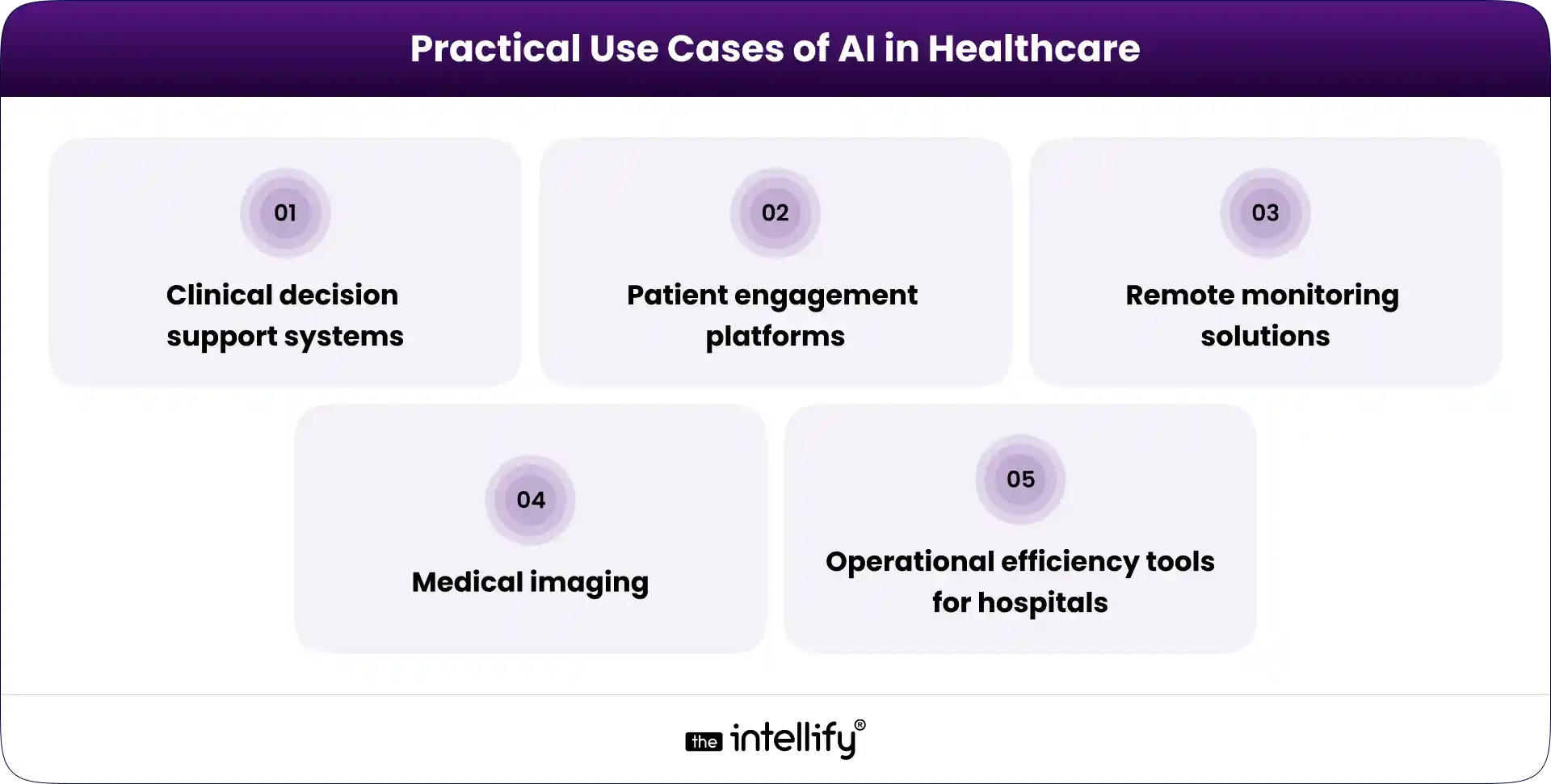
Use Cases of AI in Healthcare

AI applications in healthcare are expanding quickly, but many of the most useful solutions focus on improving efficiency and decision-making rather than replacing clinicians.

Clinical decision support systems: These tools analyze patient data and medical research to help doctors evaluate possible diagnoses or treatment options.

Patient engagement platforms are another growing area. AI chatbots and virtual assistants can answer basic health questions, schedule appointments, and remind patients to take medications.

Remote monitoring solutions use AI to analyze data from wearable devices and connected health tools. Doctors can detect changes in patient health earlier, which helps prevent complications.

Medical imaging, AI models can analyze scans such as X-rays or MRIs and highlight potential abnormalities. Radiologists still review results, but AI can help prioritize urgent cases.

Operational efficiency tools for hospitals: Predictive models can estimate patient admissions, manage staffing schedules, and optimize supply chains.

These practical uses show how AI can support healthcare professionals without interfering with patient safety or privacy.

A U.S.-based Direct Primary Care platform improved patient access and care coordination by implementing a secure digital solution across its services. The system streamlined operations for providers while keeping sensitive health data protected under strict privacy standards. This shows how modern AI-enabled technology can enhance healthcare delivery without compromising compliance. View the complete case study for more details: https://theintellify.com/work/healthcare2u/


How AI Is Helping Healthcare Go Digital

Healthcare organizations around the world are going through digital transformation. Paper records are disappearing, telemedicine is expanding, and patient services are moving online.

AI plays an important role in this shift.

1. When designed responsibly, AI enables innovation without compromising trust. Healthcare providers can analyze large datasets, automate routine processes, and deliver more personalized care.

2. Patients benefit as well. Digital health platforms can provide faster responses, easier access to care, and more consistent monitoring for chronic conditions.

3. AI also supports scalability. Healthcare systems are under constant pressure from rising patient volumes and limited resources. Intelligent automation helps organizations manage workloads more efficiently.

4. Perhaps most importantly, strong compliance frameworks create long-term credibility. When patients know their data is handled responsibly, they are more likely to adopt digital health services.

5. For healthcare providers and technology companies alike, secure AI systems can become a meaningful competitive advantage.


Common Mistakes Organizations Should Avoid

Even organizations with strong intentions sometimes make mistakes when implementing AI in healthcare.

Treating compliance as a one-time task

One common issue is treating compliance as a one-time project. Regulations evolve, technology changes, and new risks emerge over time. Compliance requires continuous monitoring and updates.

Using generic AI tools not designed for healthcare

Another mistake is using generic AI tools that were not designed for healthcare environments. These tools may lack the security features required for handling PHI.

Poor data governance practices

Poor data governance can also create problems. Without clear rules for data access, retention, and sharing, organizations may unintentionally expose sensitive information.

Lack of cross-functional collaboration

Lack of collaboration is another challenge. Building compliant healthcare AI systems requires input from multiple teams of technical experts, legal advisors, compliance officers, and clinicians. When these groups work in isolation, gaps often appear.

Underestimating ongoing maintenance needs

Finally, some organizations underestimate the effort required to maintain AI systems. Models require updates, security checks, and performance monitoring over time. Ignoring these responsibilities can create long-term risks.


Conclusion

AI has enormous potential to improve healthcare systems. It can support clinicians, streamline operations, and help organizations deliver better care. But healthcare technology operates in an environment where trust is essential. Patients expect their data to remain private and secure. Any AI system that processes medical information must respect that responsibility.

Building compliant systems requires thoughtful architecture, strong security practices, and clear governance. Organizations that prioritize privacy from the beginning are better positioned to innovate safely. A principle followed by responsible technology teams across the industry, including companies like The Intellify that work closely with data-sensitive solutions. For decision-makers and product teams, the key takeaway is simple: innovation and compliance are not opposing goals. When implemented correctly, they reinforce each other.

The future of healthcare AI will belong to platforms that combine intelligent technology with responsible data protection. And the organizations that understand this balance today will shape the healthcare systems of tomorrow.

 

AI solutions for Healthcare


Frequently Asked Questions (FAQs)

1. Can AI use patient data without breaking HIPAA laws?

Yes, but only with safeguards. Data is usually anonymized or de-identified so individuals cannot be identified. In some cases, patient consent or legal agreements are also required.

2. Which healthcare platforms typically use HIPAA-compliant AI?

Telehealth apps, patient portals, remote monitoring tools, clinical decision systems, and hospital management platforms commonly use it. Any system handling patient data can benefit from secure AI.

3. Is cloud-based AI safe for healthcare use?

It can be safe if the cloud provider meets healthcare security standards. Proper configuration, encryption, and access controls are essential. Organizations still remain responsible for protecting the data.

4. What happens if healthcare AI is not HIPAA compliant?

Organizations risk data breaches, legal penalties, and loss of patient trust. It can also damage reputation and disrupt services. Compliance helps prevent these risks.

5. Do startups also need HIPAA-compliant AI systems?

Yes. If a startup handles patient health information, it must follow HIPAA rules regardless of size. Building compliance early is easier than fixing problems later.
MCP vs RAG Explained: Which AI Model Is Leading the Next Tech Revolution?

Introduction

Large language models (LLMs) are impressive at generating text, but they often lack the latest information or the ability to act on data. Two emerging approaches aim to bridge these gaps: Retrieval-Augmented Generation (RAG) and Model Context Protocol (MCP)

In simple terms, RAG outfits an AI with a “knowledge fetcher” that grabs relevant documents or data before answering a query. MCP is an open standard that lets the AI connect to tools and databases through a common interface, think of it as a “USB-C port for AI”. Each method has its strengths and ideal scenarios; in practice, they often complement each other.


RAG vs. MCP: Statistical Comparison

Market Size & Growth

Retrieval-Augmented Generation (RAG):

  • The global market was estimated at $1.04 B in 2023, projected to reach $17 B by 2031, growing at a CAGR of 43.4% (2024–2031).
  • In Asia Pacific alone, RAG generated $284.3 M in 2024 and is expected to hit $2.86 B by 2030, with an impressive 46.9% CAGR.

Model Context Protocol (MCP):

  • As a protocol, MCP has no direct market valuation, but its ecosystem shows rapid adoption:
    • 5,000+ active MCP servers deployed as of May 2025.
    • Adoption by industry leaders: OpenAI (March 2025), Google DeepMind (April 2025), Microsoft, Replit, Sourcegraph, Block, Wix.


What is Retrieval-Augmented Generation (RAG)?

Retrieval-Augmented Generation (RAG) is an AI architecture that enhances a large language model (LLM) by retrieving relevant content from external sources before generating a response. Instead of relying solely on its pre-trained knowledge (which may be outdated), the model first searches a knowledge base or document store for information related to the user’s question.


It then incorporates that fresh context into the prompt to produce its answer. In other words, RAG enables the model to “look things up” in real-time. This process dramatically improves accuracy. As one RAG developer explained, RAG “actually understands what you’re asking” and provides “real answers, not hallucinations” by checking trusted sources first.


How Retrieval-Augmented Generation (RAG) Works: Retrieval Then Response

For example, imagine asking an AI: “What is our company’s travel reimbursement policy?” A RAG as a service-based assistant would query your HR documents or database, retrieve the relevant policy, and then base its answer on the exact text it found.
The result is a grounded, precise response.


Why RAG Improves Accuracy and Reduces Hallucinations

Traditional LLMs can generate fluent but incorrect information (“hallucinations”) because they rely on pre-trained knowledge. RAG solves this by grounding responses in real-time, trustworthy data, dramatically improving factual accuracy.


RAG in Real Life: How Companies Implement Retrieval-Augmented Generation

Companies like HubSpot have built tools around this idea. HubSpot’s open-source RAG Assistant searches internal developer documentation so engineers can quickly find accurate answers without wading through dozens of pages.


What is Model Context Protocol (MCP)?

Model Context Protocol (MCP) is a system that allows language models to maintain, access, and understand long-term context across user interactions. While traditional language models handle input on a session-by-session basis, MCP introduces a structured way to carry context forward, enabling continuity and personalised responses over time.

This means that instead of starting from scratch every time, an AI model equipped with MCP can remember key facts, preferences, or previous conversations, greatly enhancing usefulness, efficiency, and the sense of natural interaction.


How Model Context Protocol Works: Persistent Memory in AI

With MCP, language models can reference stored context (like user goals, past queries, or organisational data) when generating new responses. This persistent memory is securely managed, often stored in external context stores or embedded within user profiles.

The protocol outlines how the model queries, updates, and prioritises this context, ensuring relevant information is retrieved dynamically and used to enrich new prompts in real time.


Why MCP Improves Personalisation and User Experience

MCP enables a more fluid, personalised AI experience by reducing repetitive inputs and enabling intelligent follow-ups. For instance, a customer support chatbot using MCP can recognise returning users, recall prior issues, and respond with much more accuracy and relevance than a stateless system.


MCP in the Real World: Enterprise Use Cases and Adoption

Organisations implementing MCP-like systems benefit from improved efficiency, especially in knowledge-intensive environments like support, sales, education, or internal documentation.
Some advanced copilots and enterprise LLM platforms now offer MCP-compatible frameworks, allowing users to fine-tune how long-term context is stored, filtered, and applied securely.


Key Differences Between RAG and MCP

RAG and MCP both aim to enhance LLMs with external context, but they do so in very different ways. A quick contrast:

Key Differences Between RAG and MCP

  • Primary goal: RAG enriches an AI’s knowledge; MCP enables the AI to do things. In RAG, the focus is on feeding the model updated information, whereas MCP is about giving the model interfaces to tools.
  • Workflow: With RAG, the pipeline is “retrieve relevant data → add to prompt → generate answer”. With MCP, the pipeline is “list available tools → LLM invokes a tool → tool executes and returns data → LLM continues”.
  • Use cases: RAG shines in Q&A and search tasks (e.g. enterprise knowledge search), while MCP excels in task automation (e.g. creating tickets, updating records).
  • Setup: RAG requires building and maintaining a vector search index, embedding pipeline, and chunked documents. MCP requires setting up MCP servers for each tool or data source and ensuring an LLM client is connected.
  • Integration style: RAG integrates data by pulling it into the prompt. MCP integrates by letting the model call an API; it’s a standardised protocol for tool integration.
  • Data freshness: RAG naturally pulls the latest facts at query time. MCP can use live data too, but its strength is in action (e.g., reading a live database or executing real-time tasks).

In practice, the two are often used together. As one expert put it, RAG and MCP “aren’t mutually exclusive”. The AI community increasingly sees them as complementary: use RAG when your model needs fresh data or references, and use MCP when it needs to integrate with software or perform actions.


RAG Advantages

RAG offers clear benefits that improve AI accuracy and trust:

  • Up-to-date knowledge: RAG lets the model fetch fresh information at runtime. An LLM can retrieve the latest research papers, financial reports, or internal wiki pages and use that information to answer queries. This means the AI’s answers reflect current facts instead of outdated training data.
  • Reduced hallucinations: By grounding responses in real data, RAG dramatically cuts hallucinations. A report noted that over 60% of LLM hallucinations are due to missing or outdated context. RAG mitigates this by anchoring answers in retrieved documents.
  • Citations and trust: Many RAG systems can cite their sources. For example, Guru’s enterprise AI search uses RAG to answer employee questions and includes direct links to the original documents. This transparency boosts user trust and allows verification.
  • Domain expertise: You can plug in specialised databases. In healthcare, for instance, RAG can “extract and synthesise relevant information from extensive medical databases, electronic health records, and research repositories”. In effect, RAG turns your private or proprietary data into an expert knowledge base.
  • Proven accuracy: RAG has been shown to improve performance on hard tasks. In one medical study, a GPT-4 model using RAG answered pre-surgical assessment questions with 96.4% accuracy, significantly higher than human experts’ 86.6%. That’s the power of adding the right context.
  • Modularity: You can update a RAG system by simply adding new docs or retraining the retriever. The underlying LLM can stay the same. This modularity scales well as your knowledge grows.


RAG Challenges

RAG is powerful, but it adds complexity:

  • Infrastructure overhead: You need a vector database and an embedding pipeline. Data must be ingested, chunked, and indexed. Maintaining this system (ensuring the data is fresh, re-indexing updates) requires engineering effort.
  • Latency: Every query involves a search step. Large indexes and similarity searches can introduce delays. For high-traffic applications, optimising performance is non-trivial.
  • Tuning required: The retrieval step must be tuned carefully. If the LLM retrieves irrelevant or too much data, the answer can degrade. Choices like chunk size, the number of documents, and similarity thresholds need constant tweaking.
  • Dependence on data quality: Garbage in, garbage out. If your knowledge base is incomplete or poorly organised, RAG won’t magically fix it. You still need good content curation.
  • Limited agency: RAG enhances what the AI knows, but doesn’t let it interact. An LLM with RAG can answer “What is our sales target?” better, but it still can’t raise a purchase order or send an email on its own.

Despite these downsides, many organisations find the trade-offs worthwhile when accuracy and traceability are crucial. RAG’s extra engineering is the price paid for more reliable, context-rich AI answers.


MCP Advantages

MCP brings its own set of strengths:

  • Standard integration: MCP provides a single, unified protocol for connecting to tools. Once you expose a service via MCP, any MCP-aware model can use it. This avoids building custom code for every new LLM integration. As one analysis notes, MCP acts as a “universal way for AI models to connect with different data sources”.
  • Agentic capabilities: With MCP, your AI can act. It’s not limited to chatting; it can run workflows. For instance, an AI assistant could create a Jira ticket or check inventory by invoking the right MCP tools. This turns the LLM into an agentic collaborator.
  • Dynamic discovery: An LLM host can list available MCP tools. That means you can add new capabilities on the fly. If you publish a new MCP server, your agents can see and use it without changing the model prompt.
  • Security and control: MCP centralises how tools are accessed. You can enforce ACLs and authentication at the MCP layer. (For example, Claude Desktop’s MCP support asks the user to approve a tool on first use.) This can make it safer than ad-hoc API calls buried in prompts.
  • Growing ecosystem: Already, many MCP servers exist, from Google Workspace connectors to CRM and dev tools. This open ecosystem means faster development: you can leverage existing servers (Box, Atlassian, etc.) rather than coding everything from scratch.
  • Flexibility: Because MCP is open-source and vendor-neutral, you can switch AI models or providers without breaking integrations. Your tools speak MCP, and the AI speaks MCP; they decouple.

In short, MCP can significantly reduce the “glue code” needed to connect AIs to real-world systems. It turns multi-step integrations into standardised calls. Companies like Cloudflare and K2View are building platforms around MCP servers, enabling LLMs to manage projects, query databases, and more, all with just one protocol.


MCP Challenges

MCP is exciting but still new, so tread carefully:

  • Security & permissions: Giving an LLM broad tool access is powerful but risky. Every MCP call can perform a real action, so permission management is crucial. For example, if a user approves a tool once, some clients may not prompt again, meaning a later malicious command could slip through silently. In practice, this demands strong safeguards (trusted hosts, encrypted channels, fine-grained permissions).
  • Complex setup: Each data source or app still needs an MCP server wrapper. Until platforms provide “MCP out of the box,” developers must build or deploy these servers. It’s overhead on top of your application.
  • Maturity: MCP tooling and best practices are still evolving. Debugging agentic workflows can be tricky. Enterprises adopting MCP today must be early adopters, ready for some growing pains.
  • User experience: Interacting with MCP-enabled AI often means pop-up permissions or detailed configurations. Getting the balance between safety and usability (i.e., avoiding “click-fatigue”) is non-trivial.
  • Scope limits: MCP excels at actions, but it doesn’t inherently solve knowledge retrieval. In many cases, you still pair it with RAG. For example, an AI agent might use RAG to understand a question and MCP to execute a task, doubling the complexity.

So far, companies piloting MCP-driven agents (like Claude) are cautious. They emphasise secure deployment of servers and proper user consent. As one security analysis warns, “permission management is critical,” and current SDKs may lack built-in support for that. In summary, MCP adds a layer of power and responsibility.


Use Cases Across Industries

Both RAG and MCP find practical homes in real businesses. Here are some examples:

Use Cases Across Industries

  • Healthcare: RAG can turn mountains of medical data into actionable knowledge. As one AI consulting firm notes, RAG acts like “an AI doctor’s assistant, or AI in Healthcare” capable of sifting through medical records and research in seconds. Research confirms it: a recent study showed a GPT-4+RAG system answered pre-op medical queries with 96.4% accuracy, far above typical human performance. Healthcare providers and insurtech firms are exploring these capabilities to improve diagnoses, triage patients, and keep up with rapidly changing medical guidelines. (The Intellify, for instance, lists “InsureTech & Healthcare” as a target sector for its AI solutions.)
  • Finance: Financial analysts and advisors need the latest market data. RAG fits well here. For example, one guide explicitly recommends RAG for “financial advising systems that need current market data”. A chatbot with RAG could pull in real-time stock quotes or news and then analyse them. On the operations side, an MCP-enabled agent might automate tasks: fetching account balances, generating reports, or even executing trades through secure APIs.
  • HR & Operations: HR is a big use case for both. The Intellify’s new Alris.ai platform is a great example of MCP in action: it uses agentic AI to automate HR workflows like recruiting, onboarding, and scheduling interviews. In other words, the AI can pull resumes (via RAG), answer candidate questions, and use MCP tools to set up meetings or send offer letters. On the RAG side, simple “HR chatbots” are popping up. For instance, Credal describes a “Benefits Buddy”, a RAG-based assistant that answers employee questions about company policies. It retrieves the relevant policy documents so HR teams can scale support without manual workload.
  • Customer Support & Knowledge Search: Many enterprise search and help desk tools rely on RAG. Guru’s AI search, for example, uses RAG as “a core functionality”. Employees ask questions on the platform, and Guru’s LLM retrieves answers from the company’s files and wiki, including source links for verification. In the support industry, chatbots powered by RAG can answer policy or product questions instantly, using the latest manuals or support tickets. MCP could extend this by letting a bot not only answer but act, for instance, automatically creating a follow-up ticket in a CRM after providing an answer.
  • Technology & Developer Tools: Beyond businesses, even developers benefit. As mentioned, HubSpot’s engineering team built a RAG Assistant to navigate their huge documentation set. This makes onboarding and dev support much faster. Similarly, software platforms (like GitHub or StackOverflow) could use RAG to let users query all public Q&A with an AI. On the agentic side, tools like GitHub Copilot currently use integrated tool calls (e.g., running code); future MCP support could let them directly manipulate repos or CI/CD pipelines on demand.
  • Other Industries: Anywhere there’s structured data or repeatable tasks, these techniques apply. Manufacturing could use RAG to find best-practice guidelines in manuals, and MCP to update IoT dashboards or trigger maintenance workflows. Retail systems might use RAG to answer inventory or pricing questions, and MCP to update online catalogues or reorder stock automatically. In marketing, RAG can fuel content research while MCP connects to publishing platforms to post the content. The sky’s the limit as teams get creative.

Each industry and problem can lean more on one technique or the other. Often, the best solutions blend both. For example, an AI agent in finance could retrieve the latest portfolio info via RAG and then execute trades via MCP tools. The key is understanding the difference: know when you need more data (RAG) versus when you need more action (MCP).


Comparison Table

The table below summarises how RAG and MCP stack up:

Feature RAG (Retrieval-Augmented Generation) MCP (Model Context Protocol)
Goal Enhance LLM answers with up-to-date info Enable LLMs to use external tools and APIs
How it works Retrieve relevant documents/data, then generate a response LLM calls a standardized tool (MCP server); the tool executes and returns the result
Best for Answering questions, knowledge search (enterprise search, support bots) Performing tasks/automations (update records, create tickets, etc.)
Examples Guru’s search platform (answers FAQs with sources), legal/medical search bots AI assistants automating HR workflows (e.g. scheduling interviews via Alris.ai), cloud-infra bots calling APIs
Setup complexity Requires vector DB, embeddings, indexing content, and prompt engineering Requires implementing MCP servers for each data source/tool; managing client connections
Advantages Fresh data, citations, and higher accuracy Standardized, plug-n-play tool access; real-time actions
Challenges Latency, retrieval tuning, index upkeep Security/permission management, early maturity


Conclusion and Future Outlook

In the race to build smarter AI, neither RAG nor MCP is strictly “better” – they solve different problems. RAG ensures your AI has the right information, while MCP ensures it has the right capabilities. Smart AI products in 2025 and beyond will typically combine both: use RAG to fetch context and MCP to execute the next step. As one analysis put it, RAG solves what your AI doesn’t know, and MCP solves what your AI can’t do.

AI CTA

Leading companies are already moving in this direction. The Intellify, for example, emphasises its decade of AI experience in providing “custom RAG AI solutions” including “building robust retrieval systems” for clients. Its Alris.ai platform shows how agentic AI can automate HR tasks end-to-end. 

HubSpot, a major tech firm, rolled out a RAG-powered assistant to help developers find answers in documentation quickly. Enterprises like K2View are combining MCP with “agentic RAG” to ground AI agents in real-time company data.

Looking ahead, the ecosystem will only mature. AI frameworks and platforms (like Claude, LangChain, and others) are adding more out-of-the-box RAG and MCP support. Tools for easier MCP server deployment are emerging (e.g. one-click MCP hosts on Cloudflare). 

Data platforms are optimising to serve vector stores for RAG queries. All of this means developers and business leaders will have ever more power to create AI systems that are both knowledgeable and capable.

For now, the guidance is clear: if your AI needs fresh knowledge, think RAG. If it needs to interact with apps or perform business logic, think MCP. And often, the answer is “both.” By blending these approaches, your AI can confidently answer questions and also take meaningful action, making your applications smarter, faster, and more useful than ever.


View
Case Study